

401(k) Catch-Up Contributions: Who Qualifies and How Much
Who can make a 401(k) catch-up contribution in 2026?
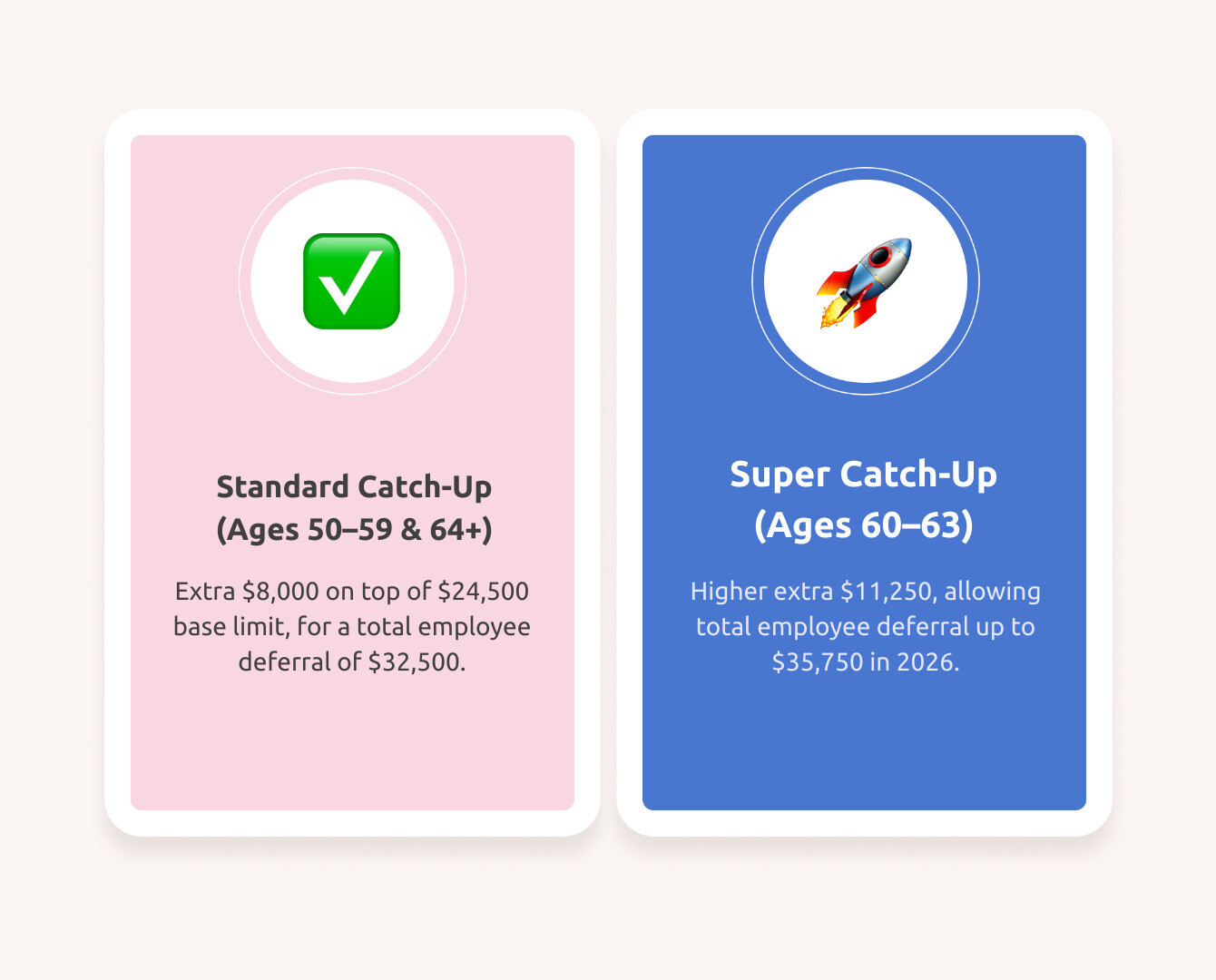
If you turn 50 or older by December 31, 2026, you may be able to make a catch-up contribution to a 401(k). The 2026 IRS limits allow an extra $8,000 beyond the usual $24,500 employee limit, for a total of $32,500. If you are 60 to 63 by year-end, the higher catch-up limit is $11,250, bringing your possible total to $35,750.
You make catch-up contributions through payroll if your plan allows them. Employer matching contributions do not use up your employee catch-up limit. For 2026, a separate rule requires workers whose 2025 wages from that employer exceeded $150,000 to make catch-up contributions on a Roth, or after-tax, basis.
2026 catch-up contribution 401(k) rules and limits
For tax year 2026, the Internal Revenue Service (IRS) sets the standard employee elective deferral cap at $24,500. This base cap applies to all eligible participants regardless of age.
When you factor in employer matching, profit-sharing, or forfeiture reallocations, the total annual additions under Internal Revenue Code Section 415(c) cannot exceed $72,000 (or 100 percent of your compensation, whichever is less). Catch-up contributions sit above this $72,000 ceiling.
To confirm the specific options available in your workplace plan, review your plan’s Summary Plan Description (SPD). You can also review updated 401(k) catch-up contribution rules for 2026 to see how annual indexing applies.
Standard limits and the 401(k) catch-up contribution age
The standard 401(k) catch-up contribution age is 50. Under IRS guidelines, you do not need to wait for your actual birthday to begin saving extra funds. As long as you reach age 50 on or before December 31, 2026, you are treated as eligible for the entire calendar year.
For participants aged 50 to 59, as well as those aged 64 and older, the standard 2026 catch-up limit is $8,000. When combined with the $24,500 base elective deferral, your total allowable employee contribution reaches $32,500.
Super catch-up limits for ages 60 to 63
Under Section 109 of the SECURE 2.0 Act of 2022, an elevated catch-up tier applies to participants who reach age 60, 61, 62, or 63 during the tax year.
For 2026, eligible employees in this age band can contribute an enhanced catch-up amount of $11,250 (instead of the standard $8,000), if their employer’s plan allows it. Adding this enhanced catch-up to the $24,500 base deferral allows an aggregate employee deferral of up to $35,750. Once you turn 64, your allowable catch-up limit returns to the standard $8,000 tier.
| Age tier in 2026 | Base elective deferral | Catch-up limit | Total maximum employee deferral |
|---|---|---|---|
| Under age 50 | $24,500 | $0 | $24,500 |
| Ages 50–59 | $24,500 | $8,000 | $32,500 |
| Ages 60–63 | $24,500 | $11,250 | $35,750 |
| Age 64 and older | $24,500 | $8,000 | $32,500 |
SECURE 2.0 Roth requirement for high-income earners

Beginning in tax year 2026, Section 603 of the SECURE 2.0 Act introduces a mandatory structural change for higher earners. If your wages subject to Social Security tax (FICA Box 3 on your Form W-2) exceeded $150,000 in the prior calendar year (2025) from the employer sponsoring the plan, your catch-up contributions must be designated as Roth contributions.
This rule applies solely to catch-up contributions, not your base $24,500 elective deferral. You can explore the regulatory background of these changes in our overview of SECURE Act 2.0 provisions.
How high earners make a catch-up contribution to a 401(k)
When making a catch-up contribution to a 401(k) under the Roth mandate, your payroll department withholds the catch-up funds using after-tax dollars. You do not receive an upfront federal income tax deduction for these specific dollars in the contribution year.
In exchange, qualified distributions of both your contributions and accumulated earnings can be withdrawn 100 percent tax-free in retirement. To qualify for tax-free earnings withdrawals, the distribution must occur after age 59½ and satisfy the statutory five-year Roth aging clock.
Under the statutory rules, if a plan has participants subject to this mandate, the plan must offer a Roth feature in order for those high-earning participants to make catch-up contributions.
Self-employed and 1099 income exceptions
The statutory language of Section 603 ties high-earner status specifically to W-2 FICA wages from the business sponsoring the plan.
As a result, business owners receiving Schedule C net sole proprietorship income or partnership distributions (K-1 earnings) generally do not have W-2 FICA wages from that business entity. Under current IRS regulatory guidance, these self-employed individuals and partners may continue making their 401(k) catch-up contributions on a pre-tax basis through a Solo 401(k) or partnership plan, regardless of their net earnings level.
How to maximize your 401(k) catch-up strategy

Taking full advantage of catch-up contributions requires coordinating your payroll deferrals early in the year. Establishing regular contributions across all pay cycles helps you utilize dollar-cost averaging while avoiding disruption to employer match formulas.
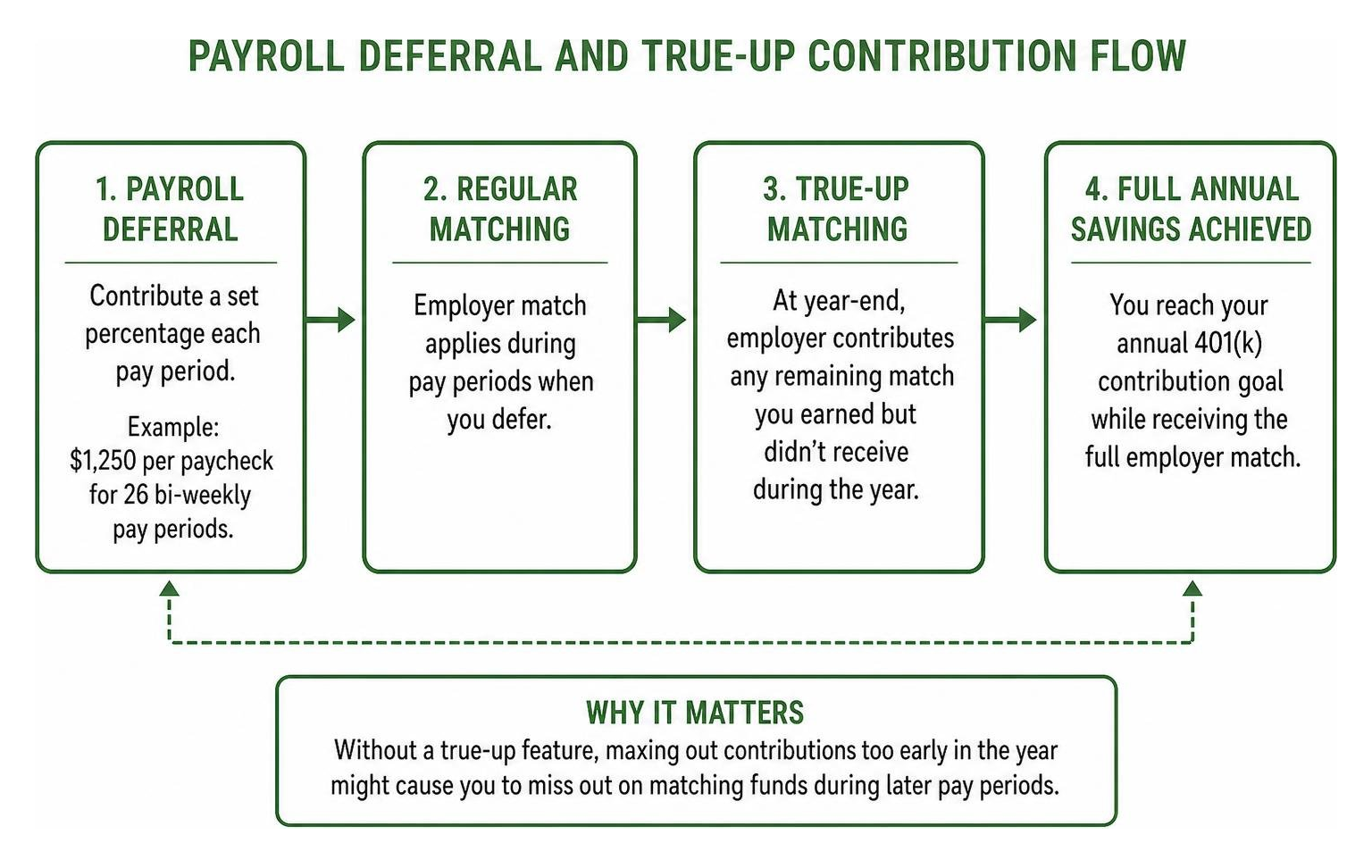
Review whether your employer provides a “true-up” matching provision. Without a true-up feature, maxing out your total contributions too early in the calendar year might cause you to miss out on matching funds during later pay periods where no employee deferral occurs.
Maximizing a catch-up contribution to a 401(k)
Hitting your full 401(k) catch-up contribution limit requires setting accurate payroll percentages. For example, a 52-year-old employee aiming to save the full $32,500 in 2026 across 26 bi-weekly pay periods would allocate approximately $1,250 per paycheck.
Consistently utilizing catch-up provisions can have a noticeable compounding impact over a decade or more. You can check the complete schedule of 2026 retirement contribution limits to coordinate your savings across all available household accounts.
Managing multiple 401(k) plans and excess deferrals
IRS elective deferral limits apply to you as an individual taxpayer across all workplace plans, rather than separately to each employer. If you change employers mid-year or participate in two unrelated 401(k) plans simultaneously, your aggregate base deferrals cannot exceed $24,500, plus your applicable $8,000 or $11,250 catch-up limit.
If you inadvertently exceed the annual deferral cap across multiple plans:
- Notify your plan administrator before March 1 following the close of the tax year.
- Request a corrective distribution of the excess deferral plus allocable earnings.
- Ensure the excess funds are distributed by April 15 to avoid double taxation on the excess amount.
Catch-up limits across other retirement accounts
Catch-up allowances are also available across other tax-advantaged retirement accounts, though the specific dollar limits differ by account type for 2026:
- Traditional and Roth IRAs: For individuals aged 50 and older, the 2026 IRA catch-up contribution limit is $1,100 (indexed for inflation), bringing the maximum IRA contribution to $8,600.
- SIMPLE 401(k) and SIMPLE IRA plans: The standard catch-up limit for participants aged 50 and older is $4,000. Under SECURE 2.0 rules, participants aged 60 to 63 have a higher catch-up limit of $5,250 in 2026.
- Governmental 457(b) plans: Standard catch-up limits mirror 401(k) plans ($8,000 for age 50+; $11,250 for ages 60–63). In addition, governmental 457(b) plans may offer a separate “special three-year catch-up” provision prior to normal retirement age.
| Account type | Standard catch-up (age 50+) | Super catch-up (ages 60–63) | Total employee contribution cap |
|---|---|---|---|
| 401(k) / 403(b) / governmental 457(b) | $8,000 | $11,250 | $32,500 / $35,750 |
| SIMPLE IRA / SIMPLE 401(k) | $4,000 | $5,250 | $20,500 / $21,750 |
| Traditional / Roth IRA | $1,100 | N/A (standard only) | $8,600 |
Key takeaways for 2026 catch-up contributions
- Age qualification: You qualify for catch-up contributions if you turn 50 (or ages 60–63 for super catch-up) by December 31, 2026.
- 2026 contribution caps: The base 401(k) deferral limit is $24,500. Standard catch-up (ages 50–59, 64+) is $8,000; super catch-up (ages 60–63) is $11,250.
- Mandatory Roth catch-up: Employees with prior-year W-2 FICA wages over $150,000 from the plan sponsor must make catch-up contributions into a Roth 401(k).
- Aggregate limits: Deferral limits apply per person across all employers. Monitor your payroll withholding carefully if you switch jobs mid-year.
Frequently asked questions about 401(k) catch-up contributions
What is the 401(k) catch-up contribution limit for 2026?
The standard 401(k) catch-up limit is $8,000 for workers aged 50 to 59 and age 64 and older, permitting a maximum employee deferral of $32,500. For employees who reach ages 60 through 63 in 2026, the enhanced super catch-up limit is $11,250, allowing a total employee deferral of up to $35,750.
Can I catch up 401(k) contributions if I switch employers mid-year?
Yes, you can catch up 401(k) contributions at a new employer, but your annual elective deferral limit applies across all plans combined. You must track your year-to-date withholdings from your prior job to ensure your combined base and catch-up deferrals do not exceed the annual IRS caps.
Do employer matching contributions count toward the catch-up limit?
No. Employer matching and non-elective profit-sharing contributions do not count against your individual elective deferral or catch-up limits. They apply toward the overall Section 415(c) annual additions limit ($72,000 in 2026), which sits separate from your catch-up contributions.
Conclusion
Maximizing your catch-up contributions is an effective way to accelerate your retirement savings during your peak earning years. However, saving more is only one part of retirement planning; managing portfolio risk, monitoring investment fees, and rebalancing regularly are equally critical.
401(k) Maneuver provides professional 401(k) account management designed to help you optimize your workplace savings. As an independent fiduciary, our team provides personalized, quarterly account rebalancing and downside-risk management without moving your funds out of your existing workplace plan. To learn more about how we can help you manage your account, explore how professional account management works or speak with a 401(k) Maneuver adviser at 1-877-218-5060.
Disclosure: 401(k) Maneuver is a business name of Royal Fund Management, LLC, an SEC-registered investment adviser. This article is for informational and educational purposes only and does not constitute individualized investment, legal, or tax advice. Investing involves risk of loss, and past performance or account rebalancing does not guarantee future results or protect against loss in declining markets.