

401k Contribution Deadlines: Why Timing Matters
401(k) Contribution Deadlines: Why Timing Matters
When is the 401(k) contribution deadline?
If you are planning your retirement savings for the year, we believe the official 401(k) contribution deadline is essential. For most employees, the last day to contribute to a 401(k) for 2026 is tied to your final 2026 paycheck. Your contribution must come from pay issued by December 31, 2026; you generally cannot add a 2026 payroll contribution after year-end as you can with an IRA. Your employer may have more time to make matching or profit-sharing contributions, often until its tax-return deadline, including extensions. IRS guidance on 401(k) contributions explains the separate rules.
Check your final payroll date rather than waiting until December 31 to change your contribution rate. If your employer matches contributions each paycheck, spreading your contributions across the year may help you receive the full match. Your plan’s Summary Plan Description can tell you how its match works.
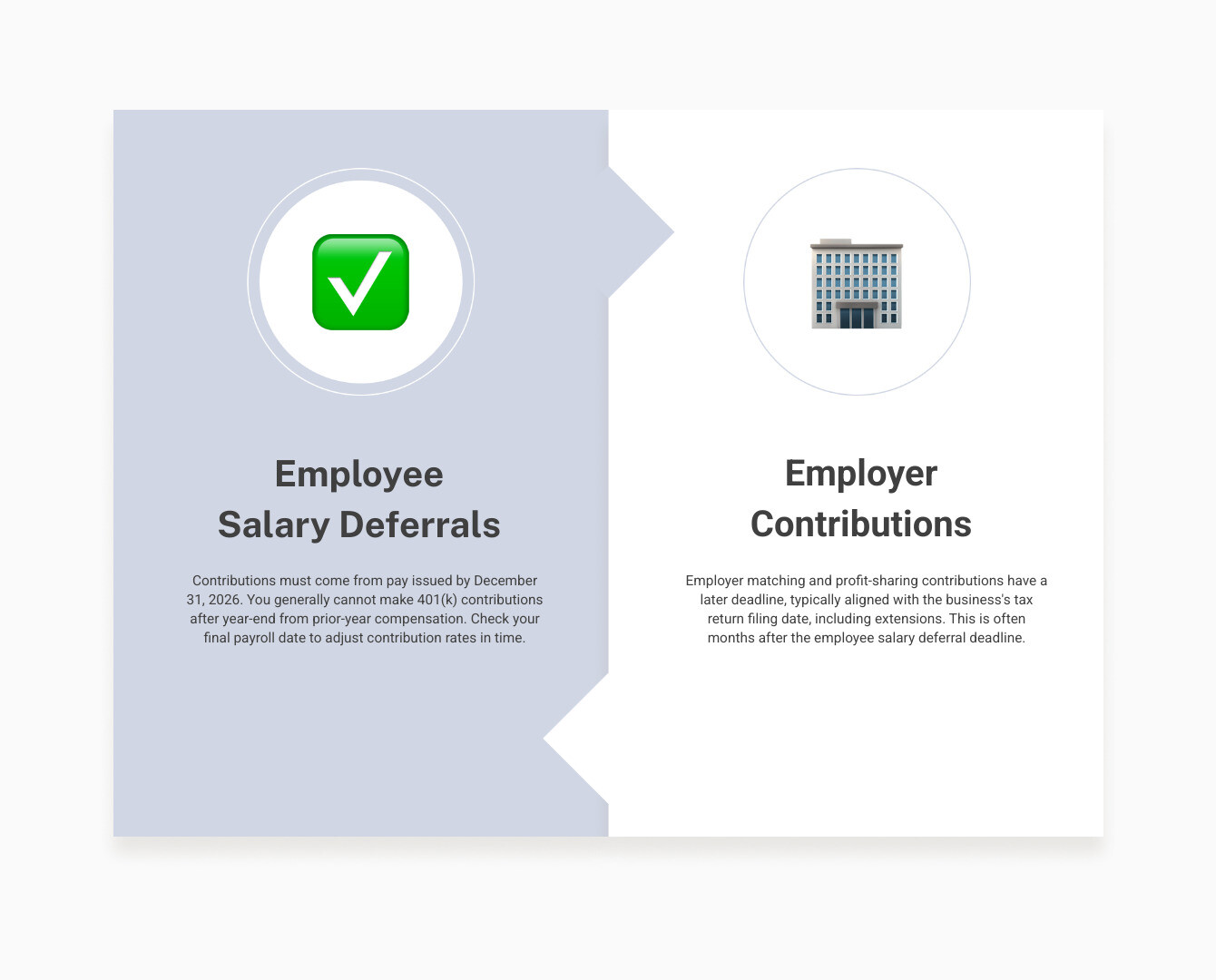
Understanding standard retirement timelines helps you make the most of your workplace retirement plan while avoiding administrative pitfalls. In this guide, we review the exact dates for employee deferrals, employer contributions, solo retirement plans, and the annual limits established by the IRS.
Key 401(k) contribution deadline rules for employee salary deferrals

For most workplace retirement plans, employee contributions—also called elective deferrals—must come directly through payroll deductions. You cannot write a personal check to your corporate 401(k) at the end of the year to reach your savings target.
Understanding how payroll withholdings align with calendar-year cutoffs can be an essential part of discovering effective strategies to maximize your 401(k) contributions before the annual window closes.
The December 31 cutoff for traditional and Roth payroll deferrals
Under IRS regulations, elective deferrals apply to the tax year in which the compensation is actually paid. For a standard calendar-year plan, the employee 401(k) deadline is December 31.
This cutoff applies equally to pre-tax deferrals and designated Roth contributions. Because payroll processing schedules vary, your human resources or payroll department may require changes to your contribution rate one to two pay periods before the final paycheck date. If your final 2026 pay date falls on December 30, your deferral must process on that payroll run to count toward your 2026 W-2 compensation and annual limits.
Small business safe harbor and DOL deposit deadlines
Once an employer withholds money from your paycheck, strict Department of Labor (DOL) rules govern when those dollars must enter the plan trust. According to the DOL, an employer must deposit employee salary deferrals as soon as they can reasonably be segregated from the company’s general assets.
To provide clear compliance standards, the DOL established specific benchmarks:
- 7-Business-Day Safe Harbor: Small employers with fewer than 100 participants automatically satisfy the timely deposit requirement if they deposit withholdings into the plan within 7 business days of the payroll date.
- General Asset Rule: For larger employers, deposits must be made as soon as administratively feasible, but no later than the 15th business day of the month following the month in which the amounts were withheld.
The 15th business day standard is an outer limit, not a safe harbor. If an employer regularly segregates funds in 3 days, holding funds until the 15th business day can constitute a fiduciary failure. Plan sponsors that miss these windows must restore lost earnings and may be subject to excise taxes reported on Form 5330. For complete rules, review DOL guidance on plan administration and compliance.
Employer contribution deadlines: matching, profit-sharing, and tax extensions

Unlike employee payroll withholdings, employer matching and profit-sharing contributions operate on business tax timelines. Company contributions are generally deductible for a given tax year if they are deposited by the due date of the business’s federal income tax return, including filed extensions.
Deductibility deadlines by business entity type
The exact funding cutoff for company contributions depends on the entity structure and whether the business requests an extension from the IRS.
| Business Entity Type | Standard Tax Filing Deadline | Extended Tax Filing Deadline |
|---|---|---|
| S-Corporation (Form 1120-S) | March 15 | September 15 |
| Partnership / Multi-Member LLC (Form 1065) | March 15 | September 15 |
| C-Corporation (Form 1120) | April 15 | October 15 |
| Sole Proprietorship / Single-Member LLC (Schedule C) | April 15 | October 15 |
As detailed in IRS Publication 560, funding the employer portion by these dates helps to preserve the business deduction for the preceding tax year, even if deposits occur several months after the calendar year concludes.
Maximizing employer match and true-up timing
Many workplace plans offer an employer match calculated on each individual pay period—for example, matching 50% of your contributions up to 6% of your pay per check. If you max out your elective deferral limit early in the year, you might stop contributing in November or December. Without ongoing contributions, you could miss out on the company match for those final pay periods.
To prevent this loss, some plans include a true-up provision. A true-up is an annual calculation performed by the plan administrator after year-end to review that you receive the full matching contribution you were entitled to based on your total annual compensation.
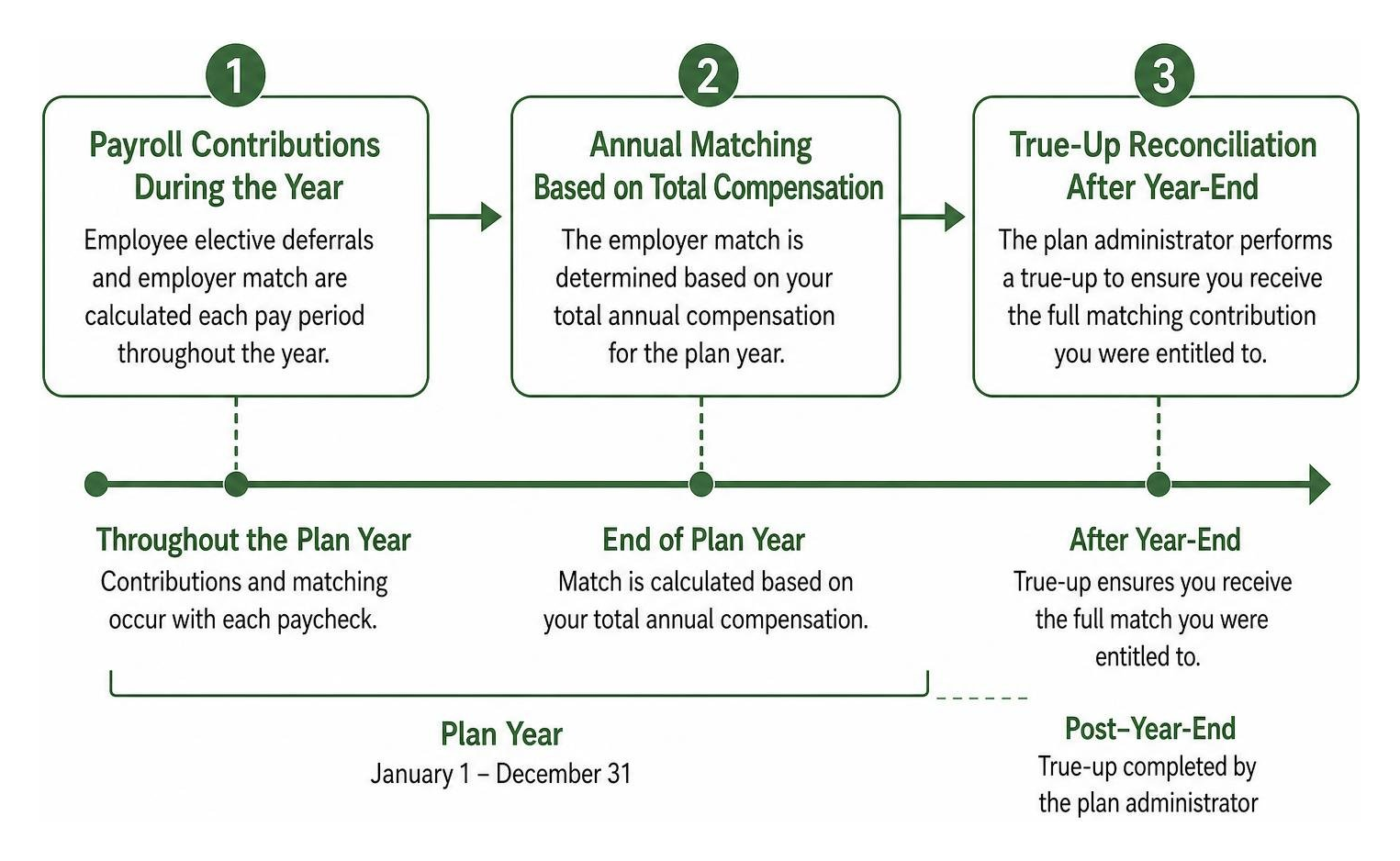
Review your plan’s Summary Plan Description to see if a true-up provision is included, or consider pacing your contributions evenly across all pay periods.
Solo 401(k) deadlines: rules for self-employed business owners
A Solo 401(k)—also referred to as a one-participant plan—is designed for business owners, sole proprietors, and independent contractors with no common-law employees other than a spouse. Because you act as both employee and employer, you navigate two distinct sets of deposit rules.
The 401(k) contribution deadline for solo salary deferrals and profit sharing
For unincorporated businesses (such as sole proprietorships and single-member LLCs), you can generally make both employee salary deferrals and employer profit-sharing contributions up to your federal tax return deadline, including extensions. However, standard rules require you to sign a written salary deferral election by December 31 of the tax year.
For incorporated businesses (such as S-Corps or C-Corps), the owner receives a W-2. In this case, employee elective deferrals must process through payroll by December 31, while employer profit-sharing contributions can remain open until the corporate tax filing deadline. Review IRS guidance on one-participant 401(k) plans to determine the exact requirements for your corporate structure.
Plan setup deadlines and Form 5500-EZ annual reporting
Under recent provisions enacted by the SECURE 2.0 Act, an employer may adopt a new retirement plan after the close of the taxable year up to the employer’s tax return due date (including extensions) and treat the plan as established on the last day of the prior taxable year for employer contribution purposes. However, to allow employee salary deferrals in standard corporate structures, establishing the plan documents by December 31 remains standard practice.
Solo 401(k) plan administrators has to also track total plan value. Once total assets in the plan (including spousal balances) exceed $250,000 at the end of the plan year, you are required to file Form 5500-EZ annually with the IRS to maintain compliance.
Comparing 401(k) deadlines to IRA deadlines and contribution limits
Individual Retirement Accounts (IRAs) and workplace 401(k)s operate under different funding timelines and statutory caps.
| Feature | Workplace 401(k) Plan | Traditional or Roth IRA |
|---|---|---|
| Employee Contribution Cutoff | Final payroll run by December 31 | Tax filing day (typically April 15) |
| Prior-Year Funding Window | Not allowed for employee W-2 deferrals | Allowed through April 15 of following year |
| Tax Extensions Apply to Employee | No (payroll cutoff strictly applies) | No (extensions do not extend IRA deadline) |
| 2025 Contribution Limit | $23,500 ($31,000 if age 50+) | $7,000 ($8,000 if age 50+) |
| 2026 Contribution Limit | $24,500 ($32,500 if age 50+) | $7,500 ($8,600 if age 50+) |
Reviewing our guide on retirement 401(k) and IRA contribution limits for 2025 provides additional historical context for comparing these accounts.
Annual limits and the 401(k) contribution deadline for catch-up contributions
Under the official IRS 2026 contribution-limit guidance, the employee deferral limit for 2026 is $24,500 (up from $23,500 in 2025). The total annual additions limit under Section 415(c)—combining employee deferrals and employer contributions—is $72,000 for 2026.
If you are age 50 or older, you can make additional catch-up contributions:
- Standard Catch-Up (Age 50+): $8,000 in 2026 ($7,500 in 2025).
- Enhanced Catch-Up (Ages 60–63): Under SECURE 2.0, participants aged 60, 61, 62, or 63 have access to a higher catch-up limit of $11,250 if their plan offers it.
SECURE 2.0 also introduced a rule requiring high-earning employees (those with prior-year FICA wages exceeding $145,000, adjusted for inflation to $150,000) to make all catch-up contributions on a Roth (after-tax) basis. The IRS provided an administrative transition period for this rule through 2026 to allow plan recordkeepers time to implement the necessary systems. For full details, see our review of the 401(k) catch-up contribution rules for 2026.
401(k) vs. IRA timing differences
The key operational difference between an IRA and a 401(k) is flexibility after year-end:
- IRAs: You have until Tax Day (usually April 15 of the following year) to deposit contributions and designate them for the prior tax year.
- Workplace 401(k)s: Because employee contributions are tied to payroll withholdings and Form W-2 reporting, you cannot fund an employee account retroactively with personal checks after December 31.
Frequently asked questions about 401(k) contribution deadlines
What is the absolute last day to contribute to 401(k) plans for 2026?
The last day to contribute to 401(k) elective deferrals for 2026 is your employer’s final payroll processing date of the calendar year, which must pay out compensation on or before December 31, 2026.
What happens if an employer misses a 401(k) deadline?
If an employer fails to remit employee contributions according to DOL timing standards, the plan sponsor must correct the operational error. Employers often use the IRS Employee Plans Compliance Resolution System (EPCRS) or the DOL Voluntary Fiduciary Correction Program (VFCP). The employer must deposit the late contributions along with calculated lost earnings and may be subject to an excise tax under Internal Revenue Code Section 4975.
Can I make prior-year 401(k) contributions like an IRA?
As an employee in a corporate workplace plan, you cannot make prior-year personal contributions after December 31. Only self-employed individuals with a Solo 401(k) or employers funding profit-sharing allocations may deposit contributions up to their business tax filing deadline (including extensions) for the prior tax year.
Some Key takeaways
- Employee Deferrals End December 31: Employee payroll contributions must be deducted from wages earned and paid within the calendar year.
- Employer Contributions Follow Tax Filings: Company match and profit-sharing contributions can be funded up to the business’s tax return deadline, including extensions.
- Pacing Can Help Preserve Your Match: Spreading your elective deferrals across the entire year may help you capture the full employer match if your plan lacks an annual true-up provision.
- Catch-Up Opportunities Expand: Workers age 50 and older can contribute additional funds, with specialized higher limits available for individuals aged 60 through 63 if the plan allows.
Help Optimize your workplace 401(k) account
Managing annual limits, timing payroll deductions, and choosing appropriate investments within your workplace retirement account takes ongoing attention. At 401(k) Maneuver, we serve as an independent fiduciary providing professional, human-run account management. We provide personalized, quarterly account adjustments designed to manage downside risk and keep your portfolio aligned with your retirement timeline—all while your savings stay in your existing plan.
To discuss your account or ask questions about managing your retirement strategy, see how 401(k) Maneuver manages participant accounts.
Disclosure: 401(k) Maneuver is a business name of Royal Fund Management, LLC, an SEC-registered investment adviser. This article is provided for educational and informational purposes only and does not constitute individualized financial, tax, or legal advice. Investing involves risk of loss, and past performance is no guarantee of future results. Diversification and portfolio rebalancing do not guarantee a profit or protect against loss in declining markets. Always consult your plan’s Summary Plan Description and a qualified tax professional regarding your personal situation.