

How a 401(k) Employer Match Works (and How Not to Leave It on the Table)
How to get your full 401(k) employer match
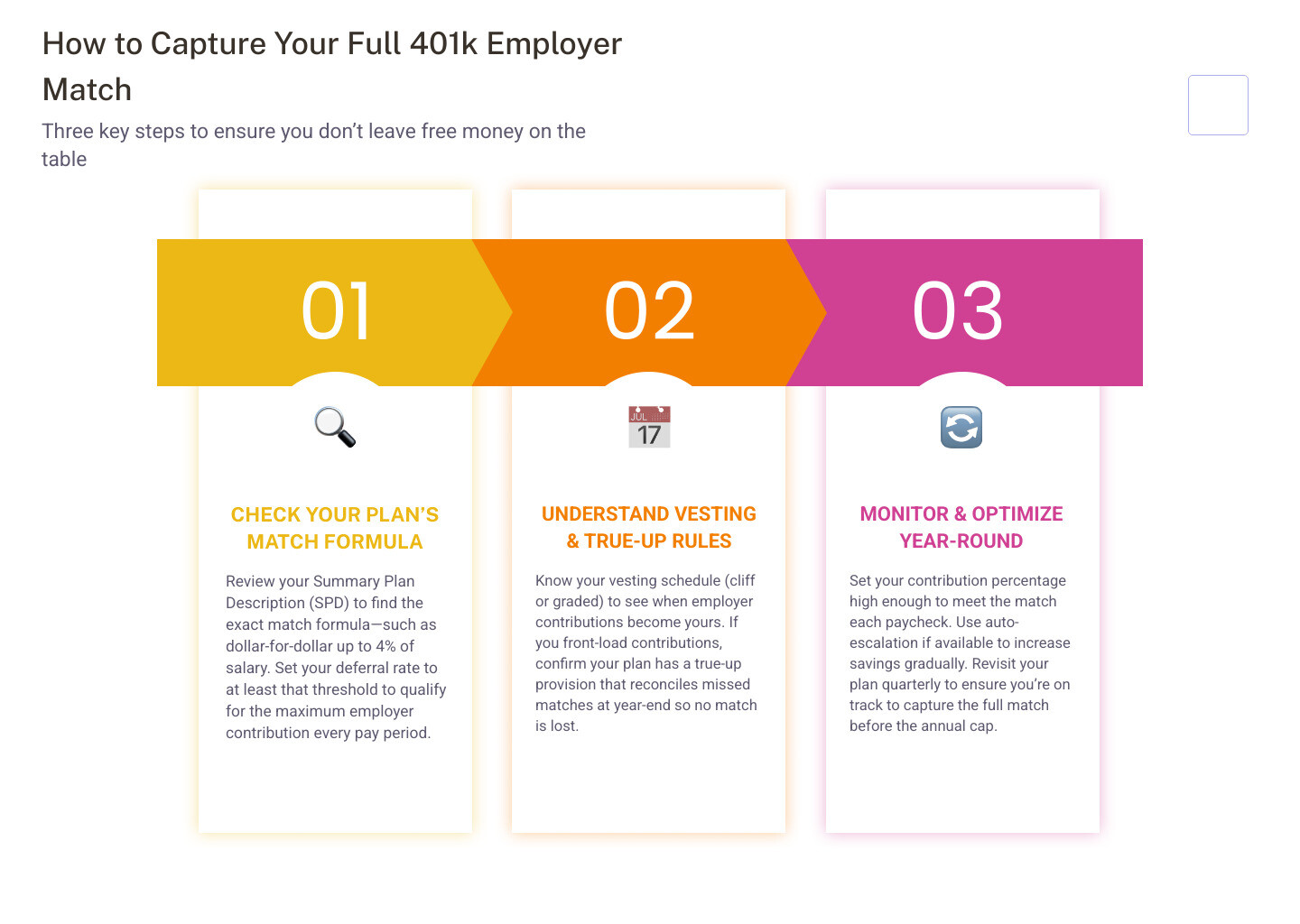
A 401(k) employer match is money your employer adds to your retirement account when you contribute, up to the limit set by your plan. To get the full match, check your Summary Plan Description for the match formula. Then set your contribution high enough to meet it each paycheck.
Also check when your employer calculates the match. If you contribute more early in the year, a true-up may make up for matching dollars missed on later paychecks, but only if your plan offers one. Your vesting schedule tells you when the employer’s contributions become yours to keep.
Easy 401(k) employer match glossary:
- 401(k) auto enrollment
- 401(k) beneficiary
Understanding how a 401(k) employer match works
A workplace retirement plan allows you to save money directly from your paycheck via elective deferrals. When you decide how much to contribute to a 401(k) and set your savings rate, your employer may agree to match a portion of those funds. This match acts as an additional workplace contribution that is deposited directly into your retirement account alongside your personal savings.
Most employer-sponsored plans offer some form of employer contribution, whether through matching or nonelective contributions, according to the Department of Labor’s overview of retirement plan features. The matching funds are credited through your company payroll system on a regular schedule, most often per pay period. While these contributions can help build your account over time, the exact rules and calculations are defined strictly by your company’s plan design, and investing always involves risk of loss.
Common 401(k) employer match formulas and calculations
Plan sponsors use different formulas to calculate matching contributions. Understanding the math behind your plan helps you see how much you may need to contribute to capture the available match.
- Dollar-for-Dollar Match (100% Match): The employer matches 100% of your contributions up to a specific percentage of your salary. For example, in a hypothetical illustration where an employer offers a 100% match up to 4% of compensation on an assumed $60,000 salary, contributing $2,400 (4%) could result in an employer contribution of $2,400.
- Partial Match (e.g., 50% Match): The employer contributes 50 cents for every dollar you save up to a cap. If the plan matches 50% on contributions up to 6% of compensation, you would need to contribute 6% of your salary to receive the maximum 3% match from your employer.
- Tiered Match: Some formulas combine multiple matching levels. A common structure provides a 100% match on the first 3% of your salary, plus a 50% match on the next 2% of your salary. To receive the maximum 4% match under this formula, you would need to contribute at least 5% of your pay.
Note: All examples below are hypothetical illustrations based on an assumed $80,000 annual compensation level and assume consistent payroll contributions across the plan year. Your plan’s actual terms may differ, so check your Summary Plan Description for specifics.
| Match Formula Type | Employee Contribution | Match Calculation Rate | Total Employer Match Received | Total Annual Account Addition |
|---|---|---|---|---|
| Dollar-for-Dollar (100% up to 4%) | 4% of $80,000 ($3,200) | 100% on first 4% | $3,200 | $6,400 |
| Partial Match (50% up to 6%) | 6% of $80,000 ($4,800) | 50% on first 6% | $2,400 | $7,200 |
| Tiered Match (100% on 3%, 50% on next 2%) | 5% of $80,000 ($4,000) | 3% + (0.5 × 2%) = 4% | $3,200 | $7,200 |
Matching contributions vs. nonelective profit-sharing
It is helpful to distinguish between a matching 401(k) contribution and a nonelective employer contribution. A matching contribution requires you to contribute your own salary before receiving employer funds. If you contribute zero, your matching contribution is zero.
In contrast, a nonelective or profit-sharing contribution is deposited by the employer regardless of whether you save any money yourself. Plan sponsors may provide a fixed percentage of pay (such as a 3% core contribution) or make discretionary contributions based on company performance, if your plan documents allow it.
Contribution limits and tax rules for matching dollars
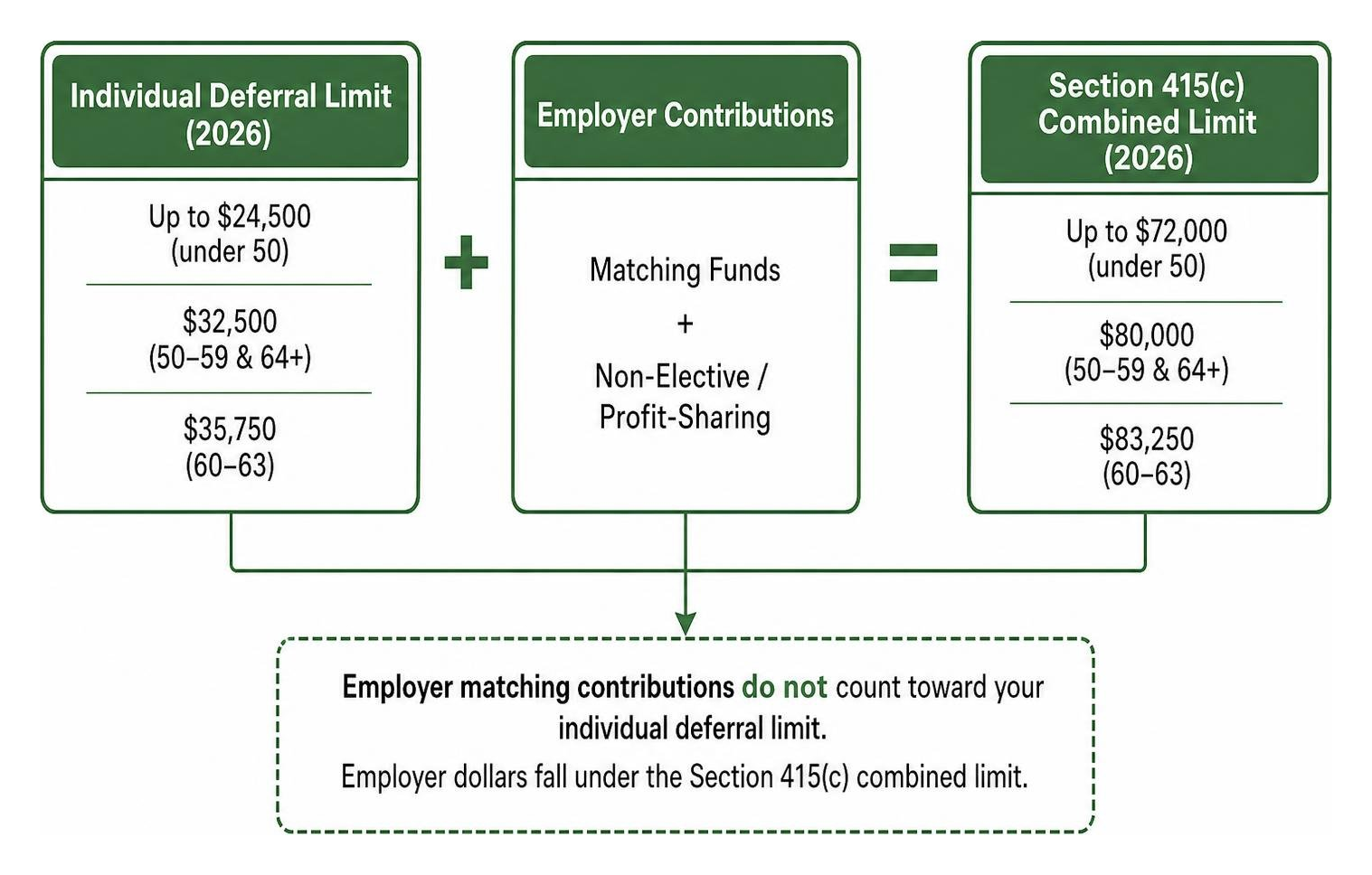
The Internal Revenue Service (IRS) sets annual boundaries on workplace retirement savings. For the 2026 tax year, the individual elective deferral limit under Internal Revenue Code Section 402(g) is $24,500 for workers under age 50. Catch-up provisions allow employees ages 50 to 59 and 64 and older to contribute an additional $8,000 (totaling $32,500), while a higher catch-up limit of $11,250 applies to individuals ages 60 to 63 (totaling $35,750) under Section 109 of the SECURE 2.0 Act of 2022.
Employer matching contributions do not count toward your individual elective deferral limit. Instead, employer dollars fall under the aggregate annual additions limit governed by IRC Section 415(c). For 2026, the combined employee and employer contribution limit is $72,000 for workers under 50, $80,000 for those ages 50 to 59 or 64 and older, and $83,250 for participants ages 60 to 63. You can review 401(k) contribution limits to verify how these thresholds coordinate across payroll periods.
Additionally, pursuant to statutory cost-of-living adjustments under IRC Section 401(a)(17), the maximum annual compensation that can be factored into match calculations for 2026 is $360,000. For highly compensated employee (HCE) non-discrimination compliance testing under IRC Section 414(q)(1)(B), the compensation threshold is $160,000 in 2026.
Taxation of traditional vs. Roth matching contributions
Historically, all employer matching funds were deposited strictly on a pre-tax basis into a traditional account balance, even when matching an employee’s Roth deferrals. These pre-tax funds grow tax-deferred and are taxed as ordinary income when distributed in retirement.
Under Section 604 of the SECURE 2.0 Act (effective for contributions made after December 29, 2022), employers may offer employees the option to receive matching contributions on a designated Roth basis, if the plan sponsor has adopted this provision. Roth matching contributions are treated as taxable compensation in the year they are deposited, but qualified future distributions can be withdrawn tax-free. Check your plan’s Summary Plan Description to determine if Roth employer matching is currently supported by your employer.
Vesting schedules and true-up contributions
Under federal law (IRC Section 411(a)(1) and ERISA Section 203), your own salary deferrals are always 100% vested immediately, meaning you own those dollars and their associated earnings from day one. However, company matching dollars may be subject to a vesting schedule established by the plan sponsor pursuant to IRC Section 411(a)(2)(B).
- Immediate Vesting: You own 100% of all employer matching contributions as soon as they are deposited.
- Cliff Vesting: You earn zero ownership until you complete a specified period of service, at which point you become 100% vested. Under IRC Section 411(a)(2)(B)(ii) and ERISA Section 203(a)(2)(B), cliff vesting on matching contributions cannot exceed 3 years.
- Graded Vesting: You gain ownership incrementally over time. Under IRC Section 411(a)(2)(B)(iii), graded vesting schedules cannot exceed 6 years (requiring at least 20% after 2 years of service, increasing by 20% each year until reaching 100% after 6 years).
If you leave your employer before becoming fully vested, any unvested matching balance is forfeited back to the plan. Reviewing 401(k) vesting rules helps ensure you time career transitions without unintentionally losing earned retirement funds.
Why true-up provisions protect front-loaded contributions
Many employers calculate matching contributions on a per-paycheck basis rather than over the entire calendar year. If you max out your elective deferral limit early in the year, you may contribute 0% during the final paychecks of the year, which could cause you to miss matching contributions for those pay periods.
A “true-up” provision requires the employer to review your total annual salary deferrals at year-end or quarter-end. If your total contributions earned a higher match than what was distributed on a per-paycheck basis, the plan deposits a true-up contribution to make up the difference. Always check your Summary Plan Description to confirm whether your workplace plan includes a true-up feature before front-loading your contributions.
Safe harbor plans, modern match rules, and major employer comparisons
To simplify administrative requirements, some employers implement a safe harbor 401(k) plan. Under IRC Section 401(k)(12) and Section 401(k)(13), by adopting an approved safe harbor match formula, the plan automatically satisfies mandatory IRS non-discrimination compliance testing (the Actual Deferral Percentage and Actual Contribution Percentage tests), allowing business owners and highly compensated employees to maximize their elective deferrals.
Standard statutory safe harbor formulas under IRC Section 401(k)(12)(B) require either a basic tiered match of 100% on the first 3% of pay plus 50% on the next 2% of pay, or an enhanced dollar-for-dollar match up to at least 4% of compensation. Under IRC Section 401(k)(12)(E), safe harbor matching contributions are generally required to be 100% immediately vested (or subject to a maximum 2-year vesting schedule under qualified automatic contribution arrangements pursuant to IRC Section 401(k)(13)(D)).
Under Section 110 of the SECURE 2.0 Act of 2022 (codified at IRC Section 401(m)(13), effective for plan years beginning after December 31, 2023), employers may also treat qualified student loan payments as elective deferrals for matching purposes, if the plan adopts the provision. This allows workers directing cash toward student debt to still receive employer retirement contributions. You can review how the 401(k) match for student loans works to see how employers implement these programs.
Corporate matching structures vary across industries as reported in public Form 5500 annual returns filed with the U.S. Department of Labor under ERISA Section 104 (accessible via the U.S. Department of Labor) and statutory vesting guidelines under IRC Section 411:
- UPS: Offers eligible non-union employees a matching structure combined with an additional non-elective retirement contribution of 3% to 8% of compensation, featuring immediate vesting under IRC Section 411(a)(1) as reported in U.S. Department of Labor Form 5500 filings.
- FedEx: Historically offers tiered matching models under primary retirement plan designs reaching up to 8% total company contributions, documented in public DOL Form 5500 annual reports under ERISA Section 104.
- Walmart: Provides a dollar-for-dollar match up to 6% of eligible pay after one full year of service pursuant to IRC Section 410(a) and IRC Section 411(a) as specified in its DOL Form 5500 filings.
- Amazon: Matches 50% of contributions up to 4% of compensation (a 2% maximum employer contribution), subject to a 3-year cliff vesting schedule permitted under IRC Section 411(a)(2)(B)(ii) and ERISA Section 203(a)(2)(B) as detailed in its DOL Form 5500 filings.
How to optimize your retirement contributions

Capturing your full employer match can be an essential baseline when deciding how much to contribute to your 401(k). If your cash flow feels tight, evaluating whether to pay down low-interest debt or adjust your monthly budget can clarify the trade-offs.
To verify and maintain your match eligibility we recommend you:
- Confirm the exact percentage required to unlock your plan’s maximum match via your Summary Plan Description.
- Spread your contributions evenly across all pay periods if your plan lacks a true-up provision.
- Activate automatic contribution escalation if your plan offers it, gradually raising your savings rate each year.
- Review your payroll stubs quarterly to ensure your elective deferrals match your targeted percentage.
How to capture your full 401(k) employer match each year
To avoid missing matching dollars, calculate your per-paycheck contribution percentage based on your total annual salary. If you earn $100,000 paid across 26 bi-weekly pay periods, contributing 6% allocates roughly $230.77 per paycheck, helping you capture available matching funds across the full 12 months.
If you are age 50 or older, you can also explore strategies for managing retirement contributions after age 55 to coordinate catch-up contributions with ongoing employer matching allocations.
Frequently asked questions about employer matches
Does an employer match count toward my personal 401(k) contribution limit?
No. Employer matching dollars do not count toward your individual elective deferral limit ($24,500 in 2026, or $32,500/$35,750 with catch-ups). They are counted only toward the combined IRS Section 415(c) annual additions limit ($72,000 in 2026 for workers under age 50).
What happens to my matching dollars if I leave my job early?
You keep 100% of your personal contributions and any vested portion of employer matching funds. Any unvested matching dollars are forfeited back to the plan sponsor upon termination, based on your plan’s vesting schedule.
What should I do if I cannot afford to contribute enough for the full match?
Start by contributing what your budget permits. Even contributing 1% or 2% captures a portion of the match. You can then use automatic escalation to increase your savings rate by 1% each year as your income grows until you reach the full matching threshold.
Key takeaways and conclusion
- A 401(k) employer match is an additional workplace contribution calculated as a percentage of your salary deferrals.
- Common formulas include dollar-for-dollar matches, 50% partial matches, and tiered structures governed by plan documents.
- Employer matching contributions do not reduce your individual 2026 deferral limit ($24,500 under IRC Section 402(g)) but count toward the combined Section 415(c) limit ($72,000).
- Statutory vesting schedules (IRC Section 411(a)(2)(B)) govern when matching funds become fully yours, while true-up provisions protect savers who front-load deferrals.

Managing your workplace retirement account involves coordinating contribution levels, investment selections, and ongoing portfolio adjustments. As an independent fiduciary that manages participant 401(k) accounts, the 401(k) Maneuver adviser team at Royal Fund Management is here to provide objective educational support. If you would like a professional second opinion on your workplace account allocation, we invite you to have a relaxed, no-pressure conversation with an adviser at 1-877-218-5060 or learn more about how it works.
Disclosures: 401(k) Maneuver is a business name of Royal Fund Management, LLC, an SEC-registered investment adviser. Information presented is strictly for educational purposes and does not constitute personalized investment, legal, or tax advice. Investing involves risk of loss, and diversification or account management strategies do not guarantee a profit or protect against loss. Always consult your plan’s Summary Plan Description and a qualified professional regarding your individual financial situation.