

401(k) Withdrawal Rules: How to Avoid Costly Penalties
401(k) withdrawal rules determine when you can access your money and what it will cost you. While you can typically withdraw penalty-free after age 59½, earlier withdrawals may trigger taxes and penalties, unless you qualify for exceptions. Understanding these rules can help you avoid costly mistakes.
Key Takeaways
- Most 401(k) withdrawals before age 59½ trigger a 10% IRS penalty on top of ordinary income taxes, but there are ways to avoid it.
- The IRS provides 12 specific exceptions to the penalty, including several new ones added by SECURE 2.0 that many investors do not know about yet.
- A hardship withdrawal does not automatically waive the penalty. Taxes and the 10% penalty still apply in most cases.
- A 401(k) loan avoids taxes and penalties as long as it is repaid on time, but carries its own risks if you leave your job.
- Penalty-free does not mean tax-free. Income taxes still apply to most traditional 401(k) withdrawals even when the penalty is waived.
What You Need to Know about 401(k) Withdrawal Rules
Most people know that taking money out of a 401(k) early can be costly.
Few people know exactly how costly until they see the numbers.
Take a $25,000 early withdrawal.
If you are in the 22% federal tax bracket, you will owe $5,500 in income taxes on that withdrawal.
Add the 10% early withdrawal penalty and that is another $2,500.
You have lost $8,000 before you spend a single dollar – and that does not include state income taxes.
The long-term cost is even harder to see.
That same $25,000, left invested for 25 years at 7% average annual growth, could have grown to over $135,000.
Early withdrawals do not just cost you today.
They may cost you far more in retirement.
Here is what we believe you need to know before you consider taking money out of your 401(k) early.
What Is the 401(k) Early Withdrawal Penalty?
The IRS charges a 10% additional tax on most 401(k) distributions taken before age 59½.
This penalty applies on top of ordinary income taxes, which you owe on traditional 401(k) withdrawals regardless of your age. [1]
Your employer is required to withhold 20% in federal taxes from early distributions.
So when you receive a check, that 20% is already gone.
At tax time, the 10% penalty is calculated on the full original amount withdrawn.
If you withdraw $15,000 before age 59½, you could end up keeping as little as $10,500 after taxes and penalties, depending on your tax bracket. [2]
[Related Read: Why a 401(k) Withdrawal Should Be Your Last Resort]
When Can You Withdraw from a 401(k) without Penalty?
Age 59½ is the standard threshold. Once you reach that age, the 10% penalty no longer applies.
You will still owe ordinary income taxes on withdrawals from a traditional 401(k), but the extra 10% is gone.
On the other end, the IRS requires you to begin taking withdrawals at age 73 for traditional 401(k) accounts. If you were born in 1960 or later, your RMD starting age is 75.
These are called Required Minimum Distributions (RMDs).
Roth 401(k) accounts are not subject to RMDs. [3]
The longer you can leave your money invested without touching it, the more opportunity it has to grow.
What Are the IRS Exceptions to the 10% Early Withdrawal Penalty?
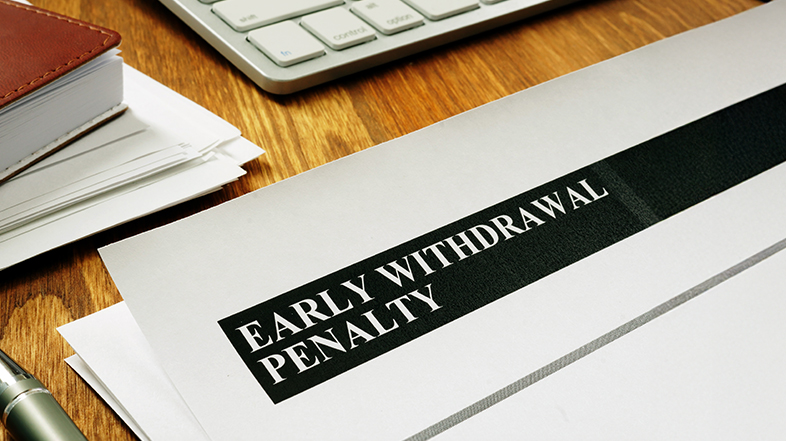
The IRS provides specific situations where the 10% penalty is waived.
Income taxes still apply in most cases, even when the penalty is avoided.
Here are the exceptions that apply to 401(k) plans:
- Separation from service at 55 or older (Rule of 55). If you leave your job in or after the calendar year you turn 55, you may take penalty-free withdrawals from that employer’s 401(k). Income taxes still apply.
- Total and permanent disability. If you become totally and permanently disabled, the 10% penalty is waived.
- Death. Beneficiaries receiving distributions from a deceased account holder’s 401(k) are not subject to the penalty.
- Unreimbursed medical expenses. You may withdraw the amount of medical expenses that exceed 7.5% of your adjusted gross income (AGI) without penalty.
- Qualified Domestic Relations Order (QDRO). If a court order requires a transfer to a former spouse as part of a divorce settlement, no penalty applies.
- Substantially Equal Periodic Payments (SEPP). Under IRS Rule 72(t), you may take penalty-free withdrawals by committing to equal payments over your life expectancy. Payments must continue for at least 5 years or until you reach age 59½, whichever is longer.
- Military reservists called to active duty. Qualified reservist distributions made during active duty are exempt from the penalty.
- Birth or adoption. You may withdraw up to $5,000 per child for qualified birth or adoption expenses without penalty.
- Emergency personal expense. You may withdraw up to $1,000 per year for an unforeseeable personal or family emergency. One withdrawal per calendar year is allowed.
- Domestic abuse victim. Victims of domestic abuse by a spouse or domestic partner may withdraw up to $10,000 (adjusted for inflation) or 50% of their vested account balance, whichever is less. The distribution must be made within one year of the abuse.
- Federally declared disaster. If you experience economic loss due to a federally declared disaster, you may withdraw up to $22,000 per disaster without penalty.
- Long-term care insurance premiums. Starting in 2026, you may withdraw up to $2,500 per year penalty-free to pay for qualifying long-term care insurance premiums. [3]
Important note: Several of the newer SECURE 2.0 exceptions are optional for plans to offer. If your plan has not yet adopted them, you may still be able to claim the exception on your personal tax return using IRS Form 5329. Speak with a tax professional if you are unsure. [3]
Does a Hardship Withdrawal Help You Avoid the 401(k) Penalty?
This is one of the most common misconceptions about 401(k) withdrawals.
A hardship withdrawal allows you to access your 401(k) if you have an immediate and heavy financial need.
Your plan administrator must approve it, and the withdrawal is limited to the amount needed to satisfy the hardship.
But a hardship withdrawal does not automatically waive the 10% penalty.
You still owe income taxes and the penalty unless the hardship also qualifies as one of the specific IRS exceptions listed above.
Common situations that may qualify as hardships under a plan include:
- Medical bills for you, your spouse, or dependents
- Costs to prevent foreclosure or eviction from your primary residence
- Tuition and higher education expenses
- Funeral or burial expenses
- Certain home repairs following a casualty loss
Even if your hardship qualifies, you will still have 20% withheld in federal taxes and the withdrawal will be taxed as ordinary income. [2]
Confirm with your plan administrator and a tax professional before proceeding.
Is a 401(k) Loan a Better Option Than an Early Withdrawal?
If you need access to funds, a 401(k) loan may cost you less than an early withdrawal.
A loan is not a distribution.
No taxes are withheld and there is no 10% penalty, as long as you repay the loan on time.
Here is how 401(k) loans work:
- The maximum loan amount is $50,000 or 50% of your vested account balance, whichever is less.
- You must repay the loan within 5 years, with interest. The interest is paid back into your own account.
- If you use the loan to purchase a primary residence, a longer repayment term may apply.
- No credit check is required, and the loan does not appear on your credit report.
There is one significant risk: If you leave your job while you have an outstanding 401(k) loan, the remaining balance typically becomes due immediately. If you cannot repay it, the unpaid amount is treated as a taxable distribution and may be subject to the 10% penalty if you are under age 59½.
A 401(k) loan is not without risk.
But for many people facing a short-term cash need, it may be a less costly option than a permanent withdrawal.
If you have questions about your 401(k) or if you need help, we’re here for you. Click below to book a complimentary 15-minute 401(k) Strategy Session.
Sources
[1] Empower / The Currency. 401(k) withdrawal rules: How to avoid penalties. September 16, 2025. https://www.empower.com/the-currency/money/can-withdraw-401k-ira-penalty-free/
[2] John Hancock Retirement. For which reasons can you take a 401(k) withdrawal without penalty? 2026. https://retirement.johnhancock.com/us/en/viewpoints/retirement-readiness/can-i-take-money-from-my-401-k/
[3] IRS.gov. Retirement topics: Exceptions to tax on early distributions.
December 2025.
https://www.irs.gov/retirement-plans/plan-participant-employee/retirement-topics-exceptions-to-tax-on-early-distributions