

401(k) Top-Heavy Rules Explained for Small Businesses
How 401(k) top-heavy rules can affect small businesses
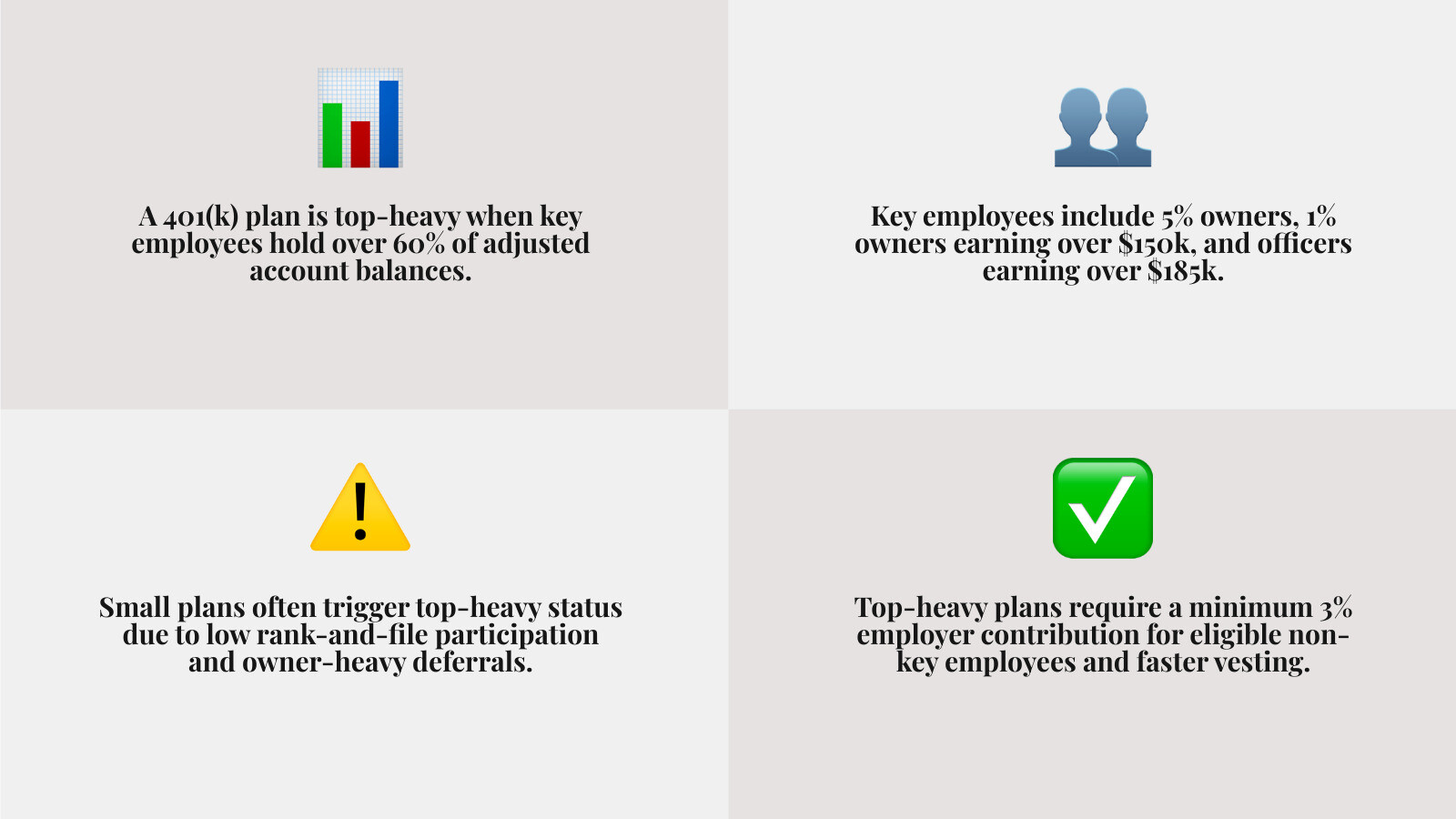
A 401(k) plan is considered to be top-heavy when key employees hold more than 60% of its adjusted account balances. Key employees include certain owners and officers. Understanding 401(k) top-heavy rules matters because if your plan is top-heavy, you may need to make an employer contribution for eligible non-key employees and meet faster vesting rules. The IRS guide to qualified plan requirements identifies contributions and vesting as core top-heavy requirements.
Small plans can reach that threshold when owners have saved for years but other employees have smaller balances. In this guide, the 401(k) Maneuver team explains how to check your plan’s status, what contributions may be required, and when a safe harbor plan may provide relief.
Understanding 401(k) top-heavy rules and definitions
The Internal Revenue Code outlines nondiscrimination provisions under Section 416 to ensure qualified retirement plans benefit rank-and-file workers alongside company leadership. Navigating these requirements starts with understanding core 401(k) terms and how asset distribution is evaluated across your workforce.
Compliance requires testing the proportion of plan assets held by leadership compared to other participating staff. The IRS guide to common qualified plan requirements highlights that failing to monitor these allocations can risk a plan’s tax-qualified status if required corrective contributions are neglected.
Who qualifies as a key employee?
The IRS uses specific criteria to identify key employees for annual compliance testing. An employee is classified as a key employee if, during the determination year, they meet any of the following definitions:
- More-than-5% owner: Anyone who owns more than 5% of the business or voting stock.
- More-than-1% owner with compensation: An individual owning more than 1% of the business who earns more than $150,000 in compensation.
- Officers: An officer of the business whose annual compensation exceeds statutory thresholds: $230,000 for 2025, $220,000 for 2024, $215,000 for 2023, $200,000 for 2022, and $185,000 for 2020–2021.

Under Internal Revenue Code Section 318, family attribution rules also apply. Ownership interests held by a spouse, children, grandchildren, or parents are attributed to family members working in the business, which may classify them as key employees regardless of their standalone title.
The 60% asset test and determination date
A plan is deemed top-heavy when the total value of accounts belonging to key employees exceeds 60% of the aggregate account balances of all employees.
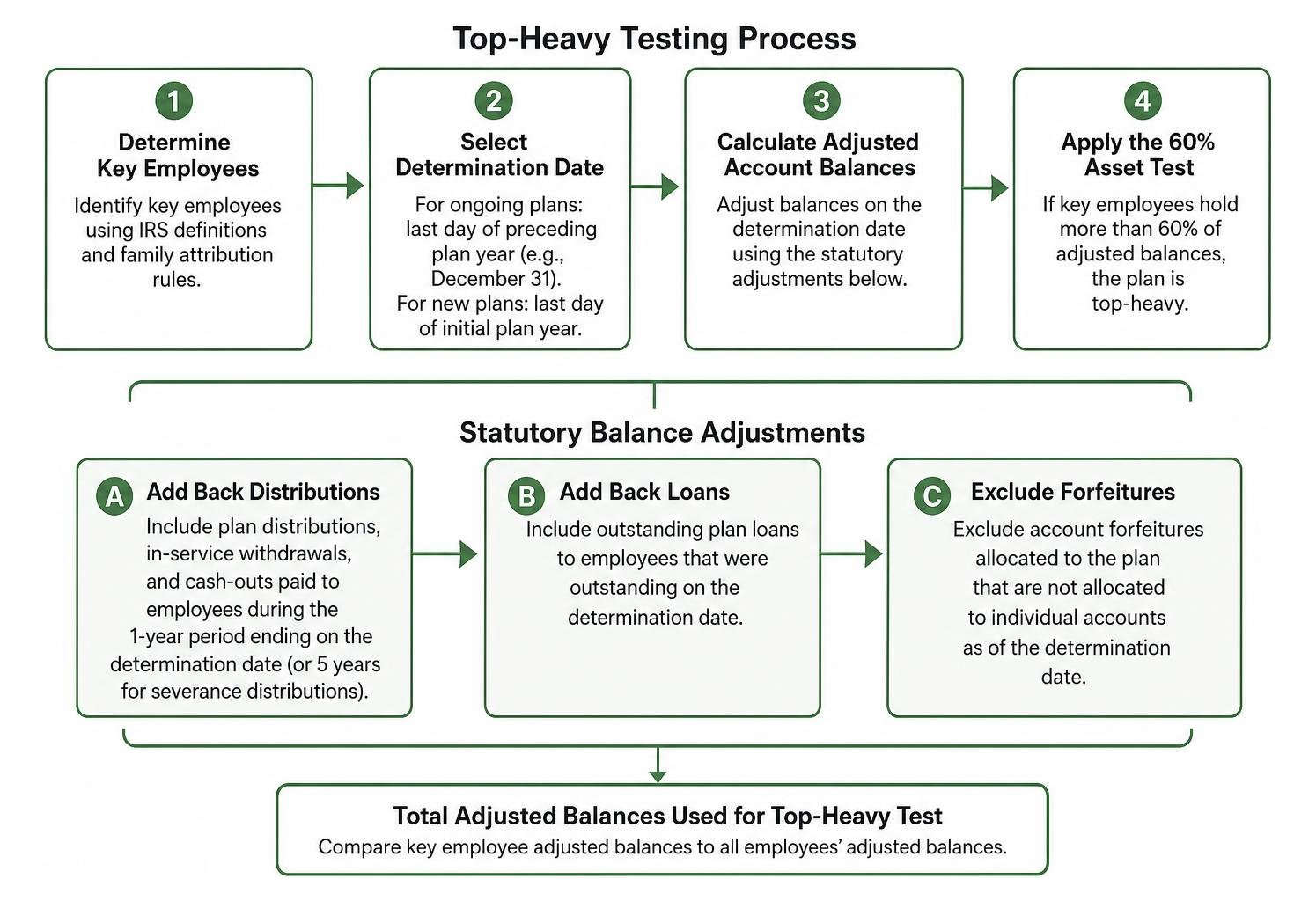
For ongoing plans, the top-heavy determination date is the final day of the preceding plan year (December 31 for calendar-year plans). For a newly established plan, the determination date is the last day of the initial plan year. Calculations generally operate on a cash basis, though initial-year plans evaluate accrued balances.
How top-heavy testing works for small employers
Conducting annual top-heavy testing requires calculating adjusted account balances rather than looking solely at current ledger totals. The IRS outlines specific audit steps in its 401(k) examination techniques manual to verify that balance adjustments are applied accurately.
Calculating account balances and statutory adjustments
To determine the accurate top-heavy ratio, plan administrators must adjust account balances on the determination date:
- Add back distributions: Include plan distributions, in-service withdrawals, and cash-outs paid to employees during the 1-year period ending on the determination date (or 5 years for severance distributions).
- Add outstanding loan balances: Include participant loan balances in the asset totals.
- Subtract unrelated rollovers: Exclude rollover contributions initiated by employees from an unrelated employer’s plan if made after December 31, 2001.
- Subtract unpaid contributions: Remove discretionary profit-sharing allocations that have not yet been deposited.
Why small business plans frequently trigger top-heavy status
Small businesses often struggle with top-heavy compliance because of basic workforce demographics. When exploring what a 401(k) is for a growing firm, owners often defer the maximum annual limit while rank-and-file workers may contribute lower percentages or experience higher turnover. Over several years, this dynamic concentrates plan assets among founders and executives.
Employer obligations under 401(k) top-heavy rules
When a plan’s top-heavy ratio exceeds 60%, the employer must provide specific minimum contributions and adhere to accelerated vesting schedules. Field guidance in the IRS intermediate audit techniques manual confirms that these minimums apply to eligible non-key employees who remain employed on the last day of the plan year, regardless of whether they completed 1,000 hours of service or made salary deferrals.
Minimum contribution formulas under 401(k) top-heavy rules
The required top-heavy minimum contribution is generally 3% of total gross compensation for each eligible non-key employee.
If the highest contribution rate for any key employee (including elective deferrals and employer contributions) is less than 3%, the required non-key contribution matches that lower percentage. For example, if the highest-deferring owner contributes only 1.5% of their compensation, the non-key minimum contribution is 1.5%.
Contributions must be deposited no later than the employer’s tax return due date (including extensions) to claim a deduction for that tax year.
Mandatory vesting schedules under 401(k) top-heavy rules
Top-heavy employer contributions must vest according to accelerated schedules. Understanding your 401(k) vesting schedule options helps ensure compliance with mandatory minimums:
| Completed Years of Service | 3-Year Cliff Vesting | 6-Year Graded Vesting |
|---|---|---|
| Less than 1 Year | 0% | 0% |
| 1 Year | 0% | 0% |
| 2 Years | 0% | 20% |
| 3 Years | 100% | 40% |
| 4 Years | 100% | 60% |
| 5 Years | 100% | 80% |
| 6 or More Years | 100% | 100% |
Using a top-heavy 401(k) safe harbor plan for automatic relief
Employers can satisfy top-heavy compliance by adopting a top-heavy 401(k) safe harbor plan design. Safe harbor designs automatically fulfill annual nondiscrimination and top-heavy testing obligations provided specific contribution formulas are maintained.
Safe harbor nonelective vs. matching contributions
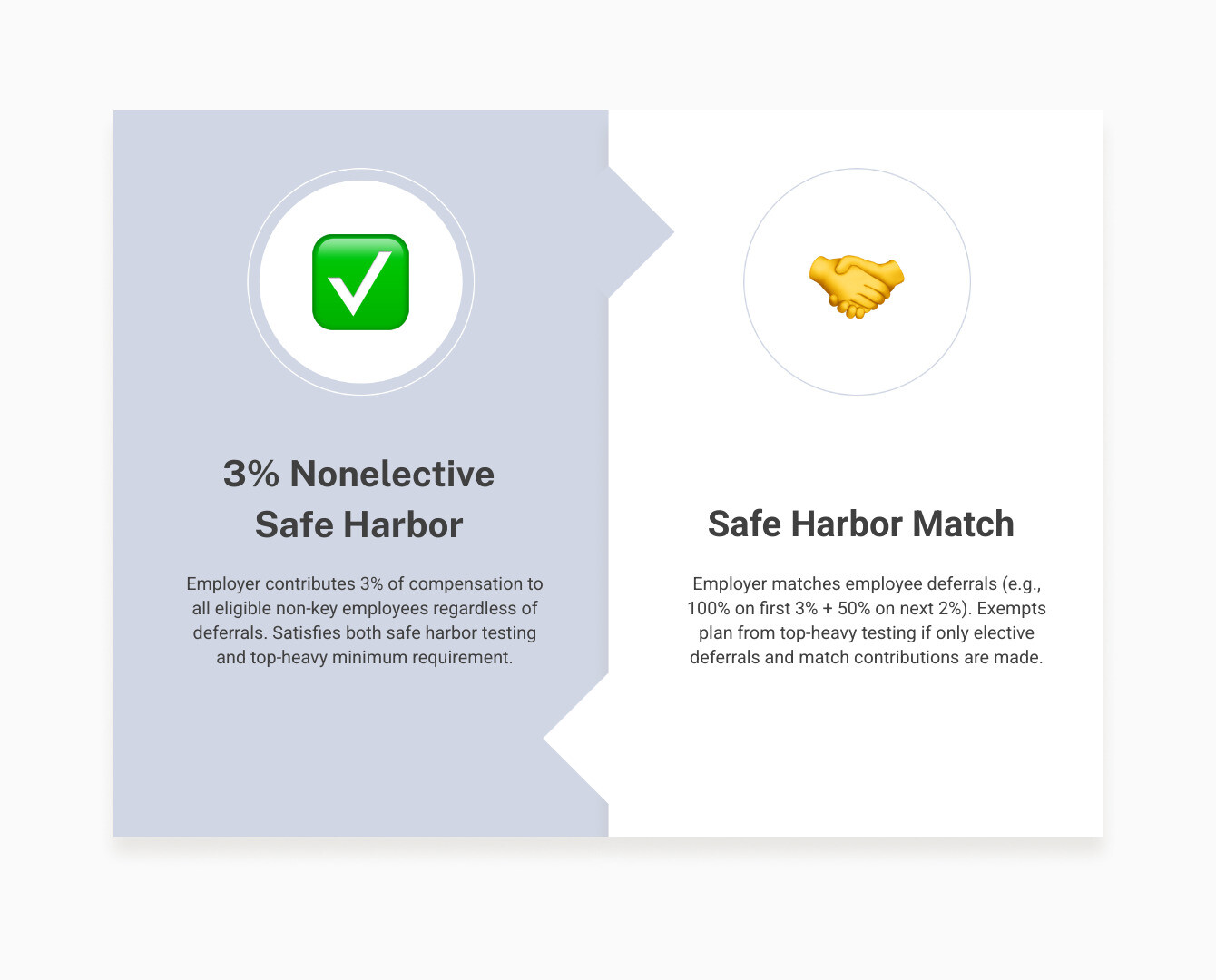
- 3% Nonelective Safe Harbor: The employer contributes at least 3% of compensation to all eligible non-key employees, regardless of whether they defer. This dual-purpose contribution satisfies both safe harbor testing and the 3% top-heavy minimum requirement.
- Safe Harbor Match: The employer matches employee deferrals (such as 100% on the first 3% deferred plus 50% on the next 2%). A basic or enhanced matching formula exempts the plan from top-heavy testing if only elective deferrals and safe harbor matching contributions are made.
Safe harbor contributions must be 100% immediately vested when allocated.
Limitations and exceptions to safe harbor protections
A safe harbor plan may lose its top-heavy exemption if the employer adds discretionary profit-sharing contributions, allocates forfeitures to key employees, or includes allocation conditions (such as 1,000 hours of service or last-day employment rules) that disqualify safe harbor protections.
Ways to correct top-heavy violations and mitigation strategies
If an annual review reveals that required top-heavy contributions were omitted, employers can utilize IRS correction frameworks to restore plan compliance.

IRS correction programs: SCP and VCP options
- Self-Correction Program (SCP): Permits employers to correct operational failures without contacting the IRS or paying user fees, provided established compliance practices are maintained. The employer makes the required corrective contribution plus lost earnings to affected non-key participants.
- Voluntary Correction Program (VCP): Used for broader compliance failures. The employer submits a formal application to the IRS and pays a statutory user fee based on plan asset value to secure an official compliance statement.
Proactive plan design adjustments for small businesses
Employers can manage top-heavy risk proactively by:
- Implementing automatic enrollment to increase rank-and-file participation.
- Restructuring discretionary contributions to coordinate with safe harbor nonelective formulas.
- Monitoring key employee deferral percentages before year-end.
Frequently asked questions about top-heavy plans
What triggers top heavy testing in a small business 401(k)?
Testing is triggered annually by comparing total account balances. If key employees hold more than 60% of the total adjusted assets on the determination date, top-heavy contribution and vesting rules apply for the upcoming plan year.
Can an employer avoid top-heavy minimum contributions?
Yes. Employers can avoid unexpected obligations by adopting a safe harbor nonelective contribution of at least 3%, utilizing qualifying safe harbor match designs, or ensuring no key employees contribute to the plan during the year.
How does family attribution affect key employee status?
Under IRS rules, ownership stakes held by business owners are attributed to their spouses, children, grandchildren, and parents who work for the company, which may classify those family members as key employees regardless of compensation.
Key takeaways
- A 401(k) plan becomes top-heavy when key employees hold more than 60% of total adjusted plan assets on the annual determination date.
- Key employees include greater-than-5% owners, greater-than-1% owners earning over $150,000, and officers earning above IRS thresholds ($230,000 for 2025; $220,000 for 2024).
- Top-heavy status generally requires an employer contribution of up to 3% of compensation for eligible non-key employees.
- Adopting a safe harbor plan design can provide an exemption from top-heavy testing while satisfying annual employer contribution obligations.
Optimize your plan governance
Managing retirement compliance, testing requirements, and plan administrative duties requires careful oversight. Small and mid-sized employers can learn how a 401(k) Maneuver pooled employer plan works to help streamline administrative responsibilities, or contact our team at 1-877-218-5060 to discuss retirement plan options for your business.
Disclosure: 401(k) Maneuver is a business name of Royal Fund Management, LLC, an SEC-registered investment adviser. This material is provided for informational and educational purposes only and should not be construed as investment, legal, or tax advice. Investing involves risk of loss, and past performance does not guarantee future results. Plan sponsors should consult qualified legal, tax, or actuarial professionals regarding their specific plan compliance obligations.