

How to Choose and Update Your 401k Beneficiary
How to choose a 401(k) beneficiary
Name a primary beneficiary to receive your 401(k) when you die, and a contingent beneficiary as a backup. Check that the names and shares on your plan’s beneficiary form match your wishes. The form generally guides payment of the account, even if your will says something different. If you’re married, spousal rights under your plan may limit whom you can name without your spouse’s consent.
Review your choices after marriage, divorce, a birth, or a beneficiary’s death. This guide covers those common updates and the IRS rules heirs may face when taking distributions.
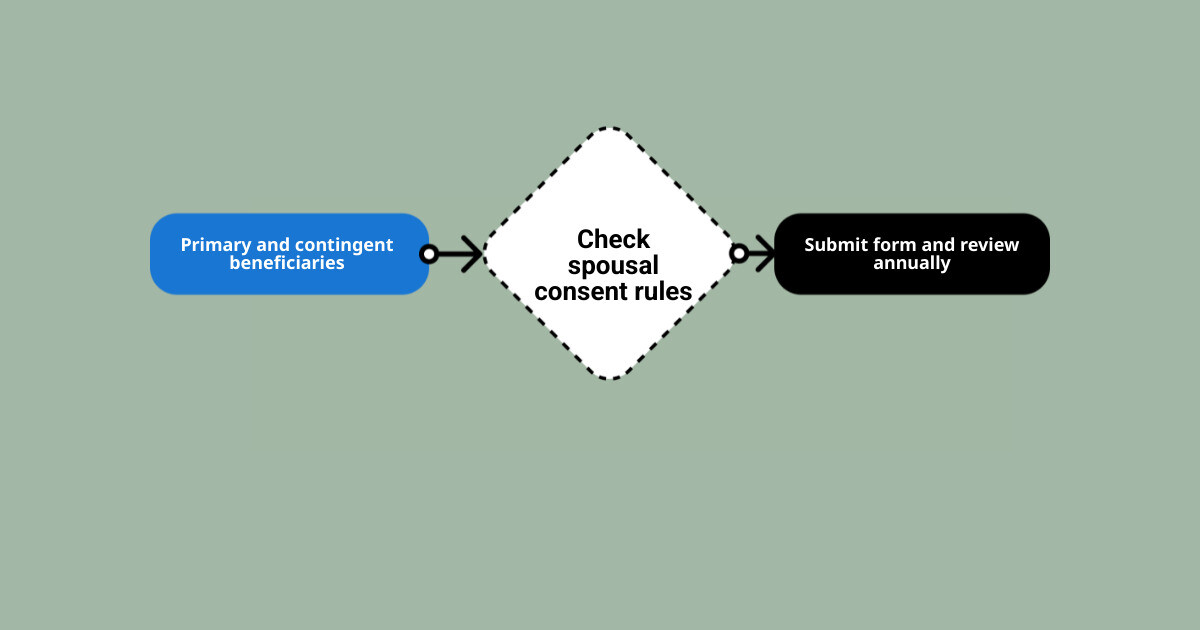
Understanding 401(k) beneficiary designations and legal priority
When you participate in an employer-sponsored retirement plan, federal law under the Employee Retirement Income Security Act of 1974 (ERISA) governs how plan assets are administered. Your workplace retirement account does not automatically transfer according to informal wishes. Instead, the plan administrator is legally bound to distribute assets according to plan documents and valid beneficiary forms on file.
Understanding what happens to your 401(k) when you die allows you to coordinate your retirement savings with your broader estate plan. According to Department of Labor guidance, retirement plans must provide clear procedures for naming individuals or entities to receive your vested account balance upon your death.
Primary vs. 401(k) contingent beneficiary options
Your primary beneficiary is the first person or entity in line to receive your retirement assets. You can name a single individual for 100% of the account or divide the balance among multiple primary beneficiaries using specific percentages that total 100%.
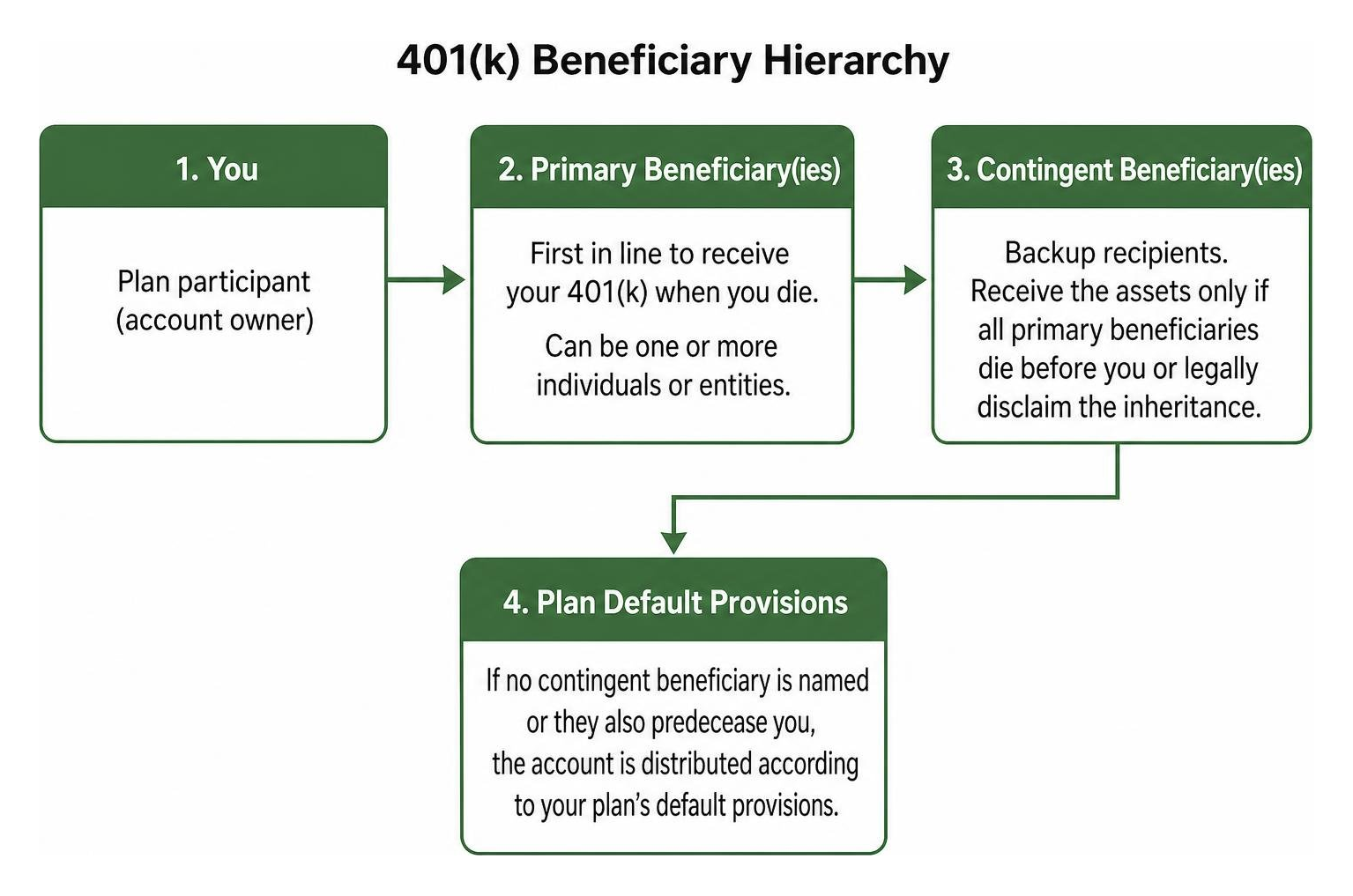
A 401(k) contingent beneficiary acts as a backup. This secondary beneficiary receives the assets only if all named primary beneficiaries pass away before you or legally disclaim the inheritance. If you do not name a contingent beneficiary and your primary beneficiary predeceases you, the account balance typically defaults to the standard provisions written into your plan document.
Beneficiary form vs. will: understanding legal precedence
A common misconception is that a last will and testament dictates who inherits a retirement plan. In reality, a valid contractual beneficiary designation on your 401(k) takes legal precedence over instructions in a will.
Because a 401(k) passes directly by contractual designation, the assets bypass the probate process entirely. This direct transfer allows your heirs to access funds without the administrative delays and court costs associated with estate probate. However, if you designate your estate as the beneficiary, the funds must pass through probate court before distribution.
ERISA spousal rights and consent requirements
Under ERISA rules, if you are married, your surviving spouse is automatically your primary beneficiary for 100% of your account balance. If you wish to name someone else—such as a child, sibling, or trust—your spouse must sign a formal written waiver consenting to the change.
This waiver generally requires notarization or witnessing by a plan representative to be legally valid. Overlooking these rules is one of the common retirement mistakes married couples make. Always check your plan’s Summary Plan Description (SPD) to confirm the specific spousal consent procedures required by your employer.
Inherited account rules and distribution options for heirs
The rules governing inherited retirement accounts changed significantly under the Setting Every Community Up for Retirement Enhancement (SECURE) Act of 2019 and subsequent regulatory updates. Heirs must follow specific IRS distribution timelines depending on their relationship to the original account owner.
| Beneficiary Category | Primary Distribution Options | Standard Timeline | Tax Treatment (Pre-Tax 401(k)) |
|---|---|---|---|
| Surviving Spouse | Rollover to own IRA/401(k), Inherited IRA, or Lump Sum | Life expectancy or delayed until owner’s RMD age | Ordinary income tax on withdrawals; deferred on rollovers |
| Non-Spouse (Standard) | Inherited IRA or Lump Sum | 10-Year Rule (full distribution by end of year 10) | Ordinary income tax on distributions |
| Eligible Designated | Inherited IRA (life-expectancy method) | Distributed across single life expectancy | Ordinary income tax on annual distributions |
For complete distribution details and single life expectancy tables, consult IRS Publication 590-B.
Distribution choices for a spouse 401(k) beneficiary
A surviving spouse possesses the greatest flexibility under federal tax law. If you inherit a spouse’s 401(k), you generally have several paths:
- Spousal Rollover: You may roll the assets into your own traditional 401(k) or individual retirement account (IRA), treating the balance as your own. Required minimum distributions (RMDs) are then delayed until you reach your own required beginning age (age 73, shifting to age 75 for individuals born in 1960 or later).
- Inherited IRA: You may transfer the assets into an inherited IRA. This allows you to take distributions based on your life expectancy or delay withdrawals until the deceased spouse would have reached RMD age.
- Lump-Sum Distribution: You may withdraw the full balance immediately, though the entire pre-tax amount is subject to ordinary income tax in the year received.
Rules when naming a non-spouse 401(k) beneficiary
Most non-spouse heirs who inherit a account after December 31, 2019, are subject to the 10-year rule under the SECURE Act. Under these 401(k) beneficiary rules, the beneficiary must withdraw the entire balance of the inherited account by December 31 of the tenth year following the participant’s death.
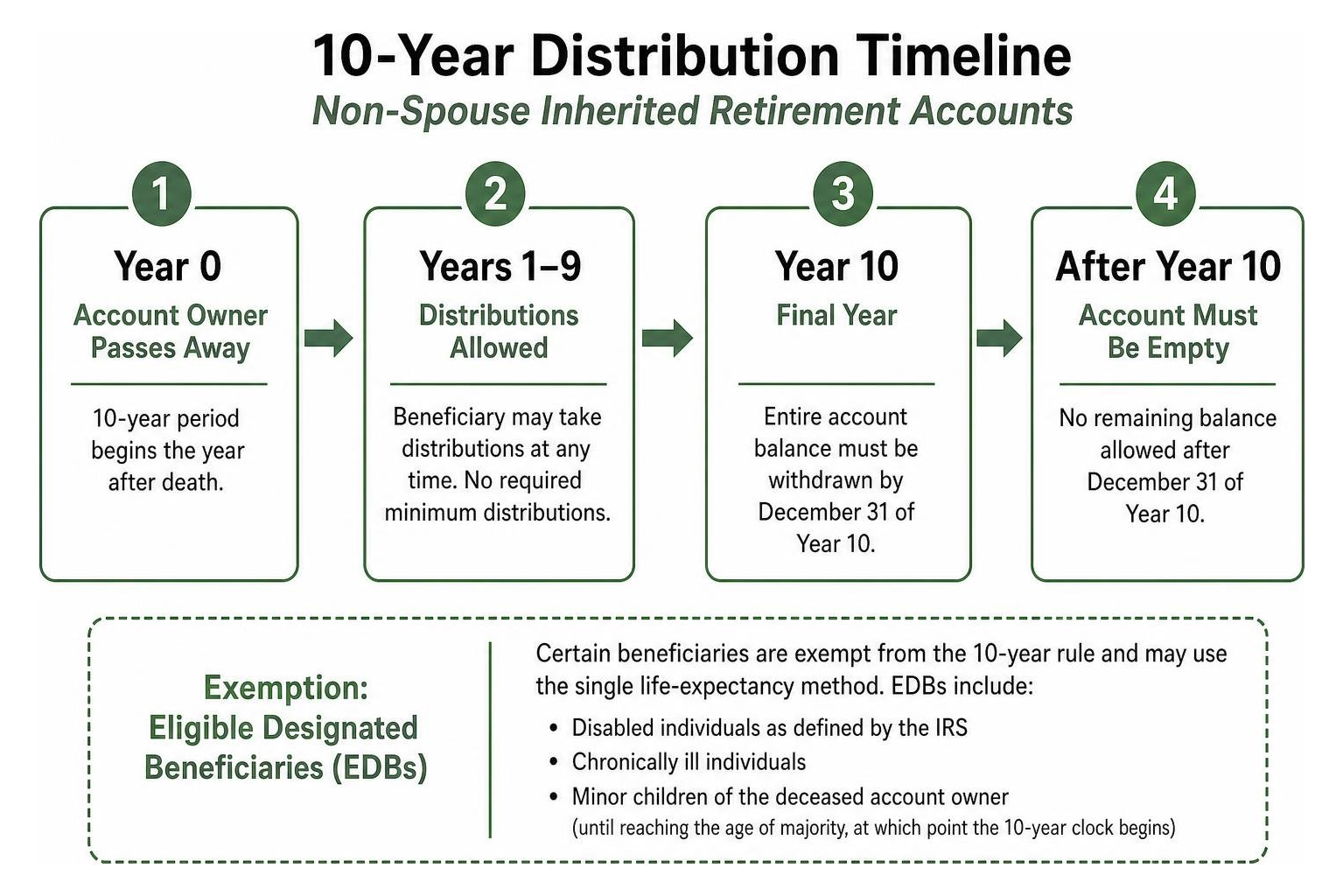
Certain individuals qualify as Eligible Designated Beneficiaries (EDBs) and are exempt from the standard 10-year requirement. EDBs include:
- Disabled individuals as defined by the IRS.
- Chronically ill individuals.
- Minor children of the deceased account owner (until reaching the age of majority, at which point the 10-year clock begins).
- Individuals not more than 10 years younger than the deceased account holder.
Eligible designated beneficiaries may calculate annual distributions over their single life expectancy, extending tax deferral over a longer duration.
Naming a trust, minor child, or Roth account
Designating specialized beneficiaries requires careful planning:
- Trusts: Naming a trust as a 401(k) beneficiary can provide asset control for heirs who may struggle with money management. To qualify for look-through treatment under IRS regulations, the trust must meet specific criteria, including being valid under state law and naming identifiable individual beneficiaries.
- Minor Children: Financial institutions cannot transfer retirement assets directly to a minor. You may designate a custodian under the Uniform Transfers to Minors Act (UTMA) or establish a trust to manage the funds until the child reaches adulthood.
- Roth 401(k) Assets: If you inherit a designated Roth 401(k), qualified distributions of contributions and earnings are generally free from federal income taxes, provided the account satisfies the five-year aging rule. However, non-spouse Roth beneficiaries are still subject to the 10-year distribution rule.
When and how to update your retirement plan designations
Updating your beneficiary designations is usually a straightforward process managed directly through your employer’s plan recordkeeper portal. It may be a good practice to complete an annual review alongside your broader estate planning.
Common life events that require an update
Life changes frequently alter your long-term intentions. We recommend reviewing your designations whenever you experience any of the following events:
- Marriage or Remarriage: Ensure your new spouse is properly registered or complete a waiver if alternative arrangements are intended.
- Divorce: Updating your forms is essential because federal ERISA rules may award plan assets to an ex-spouse if they remain listed on the official recordkeeper form. Review how divorce impacts your retirement plan to help safeguard your retirement savings.
- Birth or Adoption of a Child: Add new dependents as primary or contingent heirs.
- Death of a Beneficiary: Reallocate percentages to avoid unallocated shares reverting to default plan provisions.
- Changes in Special Needs Circumstances: Coordinate with an estate planning attorney before naming an individual who relies on need-based government benefits.
Per stirpes vs. per capita allocations
When naming multiple heirs, such as children, your plan may offer per stirpes or per capita distribution elections:
- Per Stirpes (by branch): If a named child predeceases you, their share passes automatically to their direct descendants (your grandchildren).
- Per Capita (by head): If a named child predeceases you, their share is divided equally among your surviving primary beneficiaries, leaving nothing to that deceased child’s heirs.
Check your plan’s beneficiary form to confirm whether per stirpes designations are supported by your recordkeeper.
Some Key takeaways for managing your account designations
- Beneficiary Forms Trump Wills: Your 401(k) beneficiary designation governs who inherits your retirement account, bypassing probate and overriding instructions in a will.
- Spouses Have Automatic Rights: Under federal ERISA law, a spouse is automatically the 100% primary beneficiary unless they execute a formal, notarized waiver.
- Non-Spouse Heirs Face the 10-Year Rule: Most non-spouse beneficiaries must empty an inherited 401(k) within 10 years following the owner’s death.
- Review Designations Regularly: Update your primary and contingent selections after major life events such as marriage, divorce, births, or deaths.
Frequently asked questions about 401(k) beneficiaries
What happens to a 401(k) if no beneficiary is named?
If you pass away without a valid designation on file, your account is distributed according to the default terms of your plan document. In most plans, assets pass first to a surviving spouse. If you are unmarried, the balance typically transfers to your estate, which requires probate court administration before funds can reach your heirs.
How do 401(k) beneficiary rules apply to required minimum distributions (RMDs)?
If the original account owner died after reaching their required beginning date for RMDs, non-spouse beneficiaries subject to the 10-year rule must take annual RMDs in years one through nine, with the entire balance emptied by year 10. For full technical details on withdrawal calculations, refer to IRS Publication 590-B.
Can creditors claim assets from an inherited 401(k)?
While an account owner is alive, ERISA provides robust protection against general creditor claims. Once funds are distributed to an heir, or rolled over into a non-spouse inherited IRA, that federal ERISA protection may no longer apply. State laws vary significantly regarding creditor exemptions for inherited retirement balances.
Conclusion
Structuring your 401(k) beneficiary designations properly is designed to help transition your retirement assets smoothly to your intended loved ones without unnecessary legal delays. Keeping these forms up to date is an essential part of ongoing account maintenance.
If you would like a professional fiduciary review of your workplace retirement plan, we invite you to learn How It Works to see how personalized management can assist your long-term retirement strategy.
Disclosure: 401(k) Maneuver is a business name of Royal Fund Management, LLC, an SEC-registered investment adviser. This article is provided for educational and informational purposes only and does not constitute individual investment, legal, or tax advice. Investing involves risk of loss, and past performance does not guarantee future results. Diversification and portfolio rebalancing strategies aim to manage risk but cannot guarantee a profit or protect against loss in declining markets. Consult a qualified tax professional or estate attorney regarding your specific situation.