


401k Eligibility Requirements: Setting Rules for Long-Term Part-Time Employees
401(k) eligibility requirements employers should to know
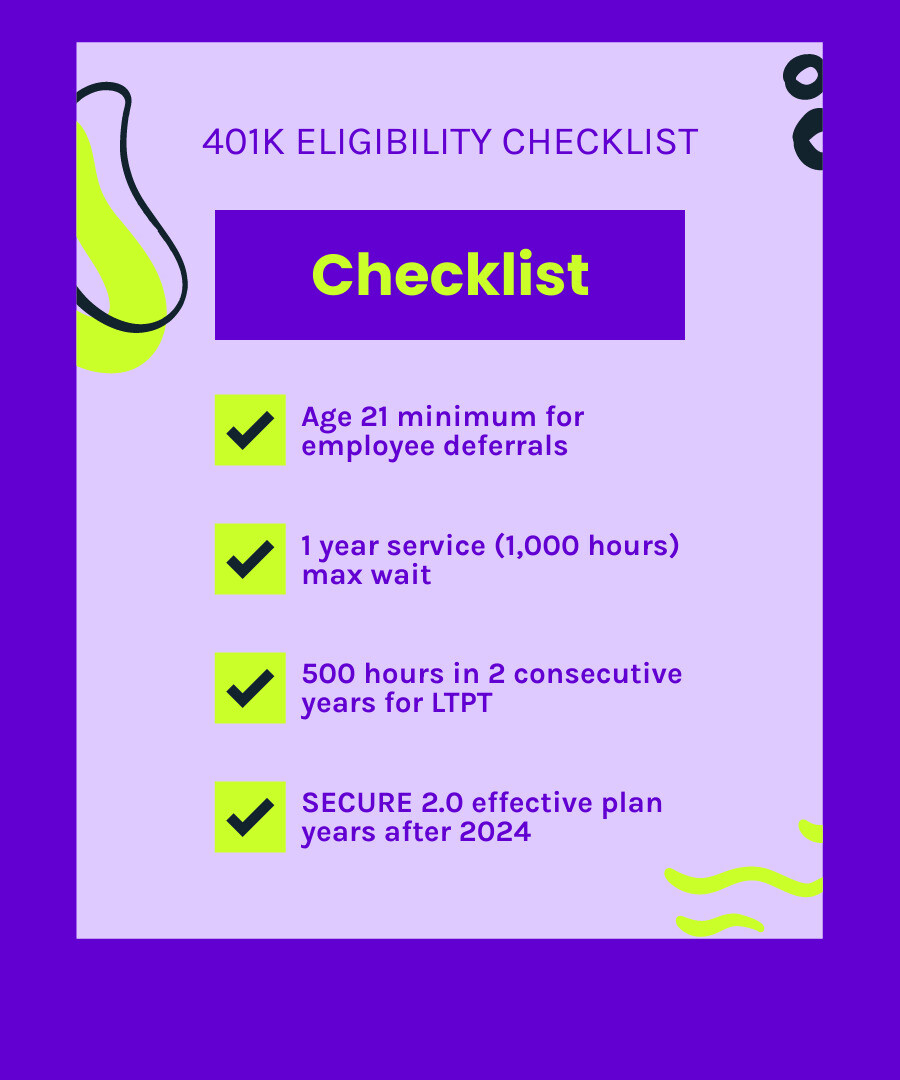
Understanding 401(k) eligibility requirements can be essential when establishing and administering a compliant workplace retirement plan. For employee contributions, a 401(k) plan generally cannot require workers to be older than 21 or complete more than 1 year of service, typically 1,000 hours. You can set less restrictive rules. For plan years beginning after December 31, 2024, employees who work at least 500 hours in each of 2 consecutive years may also qualify to make contributions under the long-term part-time rules. See IRS guidance on eligibility and the SECURE 2.0 Act.
Those limits are typically the starting point. Your plan’s entry dates, rules for employer contributions, and employee exclusions also shape who can join and when. This guide explains some choices and how they may affect plan testing.
Core 401(k) eligibility requirements and IRS limits
Designing a compliant retirement plan commonly begins with understanding the legal outer boundaries. Under Internal Revenue Code (IRC) Section 410(a), plan sponsors may set age and service standards, but they cannot make those conditions more restrictive than statutory caps.

According to the IRS in 2025 Publication 560, qualified plans must satisfy strict participation standards to maintain tax-exempt status. According to the Plan Sponsor Council of America’s 67th Annual Survey (2024), about 64 percent of plans maintain 21 as the minimum age, 20 percent require no minimum age, 13 percent set age 18, and 4 percent require ages 19 to 20. Regarding service, roughly 50.42 percent of plans use a 1-year service standard, while 22.44 percent offer immediate eligibility upon hire.
| Contribution Type | Maximum Minimum Age | Maximum Service Requirement | Required Vesting at Entry |
|---|---|---|---|
| Employee Salary Deferrals | 21 | 1 Year (or 1,000 Hours) | 100% Immediate |
| Safe Harbor Employer Match/Non-Elective | 21 | 1 Year (or 1,000 Hours) | 100% Immediate (or 2-Year Cliff for QACA) |
| Discretionary Match / Profit Sharing | 21 | 2 Years of Service | 100% Immediate (if using 2-year rule) |
| Long-Term Part-Time Deferrals | 21 | 2 Consecutive Years (500+ Hours each) | 100% Immediate (for employee deferrals) |
Maximum age and service rules for employee deferrals
For standard elective salary deferrals, employers cannot require an employee to reach an age older than 21 or complete more than 1 year of service. A year of service is defined by statute as a 12-month computation period in which the worker completes at least 1,000 hours of service.
Employers may select more generous terms, such as permitting entry at age 18 or allowing employees to contribute immediately upon hire. For sponsors evaluating foundational retirement structures, understanding basic plan rules helps clarify how participation criteria interact with everyday payroll deferrals.
The two-year rule for employer discretionary contributions
While employee elective deferrals are capped at a 1-year service waiting period, IRC Section 410(a)(1)(B)(i) provides an alternative for employer discretionary contributions, such as profit-sharing allocations or discretionary matches. A plan may require up to 2 full years of service for these employer contributions, provided the plan gives the participant 100 percent immediate vesting upon entering the plan.
This 2-year rule cannot be applied to standard Safe Harbor 401(k) plans or elective employee deferrals. Employers adopting dual-eligibility provisions—such as 1 year for elective deferrals and 2 years with immediate vesting for matching funds—must monitor these parallel tracks carefully. Plan sponsors can review 401(k) vesting schedule rules to evaluate how cliff and graded vesting schedules compare with immediate vesting mandates.
SECURE 2.0 rules and 401(k) for part-time employees
Federal retirement legislation has expanded access for non-full-time staff. The original SECURE Act of 2019 required employers to allow long-term, part-time (LTPT) employees who completed 500 hours of service across 3 consecutive years to make elective deferrals, starting in 2024.

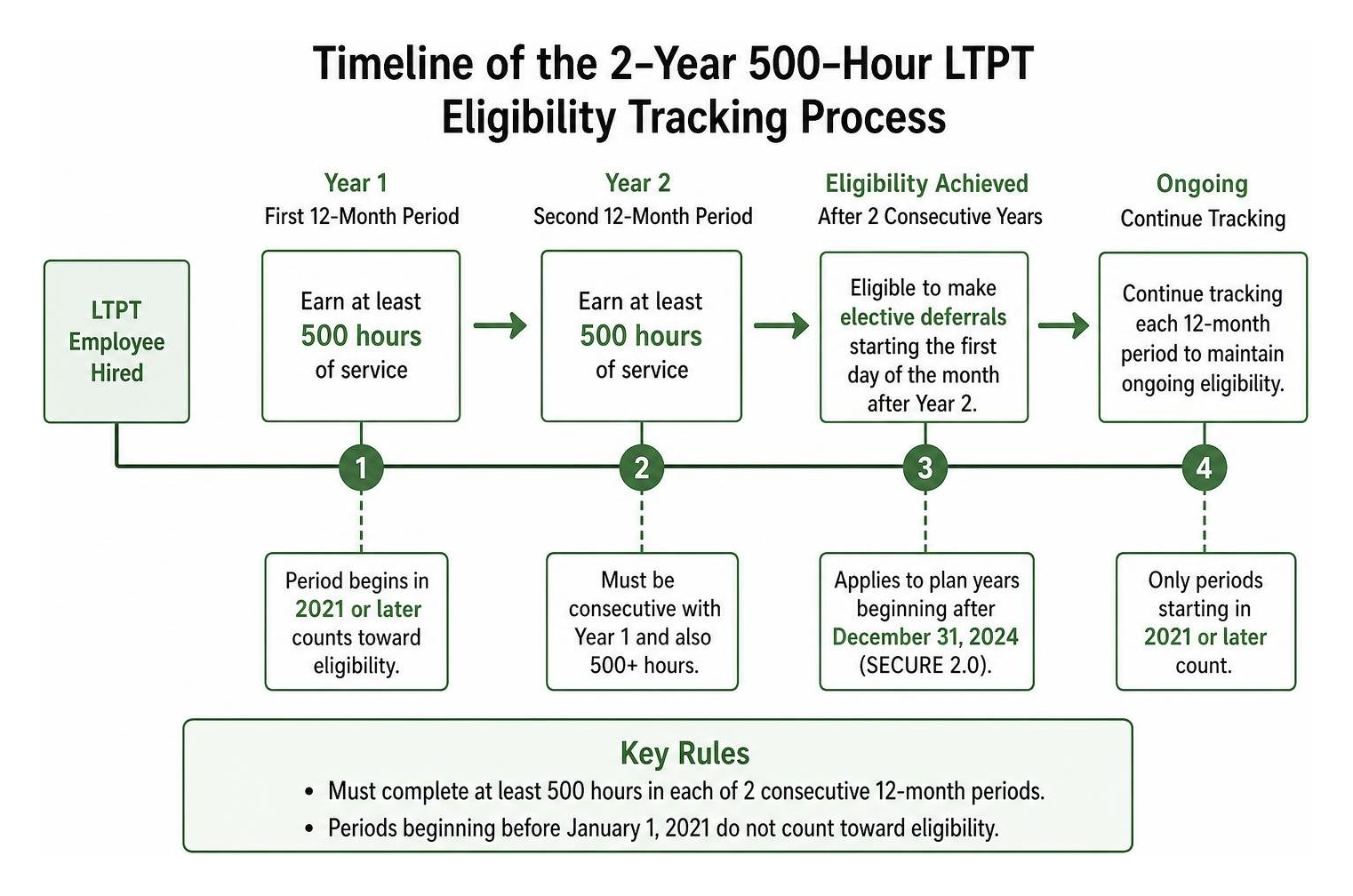
Under the SECURE 2.0 Act, Congress shortened this requirement. For plan years beginning after December 31, 2024, the service threshold was reduced from 3 consecutive 12-month periods to 2 consecutive 12-month periods with at least 500 hours in each. When offering a 401(k) for part time employees, employers must permit salary deferrals once these service milestones are reached, though employers are not statutorily required to provide matching or nonelective contributions to this group.
Tracking hours under 401(k) rules for part-time employees
Administering 401(k) rules for part time employees requires precise tracking of hours across consecutive 12-month calculation cycles. 12-month periods beginning before January 1, 2021, are excluded for eligibility purposes, but periods starting in 2021 and onward count toward service accumulation.
For vesting purposes under SECURE 2.0, if an employer chooses to provide discretionary contributions to LTPT employees, the employee must receive credit for each 12-month period in which they worked at least 500 hours, including years prior to 2021.
Measuring service under 401(k) eligibility requirements
Plan sponsors generally use one of two methods to measure service for 401(k) eligibility requirements:
- Hours of Service Method: Tracks actual hours worked during a designated 12-month computation period (typically starting on the hire date and shifting to the plan year thereafter). An employee becomes eligible after logging the specified threshold, such as 1,000 hours for standard eligibility or 500 hours for LTPT rules.
- Elapsed Time Method: Measures the total calendar duration of the employment relationship, regardless of actual hours worked. For example, an employee hired on April 1 satisfies a 1-year service requirement on April 1 of the following year if still employed.
The elapsed time method eliminates the need to track individual part-time hours, but it grants plan entry to any employee who remains on payroll for the required duration. Employers are advised to review their workforce turnover patterns when selecting an approach.
Plan entry dates and permissible employee exclusions
Satisfying the statutory age and service conditions establishes an employee’s eligibility date. However, an employee can only begin participating on their formal plan entry date.
Statutory entry dates vs. eligibility dates
Under IRC Section 410(a)(4), once an employee meets the plan’s maximum age (21) and service (1 year) requirements, they must enter the plan no later than the earlier of:
- The first day of the next plan year.
- Six months after satisfying the age and service requirements.
To comply with this statutory rule, employers commonly utilize semi-annual entry dates (e.g., January 1 and July 1 for calendar-year plans). Other options include quarterly, monthly, or immediate entry dates upon completing eligibility. While more frequent entry dates accelerate participation, structured entry dates allow plan administrators to batch communications and enrollments. Employers can evaluate these mechanics alongside other vital plan details to review to maintain organized administrative workflows.
Permissible class exclusions and restrictions
Employers may legally exclude specific categories of workers from a 401(k) plan, provided the exclusions comply with federal guidelines:
- Union Employees: Workers covered by a collective bargaining agreement where retirement benefits were the subject of good-faith bargaining.
- Nonresident Aliens: Nonresident alien employees who receive no earned income from U.S. sources.
- Leased Employees: Individuals providing services under an agreement through a leasing organization, subject to IRC Section 414(n) guidelines.
- Job Classifications: Specific, non-service-based job classifications (such as hourly division staff or specific subsidiaries), provided the plan still passes minimum coverage testing.
Exclusions cannot serve as a indirect proxy for age or service. For example, a plan cannot explicitly exclude “part-time workers” as a class, because any part-time worker who satisfies statutory hour thresholds (such as 1,000 hours, or 500 hours across 2 years) must be allowed to participate in employee deferrals.
Nondiscrimination testing, continuing eligibility, and mandatory notices
Plan eligibility structures directly influence annual compliance testing under the Internal Revenue Code and the Employee Retirement Income Security Act of 1974 (ERISA).
How 401(k) eligibility requirements impact compliance testing
Every qualified plan must satisfy IRC Section 410(b) Minimum Coverage Testing, ensuring that the percentage of non-highly compensated employees (NHCEs) benefiting from the plan is at least 70 percent of the percentage of highly compensated employees (HCEs) benefiting. Plans must also perform annual Actual Deferral Percentage (ADP) and Actual Contribution Percentage (ACP) testing unless designed as a Safe Harbor plan.
Under statutory rules, employers may elect to exclude LTPT employees from annual ADP, ACP, and top-heavy testing calculations. This statutory carve-out helps businesses include part-time workers for salary deferrals without skewing non-discrimination testing results.
Continuing eligibility rules and notice deadlines
For discretionary employer profit-sharing or matching allocations, plans may impose continuing eligibility conditions:
- Last-Day Rule: Requiring the participant to remain employed on the final day of the plan year to receive an allocation.
- 1,000-Hour Rule: Requiring the participant to complete 1,000 hours of service during the plan year to receive an allocation.
These continuing requirements cannot be applied to employee elective deferrals or Safe Harbor employer contributions.
Plan sponsors must also distribute mandatory participant notices within strict regulatory timeframes:
- Summary Plan Description (SPD): Delivered within 90 days of an employee becoming covered by the plan.
- Safe Harbor / Automatic Enrollment Notices: Provided between 30 and 90 days prior to the start of each plan year (or before immediate eligibility for new hires).
- Fee Disclosures (ERISA 404(a)(5)): Provided on or before the date a participant is first eligible to direct investments.
Strategic plan design: balancing cost control and talent retention
Selecting eligibility parameters commonly involves balancing financial management with talent acquisition goals.
- Immediate Eligibility: Offering immediate participation upon hire can serve as a recruitment incentive, appealing to candidates seeking uninterrupted retirement saving. The trade-off is higher recordkeeping overhead for high-turnover roles and more accounts with small balances.
- 1-Year Waiting Period: Using a 1-year service waiting period helps control administrative costs by filtering out short-tenured staff before they enter the plan. However, this may be viewed as less competitive in industries competing for mid-career professional talent.
- Dual Eligibility: Providing immediate entry for employee elective deferrals paired with a 1-year or 2-year service requirement for employer matching contributions allows employees to save immediately while helping protect employer benefit expenditures against early employee departures.
Some Key takeaways
- Statutory Maximums: Plans cannot require employees to be older than 21 or complete more than 1 year of service (1,000 hours) for elective deferrals.
- Part-Time Access: For plan years beginning after December 31, 2024, SECURE 2.0 requires plans to allow long-term part-time workers who log 500+ hours in 2 consecutive years to make salary deferrals.
- Employer Match Flexibility: Employers may impose up to a 2-year service requirement on discretionary employer contributions if participants become 100 percent vested upon entry.
- Testing Protections: LTPT employees participating solely in salary deferrals can be excluded from annual ADP, ACP, and top-heavy testing.
- Entry Date Rules: Eligible employees must enter the plan no later than the earlier of the first day of the next plan year or 6 months after satisfying age and service terms.
Frequently asked questions about 401(k) eligibility
What is the maximum waiting period allowed for a 401(k) plan?
For employee salary deferrals, the maximum waiting period allowed by the IRS is 1 year of service (defined as 1,000 hours in a 12-month period) and attaining age 21. For discretionary employer contributions, a plan may require up to 2 years of service if the plan provides 100 percent immediate vesting upon entry.
Do employers have to provide matching contributions to long-term part-time employees?
No. Under the SECURE 2.0 Act, employers are only required to permit eligible long-term part-time employees to make elective salary deferrals. Plan sponsors are not required to provide matching or nonelective employer contributions to this group, though they may elect to do so.
Can an employer exclude seasonal or temporary workers from a 401(k) plan?
An employer cannot exclude employees simply by using the label “seasonal” or “temporary.” If a seasonal or temporary employee meets the plan’s age and service conditions—such as completing 1,000 hours in a 12-month period or meeting the 2-year 500-hour LTPT rule—they must be allowed to participate in employee deferrals.
Optimize your workplace retirement plan strategy
Managing plan eligibility, tracking participant service hours, and navigating annual compliance requirements can involve complex administrative responsibilities for growing businesses. Employers interested in streamlining retirement oversight and exploring pooled employer plan solutions can connect with our team. We invite you to learn how the 401(k) Maneuver pooled employer plan works.
Disclosure: 401(k) Maneuver is a business name of Royal Fund Management, LLC, an SEC-registered investment adviser. This article is provided for educational and informational purposes only and does not constitute individual legal, tax, or investment advice. Plan sponsors should consult qualified legal counsel, a third-party administrator, or a certified tax professional regarding specific plan documents, eligibility structures, and compliance testing requirements. Investing involves risk of loss, and past performance is no guarantee of future results.