

How Your 401(k) Can Grow Over Time: Compounding Explained
How 401(k) growth works over time
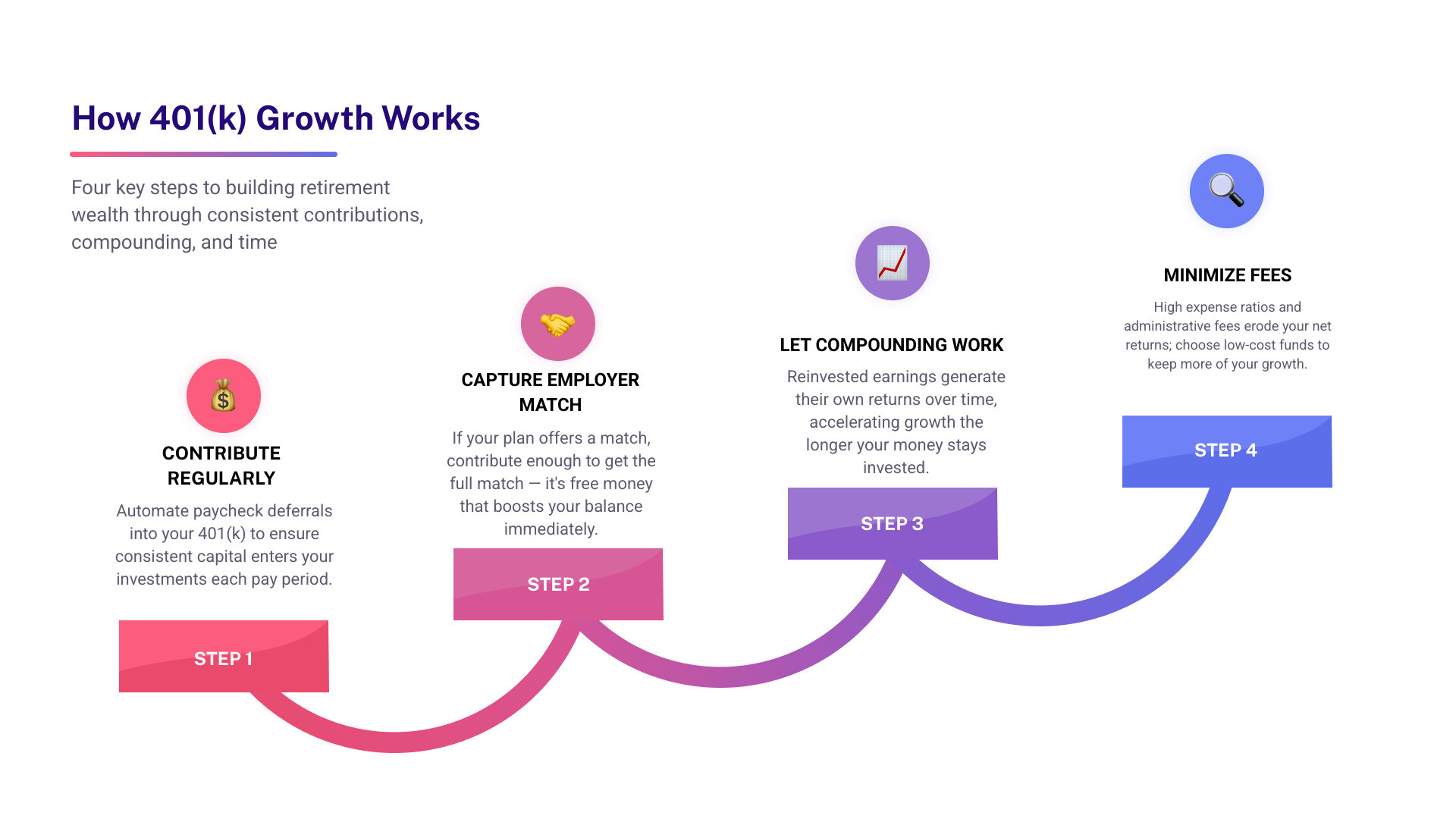
Understanding long-term 401(k) growth requires looking at three forces working together: your regular contributions, any employer match you receive, and investment returns that stay invested and may earn returns of their own. That last part is compounding. Fees reduce what stays in your account, while market downturns can slow growth or lower your balance.
Imagine you contribute from each paycheck and leave the money invested. Over time, both your contributions and any reinvested earnings have a chance to grow. To explore how different assumptions affect a hypothetical balance, try our 401(k) growth calculator.
The core drivers of 401(k) growth: Contributions, matches, and time
Building a retirement nest egg relies on three main engines working together: your personal salary deferrals, employer contributions, and the amount of time your money stays invested. When you establish one habit that may improve your 401(k) performance—such as automating your paycheck deductions—you ensure that fresh capital consistently enters the market.

Your contributions reduce your current taxable income in a traditional account, allowing more of your earnings to stay invested right away. The longer that capital remains in your plan, the more opportunity it has to experience market cycles and generate gains.
How investment compounding accelerates 401(k) growth
Compounding occurs when your investment returns begin generating their own earnings. In the early years of saving, your personal contributions make up the vast majority of your account balance. Over longer periods, reinvested dividends and potential capital growth can begin to represent an increasingly significant share of your total account.
Hypothetical Example: Suppose an individual contributes $500 per month ($6,000 per year) over a multi-decade career. In the initial years, the account balance is primarily driven by direct out-of-pocket contributions. Over time, as hypothetical investment earnings are reinvested, those cumulative earnings can begin to account for a larger portion of the total balance than the direct contributions alone. Assumptions: Assumes regular monthly contributions, continuous reinvestment of all hypothetical earnings, no withdrawals or loans, and no account fees or taxes. This illustration is purely educational, uses hypothetical assumptions rather than specific return figures or performance projections, and does not represent actual or guaranteed results of any investment.
The immediate impact of employer matching contributions
If your company offers an employer match, contributing enough to capture the full amount provides an immediate boost to your savings. Under Department of Labor (DOL) and Internal Revenue Code (IRC) guidelines, matching formulas are defined by the employer’s plan document. Common plan designs include a dollar-for-dollar match up to 3% of your salary, or a 50% match up to 6% of compensation.
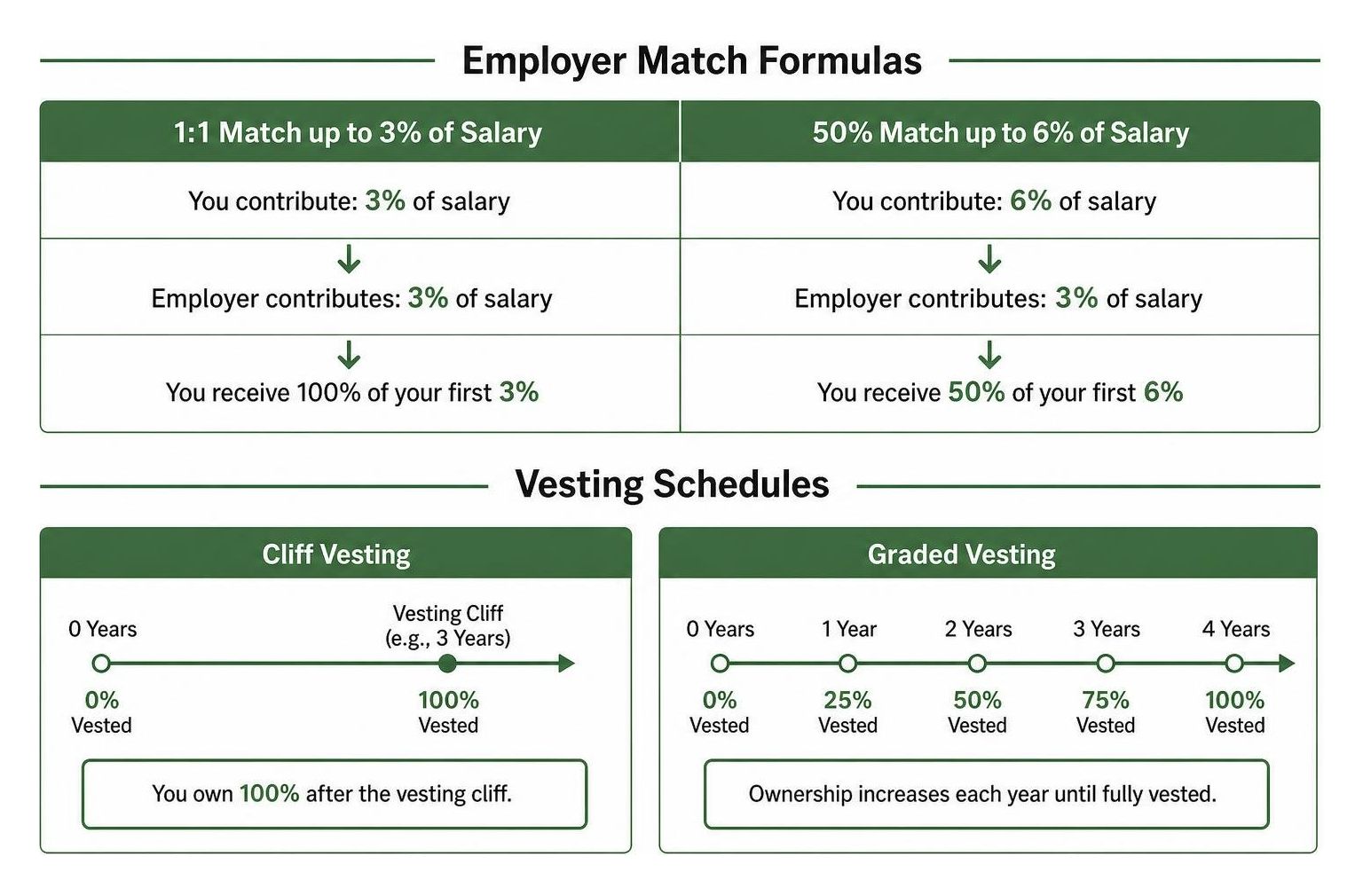
Employer matching dollars may be subject to a vesting schedule governed by ERISA Section 203 and IRC Section 411—either cliff vesting (where you gain 100% ownership after a set period, such as up to 3 years) or graded vesting (where ownership increases incrementally each year, such as over 2 to 6 years). Review your plan’s Summary Plan Description to confirm your plan’s specific vesting schedule.
How 401(k) growth patterns can differ by age
Your savings strategy naturally evolves as you move through different career stages. Younger savers often benefit from a longer time horizon, which allows them to maintain a higher allocation to equities that may experience short-term volatility in exchange for long-term growth potential.

Workers over age 40 often face a different dynamic: their existing balance is larger, meaning investment returns and market downturns have a greater dollar impact on their portfolio than annual contributions alone.
Consistency and 401(k) growth over time
Remaining invested during market pullbacks allows you to practice dollar-cost averaging—buying more investment shares when prices drop and fewer when prices rise. Consistent participation helps eliminate the urge to time the market, which can lead savers to sell during pullbacks and miss subsequent market recoveries.
2026 contribution limits and catch-up provisions
The Internal Revenue Service adjusts retirement contribution ceilings periodically for inflation under IRC Section 402(g). For tax year 2026, the standard employee elective deferral limit under IRS retirement plan contribution guidance is $24,500.
If you are age 50 or older, you can make an additional catch-up contribution of $8,000 under IRC Section 414(v) in 2026, bringing your total annual limit to $32,500. Furthermore, under SECURE 2.0 rules, workers aged 60, 61, 62, and 63 have access to a higher catch-up limit of $11,250 in 2026, for a combined total limit of $35,750. Learning how to maximize 401(k) retirement savings at any age can help you take advantage of these limits as retirement approaches.
The hidden friction: How account fees and plan decisions impact your balance
Investment returns add to your balance, but administrative costs and fund expenses work in the opposite direction. Every dollar paid in fees is a dollar that cannot compound over time.
Plan costs generally fall into two categories: administrative fees (recordkeeping, legal, and trustee costs disclosed under DOL Rule 404(a)(5)) and investment expense ratios charged by underlying mutual funds or exchange-traded funds (ETFs).
Hypothetical Example: Consider a hypothetical initial investment of $100,000 held over an extended horizon. An investment option subject to higher underlying fund fees and administrative expenses creates ongoing fee drag, leaving fewer dollars in the account to compound over time compared to a lower-cost option with minimal expenses. Assumptions: Assumes a hypothetical initial balance held over time with no additional contributions or distributions, comparing higher fee drag against lower fee drag. This illustration is purely educational, does not model specific percentage returns or fund performance, and does not represent any specific investment product.
Traditional vs. Roth tax growth considerations
If your plan allows Roth 401(k) contributions under IRC Section 402A, you can choose between pre-tax and post-tax savings:
- Traditional 401(k): Contributions are made pre-tax, reducing your current taxable income. Investments grow tax-deferred, and withdrawals are taxed as ordinary income in retirement under IRC Section 402.
- Roth 401(k): Contributions are made with after-tax dollars, offering no upfront tax deduction. Qualified distributions in retirement are tax-free if taken after age 59 1/2 and at least five years after the initial contribution, as outlined by the IRS.
Balancing both types may offer tax diversification, allowing you to manage your taxable income bracket once you stop working. Check your Summary Plan Description to confirm if Roth options are available in your workplace plan.
The true cost of early withdrawals and loans
Taking money out of your 401(k) before age 59 1/2 can disrupt compounding. Under IRC Section 72(t), early non-qualified distributions are subject to ordinary income taxes plus a 10% IRS penalty, unless a statutory exception applies.
If your plan permits loans under IRC Section 72(p), you can typically borrow up to 50% of your vested balance or $50,000, whichever is less. While you repay interest to yourself, borrowed funds miss out on potential market growth. If you leave your employer with an outstanding loan balance, the remaining amount is generally treated as a plan loan offset under IRC Section 72(p). Under IRC Section 402(c)(3)(C), you typically have until the federal tax filing deadline (including extensions) for the tax year in which the offset occurred to roll over or repay the balance into an eligible retirement plan, or it becomes a taxable distribution subject to ordinary taxes and applicable penalties. These options are available only if your plan allows them, so check your Summary Plan Description for details.
Projecting your retirement nest egg and applying the 4% rule
To determine if your savings rate is on track, financial planners frequently reference the “4% rule,” an educational heuristic used to illustrate potential initial distribution rates over a 30-year retirement horizon. While formal statutory frameworks govern lifetime income disclosures under DOL regulations in ERISA Section 105 and 29 CFR 2520.105-3, and Required Minimum Distributions under IRC Section 401(a)(9), the 4% benchmark provides a simple educational framework for conceptualizing retirement cash flow alongside official DOL and IRS guidance.
Hypothetical Example: Under DOL and IRS educational planning contexts, consider a hypothetical projected 401(k) balance of $1,000,000 at retirement. Applying the 4% heuristic results in an initial first-year distribution of $40,000, with subsequent annual adjustments designed to account for inflation. Assumptions: This hypothetical illustration assumes a starting balance of $1,000,000, an initial 4% annual withdrawal rate, and a 30-year horizon. It does not reflect actual market performance, plan administrative fees, or income taxes governed by IRC Section 402. The 4% rule is an educational guideline rather than a guarantee, as market volatility, life expectancy, and inflation rates vary.
Estimating your projected 401(k) growth with a calculator
Modeling your future savings requires testing variables such as expected salary changes, contribution rates, and conservative return assumptions. Using a dedicated planning tool allows you to visualize how small increases in your savings rate today can alter your final balance decades from now.
Key takeaways for maximizing your long-term 401(k) growth
- Capture every employer dollar: Always contribute at least enough to receive your full company match if offered.
- Let compounding work: Maintain consistent contributions across market highs and lows.
- Minimize fee drag: Review your plan’s investment options and select low-cost funds where appropriate.
- Leverage catch-up limits: If you are age 50 or older, use statutory catch-up provisions to increase your pre-retirement savings.
- Preserve your capital: Avoid non-essential loans or early withdrawals that remove money from the market.
Frequently asked questions about 401(k) growth
What rate of return should I assume for 401(k) projections?
Return rates vary depending on your portfolio’s asset allocation across equities, fixed income, and cash equivalents, as well as prevailing economic conditions and plan fees. When running hypothetical projections, using conservative return estimates can help provide a more grounded view of your retirement planning. Past performance does not guarantee future results.
How does consistent participation impact 401(k) growth over time?
Contributing regularly ensures that you buy shares continuously across market cycles, which may help smooth out the effects of volatility through dollar-cost averaging. Consistent contributions also expand the total asset base eligible for potential compound growth.
How can I catch up if my 401(k) growth is behind schedule?
You can consider increasing your annual savings rate, directing salary raises toward your plan, reducing high-interest personal debt, and utilizing IRS catch-up contributions if you are age 50 or older. Extending your planned working timeline can also provide additional time for compounding.
Conclusion
Understanding how your 401(k) grows allows you to make informed decisions about your contribution rates, investment choices, and time horizon. The 401(k) Maneuver adviser team at Royal Fund Management operates as an independent fiduciary that manages participant workplace accounts in place.
If you would like a professional second opinion on your workplace account allocation or want to explore personalized fiduciary account management, we invite you to have a no-pressure conversation with a 401(k) Maneuver adviser or see how it works.
Disclosure: This article is provided for informational and educational purposes only and does not constitute individualized investment, legal, or tax advice. Investing involves risk, including the possible loss of principal. Diversification and portfolio rebalancing strategies do not guarantee a profit or protect against loss in declining markets. Consult with a qualified professional before making financial decisions.