


Should Your 401(k) Plan Allow Loans and Hardship Withdrawals? A 401k Loan Provision Guide
Should your 401(k) plan allow loans and hardship withdrawals?
A 401(k) loan provision lets employees borrow from their retirement accounts if your plan allows it. A hardship provision may let them take a withdrawal for a qualifying need, without repaying it. Check your plan’s Summary Plan Description (SPD), which explains the benefits your plan offers.
For employers, the choice is about more than access to cash. Loans call for repayment tracking, often through payroll. Withdrawals can permanently reduce retirement savings. The 401(k) Maneuver team will walk through those trade-offs so you can decide which features fit your workforce and the work your team can manage.
Designing an employer 401(k) loan provision: rules and limits

Plan sponsors are not required by law to offer participant borrowing. According to the Plan Sponsor Council of America’s 2023 Plan Survey, roughly 80% to 90% of defined contribution plans choose to include a loan feature. Employers often adopt these features to encourage participation among workers who might hesitate to lock away savings until age 59½.
When you elect to add a borrowing feature, it must comply with Internal Revenue Code Section 72(p) and Employee Retirement Income Security Act (ERISA) standards. Participants may only borrow if the formal plan document explicitly allows it. Plan sponsors must outline these terms clearly in the plan’s Summary Plan Description (SPD). To ensure compliance, plan administrators rely on official IRS guidance on participant loans.
Some Key statutory limits under a 401(k) loan provision
Federal regulations establish strict caps on how much a worker can borrow from their vested account balance. Under IRS rules, the maximum loan amount cannot exceed the lesser of:
- $50,000, reduced by the highest outstanding loan balance during the prior 12-month period ending on the day before the new loan is originated.
- The greater of 50% of the participant’s vested account balance or $10,000 (if the plan document contains this $10,000 allowance).
The 12-month look-back rule prevents employees from borrowing, repaying, and immediately re-borrowing the full $50,000 cap. For example, if an employee held a peak loan balance of $20,000 over the past 12 months and currently owes $0, their maximum new loan limit against the federal cap is $30,000 ($50,000 minus $20,000), assuming their vested balance supports that amount.
Structuring repayment rules in a 401(k) loan provision
Plan loans must be amortized with substantially level payments made at least quarterly. Most plan sponsors establish automatic payroll deductions on a per-pay-period basis to maintain compliance.
- Standard term: The maximum statutory repayment term is five years.
- Primary residence exception: A loan used to acquire a dwelling unit that will be used within a reasonable time as the principal residence of the participant may extend beyond five years, often up to 15 or 30 years depending on plan design.
- Interest rates: IRS rules require a commercially reasonable interest rate, typically set at the prime rate plus 1% or 2%.
- Tax treatment: Repayments are made with after-tax dollars. The interest paid flows directly back into the participant’s own retirement account.
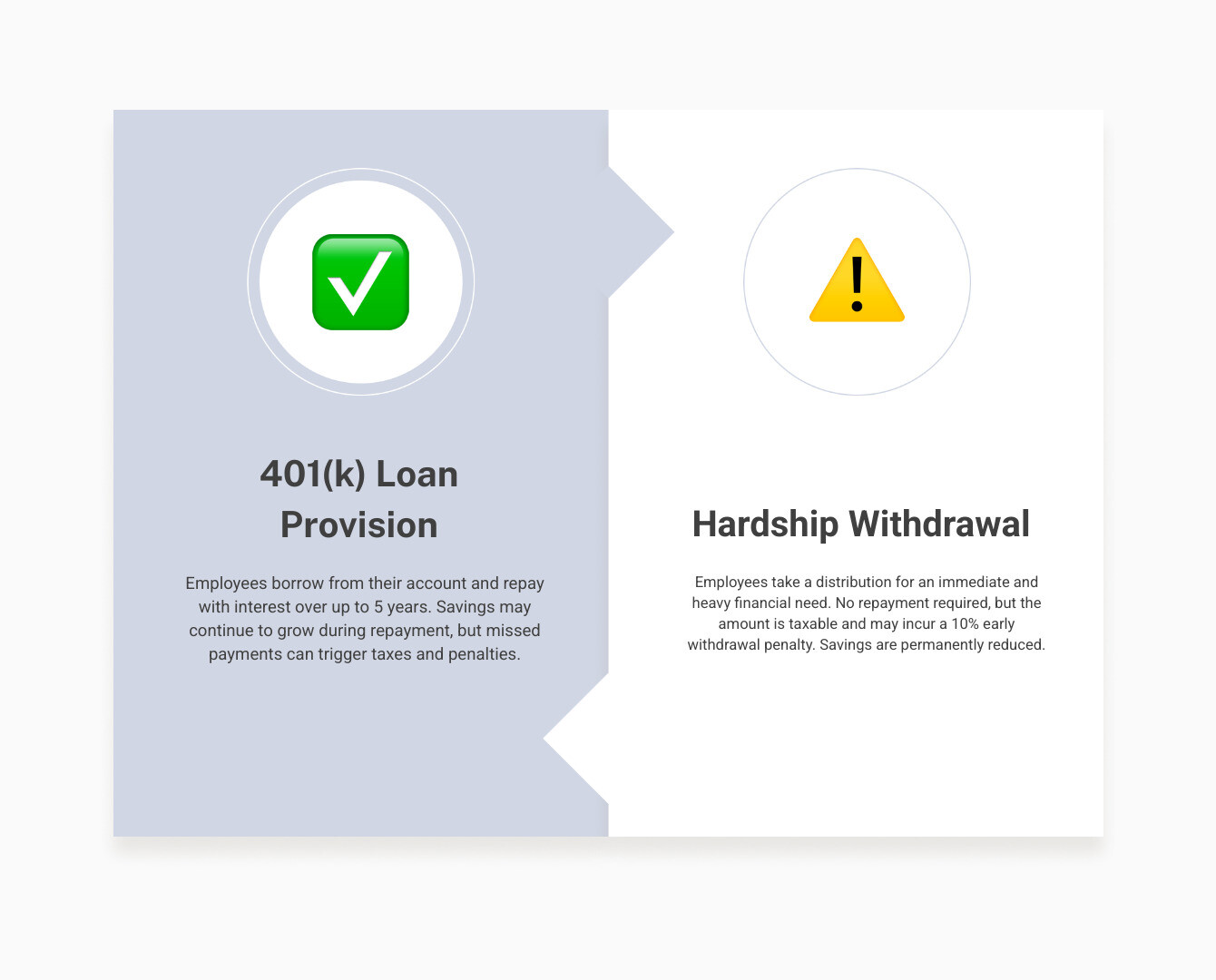
Before offering this feature, we recommend you review the core operational differences between a 401(k) loan and a withdrawal.
Plan governance: establishing a compliant 401(k) loan policy

A successful loan program likely requires an operational 401(k) loan policy. This document functions as a formal guideline alongside your SPD, describing how loans are administered day to day.
Your policy should define:
- Loan frequency and counts: Whether employees may carry only one active loan or up to two or three concurrent loans.
- Minimum loan amounts: Setting a floor, such as $1,000, prevents the administrative burden of micro-loans.
- Spousal consent: If your plan is subject to Qualified Joint and Survivor Annuity (QJSA) rules, written spousal consent may be required for loans over $5,000.
- Leaves of absence: Rules for suspending payments during qualified military leave under the Uniformed Services Employment and Reemployment Rights Act (USERRA) or during non-military unpaid leave for up to one year.
Administrative burden and default management
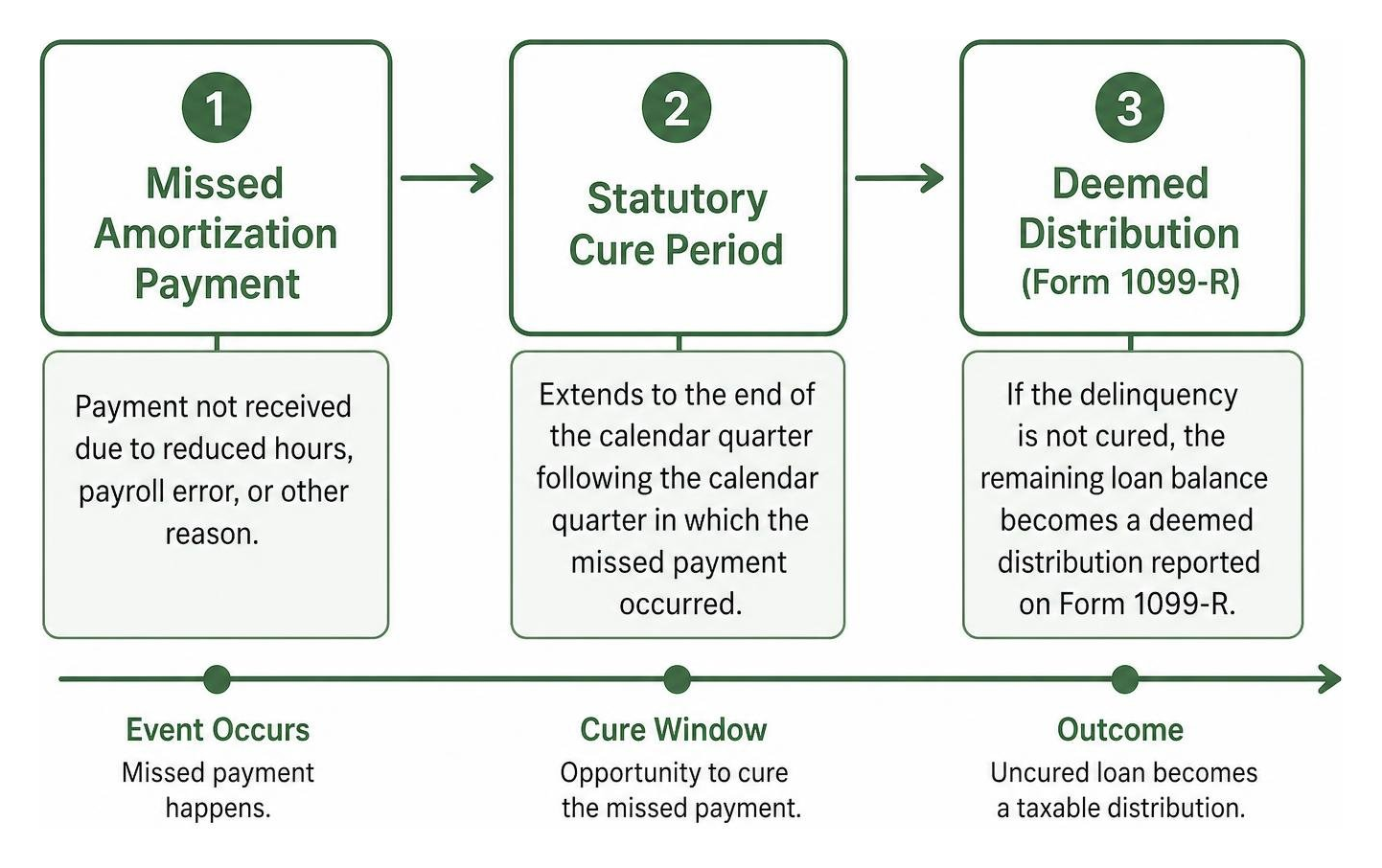
Administering loans requires active oversight between your human resources team, payroll provider, and recordkeeper. When an employee experiences a reduction in hours or an administrative error halts payroll deductions, the loan can fall into arrears.
Plans generally provide a cure period that extends to the end of the calendar quarter following the calendar quarter in which the missed payment occurred. If the participant does not cure the delinquency, the remaining balance becomes a deemed distribution. The plan administrator reports this event to the IRS on Form 1099-R, triggering ordinary income taxes and potentially a 10% early distribution tax for participants under age 59½. Plan sponsors should ensure their team understands these loan repayment rules and default risks.
Job separations and plan offsets
When an employee with an outstanding loan leaves your company, plan terms dictate the next steps. Most plans accelerate the balance upon termination. If the worker cannot repay the remaining amount, the unpaid portion becomes a plan loan offset.
Under the Tax Cuts and Jobs Act, participants who experience a qualified plan loan offset have until the due date of their federal income tax return (including extensions) for the tax year in which the offset occurred to roll over the amount into an IRA or another eligible retirement plan, as detailed in IRS guidance on plan loan offsets. Plan sponsors can educate departing workers on what happens when leaving a job with an outstanding loan to help them avoid unintended tax distributions.
Evaluating a 401(k) hardship provision vs. loan features
A 401(k) hardship provision allows participants to take an in-service distribution if they face an immediate and heavy financial need. Unlike a loan, a hardship distribution is permanently removed from the account and cannot be paid back through payroll deductions.
IRS safe harbor rules recognize specific events for hardship withdrawals, including:
- Certain medical expenses for the employee, spouse, or dependents.
- Costs directly related to the purchase of a principal residence (excluding mortgage payments).
- Tuition and related educational fees for up to 12 months of post-secondary education.
- Payments necessary to prevent eviction from, or foreclosure on, a principal residence.
- Funeral or burial expenses.
- Certain expenses for the repair of damage to the employee’s principal residence resulting from a casualty.
| Feature | 401(k) Plan Loan | 401(k) Hardship Distribution | SECURE 2.0 Emergency Distribution |
|---|---|---|---|
| Repayment Required? | Yes, amortized via payroll | No, funds cannot be repaid | Optional; up to 3 years |
| Federal Limit | Lesser of $50,000 or 50% vested balance | Amount necessary to satisfy need | Up to $1,000 per calendar year |
| Early Distribution Tax | None (if kept in good standing) | Subject to 10% tax if under 59½ (unless exception applies) | Exempt from 10% early distribution tax |
| Payroll Setup | Ongoing deduction schedules | One-time processing | One-time distribution; optional re-contribution tracking |
Under SECURE 2.0 provisions effective January 1, 2024, plan sponsors may also adopt an emergency personal expense distribution feature. This provision allows participants to withdraw up to $1,000 once per calendar year for unforeseeable personal emergencies, with self-certification permitted under IRS Notice 2024-55 guidance.
While withdrawals offer immediate financial relief, they create retirement leakage. When employees remove capital from their portfolios, they may sacrifice potential market growth and compound returns over time. Employers should consider how borrowing may affect long-term retirement savings growth when selecting plan access provisions. Investing can involve risk of loss, and diversification or rebalancing does not guarantee profit or protect against loss.
Key takeaways for plan sponsors
- Participation incentives: Offering a loan feature can increase plan enrollment by reassuring employees that their money remains accessible in emergencies.
- Administrative responsibilities: Loans require ongoing tracking, payroll adjustments, and default management.
- Leakage risks: Hardship distributions provide immediate cash relief for qualifying needs but permanently decrease account balances.
- Plan design control: Sponsors can limit participants to a single outstanding loan or establish cooling-off periods to encourage responsible borrowing.
- Modern alternatives: SECURE 2.0 emergency distributions offer smaller, penalty-free access points with lower operational overhead.
Frequently asked questions about plan loans and withdrawals
Can an employer limit the number of active 401(k) loans?
Yes. Plan sponsors have discretion to determine how many concurrent loans a participant may hold, subject to plan document terms. Many employers enforce a single-loan policy or require a 30-day cooling-off period between payoff and a new application to simplify payroll administration.
How do SECURE 2.0 emergency withdrawals compare to a 401(k) loan provision?
SECURE 2.0 allows plans to offer emergency personal expense distributions up to $1,000 per year without the 10% early distribution tax. Unlike standard loans, these require no scheduled payroll repayments, though participants have up to three years to voluntarily repay the distribution into an eligible plan.
What happens if an employee defaults on a plan loan?
If an employee fails to cure a missed payment within the plan’s cure period, the outstanding balance is treated as a deemed distribution. The amount becomes subject to ordinary income taxes and potentially a 10% early distribution penalty for participants under age 59½. Plan loan defaults do not affect consumer credit scores because 401(k) balances are not reported to credit bureaus.
Conclusion
Evaluating whether to include a loan provision, hardship withdrawals, or new emergency distribution options involves balancing employee benefits with administrative capacity. While access to funds can encourage plan participation, managing loan schedules and preventing defaults requires consistent administrative attention.
For employers looking to streamline plan management and fiduciary duties, exploring a pooled employer plan (PEP) can be a helpful step. A PEP may shift certain day-to-day administrative tasks to dedicated professionals while giving your employees access to institutional retirement services. To learn more about how plan design and professional management work together, explore our pooled employer plan resources.
Disclosure: 401(k) Maneuver is a business name of Royal Fund Management, LLC, an SEC-registered investment adviser. This article is provided for educational and informational purposes only and does not constitute legal, tax, or individual investment advice. Plan sponsors should consult their ERISA counsel, third-party administrator, or tax professional regarding specific plan documents and operational compliance. Investing involves risk of loss, and diversification or rebalancing does not guarantee profit or protect against loss.