

Common 401k Investment Options Explained: Target-Date, Index, Stable Value and More
How to compare 401(k) investment options
Your 401(k) investment options may include stock funds, bond funds, target-date funds, and stable value or money market funds. Some plans also offer company stock or a brokerage window. Start with your plan’s investment menu. Compare what each choice holds, how much its value may change, and its expense ratio—the yearly cost of owning the fund. Then choose a mix that fits your time until retirement and your comfort with market swings.
A target-date fund manages that mix for you; choosing individual funds gives you more control. Either way, check where your contributions are invested. Your plan’s default choice may not fit your goals.
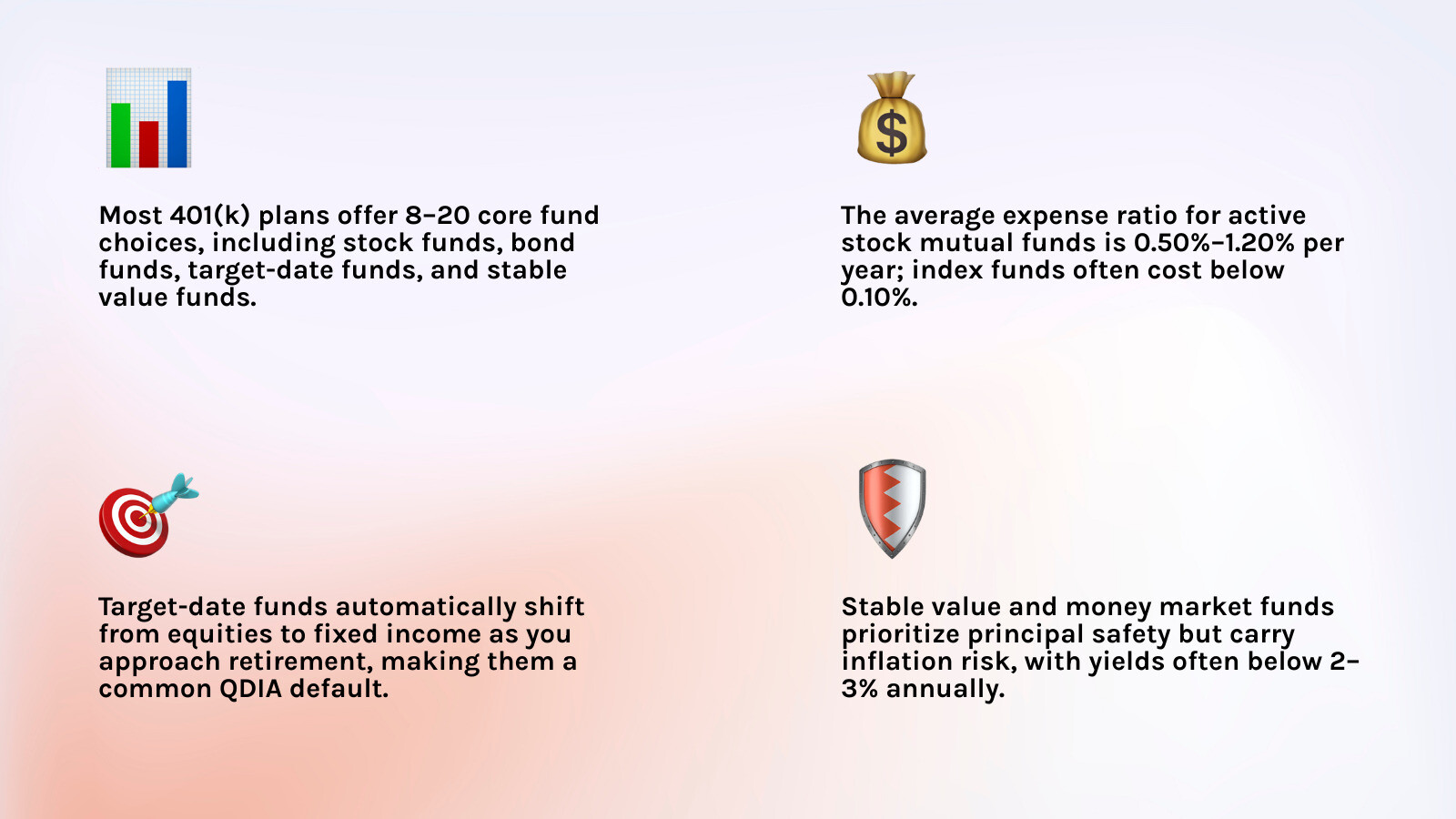
Overview of core 401(k) investment options on your workplace menu
Most employer-sponsored plans offer a curated list of around 30 investment choices. These menus generally center on three foundational asset classes: equities (stocks), fixed income (bonds), and capital preservation funds (such as stable value or money market options).
Each asset class serves a distinct role in balancing potential investment growth against volatility risk. Understanding the differences among these fund categories can help you build a portfolio suited to your personal timeline and comfort with market swings. Investing involves risk, including the possible loss of principal, and diversification does not guarantee a profit or protect against loss in a declining market.
| Fund Category | Primary Objective | Typical Risk Level | Growth Potential | Fee Range (Expense Ratio) |
|---|---|---|---|---|
| Stock / Equity Funds | Long-term capital growth | Moderate to High | High | 0.01% – 1.50%+ |
| Bond / Fixed-Income Funds | Steady income generation | Low to Moderate | Moderate | 0.03% – 0.85% |
| Stable Value / Money Market | Capital preservation | Very Low | Minimal | 0.10% – 0.60% |
| Target-Date Funds | Age-based asset mix | Moderate (shifts over time) | Moderate to High | 0.08% – 0.95% |
Equities and stock funds for long-term growth
Stock funds, or equity funds, pool your money to purchase shares of ownership in publicly traded corporations. Because businesses can expand their revenues and profits over time, equities have historically offered growth potential, although they also carry higher short-term price fluctuations.
Workplace menus often categorize stock funds by market capitalization (company size) and region:
- Large-Cap Funds: Invest in major corporations, generally defined as companies with market capitalizations of $10 billion or more. These often provide relative stability compared to smaller firms.
- Mid-Cap and Small-Cap Funds: Target medium and smaller emerging businesses. These funds can offer growth potential, but they typically experience higher volatility.
- International / Emerging Market Funds: Hold shares in foreign companies across developed and developing nations, offering geographic diversification outside the U.S. economy.
Fixed-income and bond funds for steady income
Bond funds invest in debt securities issued by corporations, municipalities, or the U.S. government. When you invest in a bond fund, you are effectively lending money to these entities in exchange for regular interest payments.
Fixed-income holdings may help stabilize an equity-heavy portfolio because bond prices often move differently than stock prices. However, bond values remain sensitive to interest rate shifts; when market interest rates rise, existing bond prices typically decline.
Stable value and money market funds for capital preservation
Stable value funds and money market funds are designed to help preserve your original principal balance. Money market funds invest in high-quality, short-term debt instruments, while stable value funds combine short-to-medium-term bonds with synthetic insurance contracts designed to help protect principal from market drops.
While these preservation options provide liquidity and may offer peace of mind during turbulent markets, they carry inflation risk. Over multi-decade periods, returns on cash-equivalent funds may not keep pace with the rising cost of living. Employers often review regulatory guidance from the Department of Labor on investing retirement plan assets to help ensure appropriate conservative options appear on participant menus.
Hands-off vs. hands-on choices: target-date, asset allocation, and specialty funds
Retirement plan providers offer diverse investment formats designed for varying levels of investor involvement. Some plan participants prefer an all-in-one hands-off fund, while others seek personalized control over their asset mix.
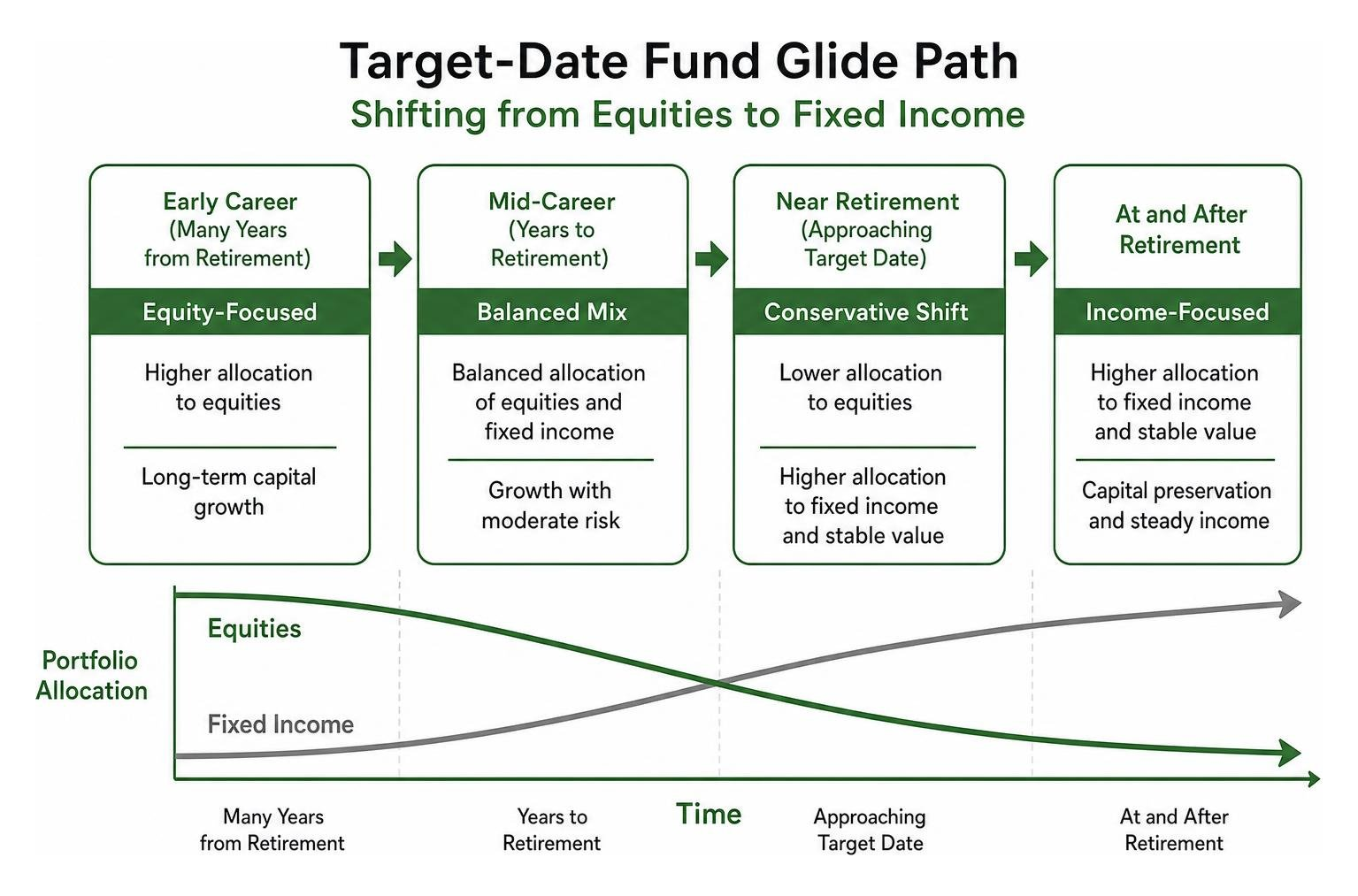
Target-date funds and asset allocation funds as packaged 401(k) investment options
Target-date funds (TDFs) are common Qualified Default Investment Alternatives (QDIAs) in workplace plans. When you are auto-enrolled without making an active selection, your contributions are often directed into a TDF matched to your projected retirement year (for example, a Target 2055 Fund).
A TDF uses an automated glide path that gradually shifts its portfolio from aggressive equities to conservative bonds as you near your target date. While convenient, TDFs apply a generalized approach based strictly on age rather than your personal financial situation or outside assets. You can review how target-date funds work and their trade-offs before deciding if an all-in-one fund aligns with your retirement timeline.
Asset allocation funds operate similarly but maintain a static risk profile (such as “Conservative Growth” or “Aggressive Allocation”) rather than shifting over time based on a target year.
Specialty, sector, and company stock funds
Some 401(k) plans feature specialized options focused on specific industries, such as technology, healthcare, energy, or real estate. While sector funds allow you to emphasize particular economic areas, they carry concentration risk and can experience steep drops during sector-specific downturns.
Employer stock funds allow participants to purchase shares of their own employer. Holding too much company stock can leave your retirement savings heavily tied to the financial health of the business that also provides your paycheck.
Self-directed brokerage windows for broader 401(k) investment options
If your plan offers a self-directed brokerage window (sometimes called a PCRA), you can move a portion of your retirement savings into a wider investment universe. This window can grant access to thousands of individual stocks, exchange-traded funds (ETFs), and individual bonds beyond your plan’s standard core menu. Brokerage windows carry additional transaction fees and require active personal oversight.
Passive vs. active: understanding index funds and expense ratios
Behind every fund is an investment strategy: passive tracking or active management. Understanding the distinction helps you evaluate what you are paying for in your account.
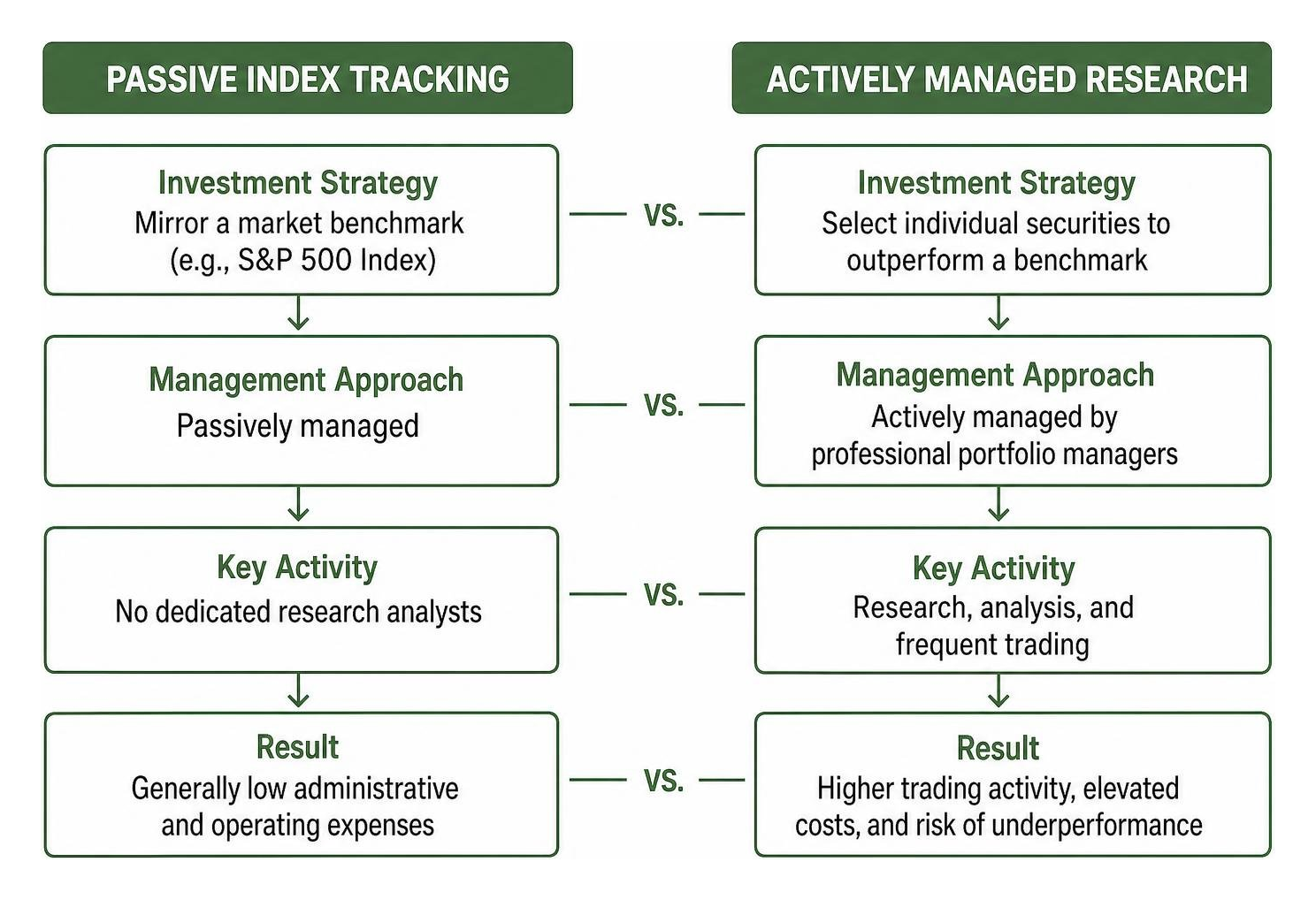
Index funds vs. actively managed mutual funds
Index funds are passively managed vehicles designed to mirror the performance of a specific market benchmark, such as the S&P 500 Index or the Bloomberg U.S. Aggregate Bond Index. Because they do not require dedicated teams of research analysts, index funds generally carry very low administrative and operating expenses.
Actively managed mutual funds rely on professional portfolio managers who select individual securities with the goal of outperforming a benchmark index. Active management can provide tactical shifts during shifting economic conditions, but it brings higher trading activity, elevated operational costs, and the risk that the manager underperforms their benchmark.
How expense ratios and plan fees impact retirement savings
An expense ratio represents the annual percentage of fund assets deducted to cover management, administrative, and marketing costs. For example, an expense ratio of 1% equates to $10 annually for every $1,000 invested, whereas an ultra-low index fund charging 0.05% costs $0.50 per $1,000.
Because investment returns compound over decades, ongoing fund fees can reduce total account accumulation. You can read our guide on how 401(k) expense ratios work to evaluate your plan menu. The Department of Labor also offers helpful tips on using retirement plan fee disclosures to locate Total Annual Operating Expenses (TAOE) on your statements.
How to evaluate and align your investment mix by age and risk tolerance
Selecting your 401(k) investment options requires balancing your time horizon until retirement against your emotional ability to endure market drops.
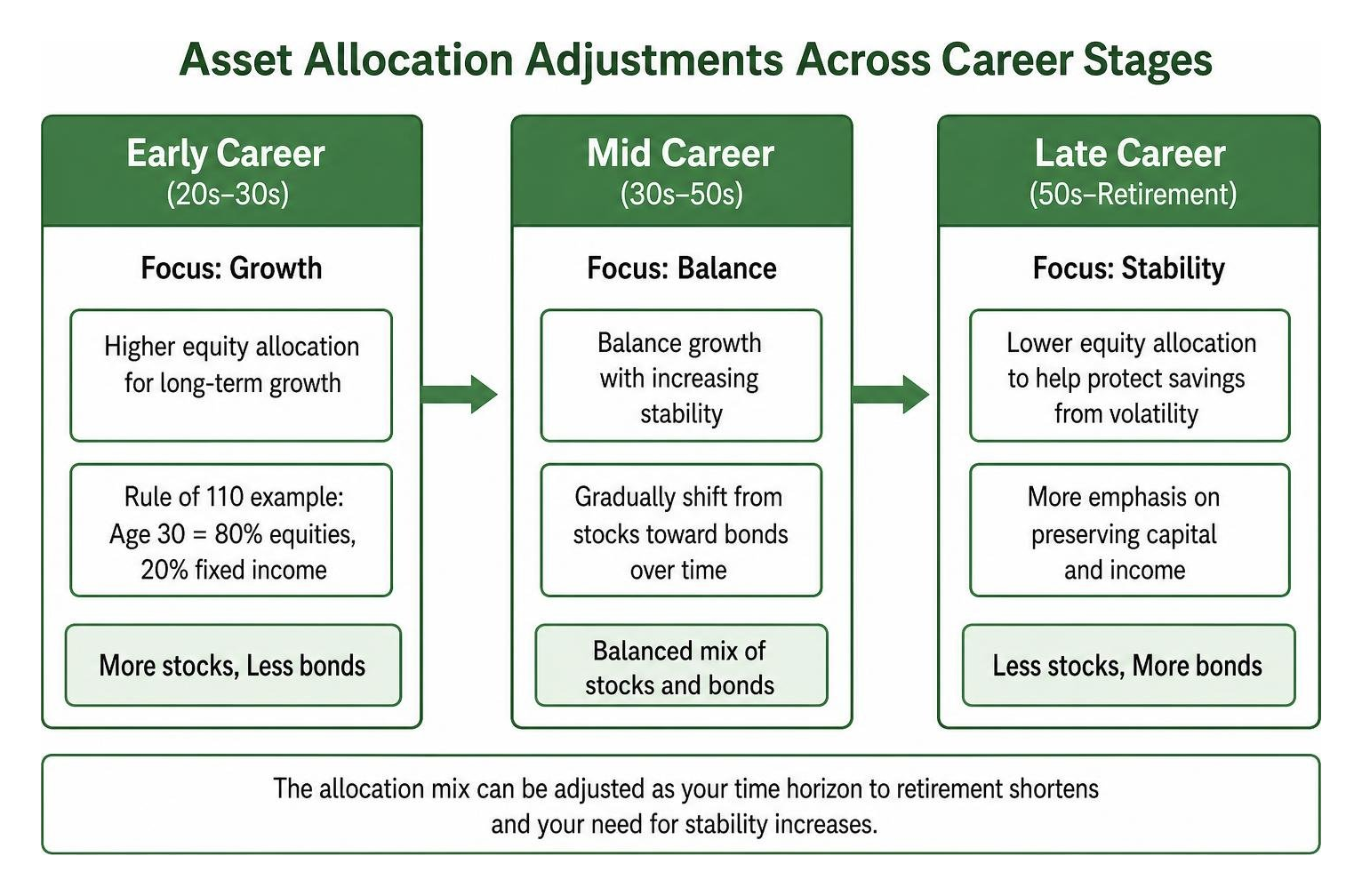
Determining your stock versus bond allocation
A traditional rule of thumb is the “Rule of 110” (or 120, reflecting longer life expectancies). Subtract your current age from 110 to find a baseline equity target percentage:
- Age 30: 110 – 30 = 80% equities, 20% fixed income
- Age 40: 110 – 40 = 70% equities, 30% fixed income
- Age 55: 110 – 55 = 55% equities, 45% fixed income
While rules of thumb offer an initial reference point, life stages and risk capacity vary. Younger savers have decades to recover from market drawdowns, whereas pre-retirees generally prioritize capital preservation to mitigate the risk of a market drop right before retirement. Implementing regular 401(k) portfolio rebalancing can keep your intended stock-to-bond ratio aligned as markets move.
Steps to review and update your 401(k) portfolio
- Log in to your plan provider portal: Locate your recordkeeper account and view your current fund positions.
- Review fund codes and summaries: Look past obscure ticker codes to identify the underlying asset class, historical performance over 1-, 5-, and 10-year periods, and the expense ratio.
- Set future contribution allocations: Choose how newly deducted payroll dollars will be distributed across your chosen funds.
- Rebalance existing balances: If your current asset weights have drifted, execute an exchange or rebalance transaction to reset your portfolio to target percentages.
- Schedule an annual review: Mark your calendar to assess your holdings at least once a year or following major life milestones.
Key takeaways on workplace fund choices
- Know Your Asset Classes: Balance equities for growth, fixed income for income, and stable value options for capital preservation.
- Watch the Expense Ratios: Opt for lower-cost funds where appropriate to minimize compounding fee drag on your savings.
- Evaluate Default Funds Carefully: Target-date funds offer hands-off convenience, but their generalized glide paths may not match your full financial picture.
- Adjust by Life Stage: Shift asset allocation over time to reflect your approaching retirement date and evolving risk tolerance.
- Review Regularly: Check your holdings periodically to rebalance drifted allocations and verify your selections remain aligned with your goals.
Frequently asked questions about 401(k) investment options
How often can I change my 401(k) investments?
Most workplace plans allow participants to change investment elections or reallocate existing balances daily or monthly online. However, some mutual funds impose short-term redemption fees or transfer restrictions if trades occur too frequently. Reviewing and rebalancing on a quarterly or annual basis is generally sufficient for long-term retirement accounts.
How do employer matches affect my 401(k) savings?
If your employer offers a match, contributing enough to receive the full available match may help you make the most of that part of your compensation. Check your plan’s Summary Plan Description for specific matching formulas and vesting schedules, and review the current IRS 401(k) contribution guidelines for applicable annual salary deferral and compensation limits.
How can I protect my 401(k) from market volatility and crashes?
No strategy can guarantee a profit or fully protect against market loss. However, broad diversification across uncorrelated asset classes—such as domestic stocks, foreign equities, government bonds, and cash preservation funds—can help buffer a portfolio against severe downturns in any single market sector.
Conclusion
Navigating your workplace retirement plan begins with understanding the distinct fund choices on your menu. By comparing equity funds, fixed-income holdings, and capital preservation options alongside their expense ratios, you can select an investment mix that supports your retirement goals.
If you prefer personalized, hands-off fiduciary oversight for your workplace retirement account, learn how our independent 401(k) management service works. The 401(k) Maneuver team provides professional, human-run account management—offering quarterly personalized rebalancing, downside-risk control, and fee management directly within your existing workplace plan. Contact a 401(k) Maneuver adviser at 1-877-218-5060 to start a conversation about your retirement account today.
Disclosure: 401(k) Maneuver is a business name of Royal Fund Management, LLC, an SEC-registered investment adviser. This article is strictly for educational purposes and does not constitute individualized investment, legal, or tax advice. Investing involves risk, including the possible loss of principal. Past performance does not guarantee future results. Diversification and rebalancing strategies do not ensure a profit or protect against loss in declining markets.