

401(k) Early Withdrawal Penalty: How It Works and Common Exceptions
How the 401(k) early withdrawal penalty works
If you take money from a 401(k) before age 59½, you may owe a 10% additional federal tax on the taxable amount, plus ordinary income tax. For example, a hypothetical $20,000 withdrawal from a traditional 401(k) could mean $2,000 in additional tax, before income taxes. IRS rules provide exceptions, but taking a withdrawal for a hardship does not, by itself, remove the 10% tax.
Exceptions may apply if you leave your employer in or after the year you turn 55, have a qualifying disability or medical expense, or meet the rules for certain emergency, birth, or adoption distributions. If your plan allows withdrawals, check its Summary Plan Description before requesting one. This guide explains the tax, the common exceptions, and what to consider before taking money out.
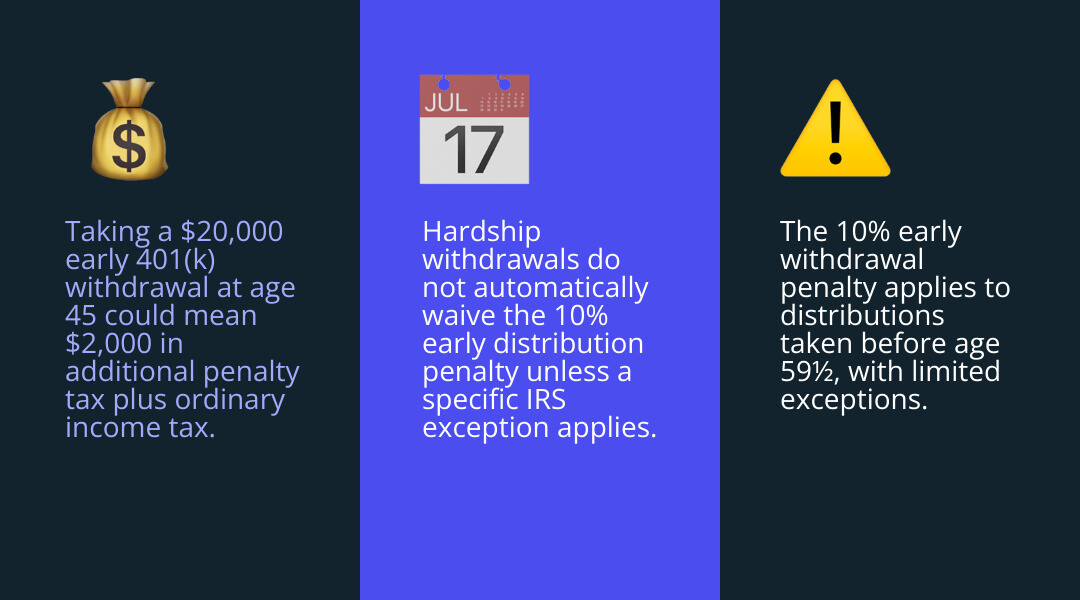
How the 401(k) early withdrawal penalty and taxation work

When you contribute to a traditional 401(k), your contributions go in on a pre-tax basis. This reduces your current taxable income and defers taxes until retirement. In exchange for this upfront tax break, the Internal Revenue Service requires you to keep these funds invested until you reach age 59½.
Taking an early distribution triggers two distinct tax layers: regular income tax and an early distribution tax. The 401(k) early withdrawal penalty adds an additional 10% tax on top of your standard marginal rate, according to IRS rules on retirement distributions. Because the distribution counts as taxable income, it can also push part of your earnings into a higher federal income tax bracket for that tax year.
Mandatory federal withholding vs. actual tax liability
When you request a lump-sum early distribution from a workplace retirement plan, federal law requires the plan administrator to withhold a mandatory 20% for federal income taxes. This withholding is not your final tax bill—it is simply a prepayment sent to the IRS.
If your marginal federal tax rate is 22% and you owe the 10% penalty, your total federal liability is 32%. The 20% withheld at the time of distribution will not cover the full amount owed, meaning you may owe additional taxes when filing your Form 1040. In addition, state and local income taxes may apply depending on where you reside.
Hypothetical breakdown: calculating the 401(k) withdrawal penalty
To see how these costs combine, consider the following hypothetical scenarios. These examples assume an employee in the 22% federal income tax bracket who takes an unqualified early distribution subject to both income taxes and the 10% penalty (excluding state taxes):
| Gross Withdrawal Amount | Mandatory 20% Withholding | 10% Early Distribution Penalty | Estimated Federal Income Tax (22%) | Estimated Net Cash Received | Total Estimated Tax & Penalty |
|---|---|---|---|---|---|
| $10,000 | $2,000 | $1,000 | $2,200 | $6,800 | $3,200 |
| $20,000 | $4,000 | $2,000 | $4,400 | $13,600 | $6,400 |
| $25,000 | $5,000 | $2,500 | $5,500 | $17,000 | $8,000 |
| $50,000 | $10,000 | $5,000 | $11,000 | $34,000 | $16,000 |
Note: This hypothetical illustration is provided for educational purposes only. Individual tax situations, state taxes, and final liabilities vary.
Understanding these aggregate costs can help you evaluate how to avoid 401(k) withdrawal penalties before finalizing any distribution.
Some Major exceptions to early distribution penalties
The tax code includes specific statutory exceptions that allow you to access retirement funds before age 59½ without paying the additional 10% tax. While these distributions remain subject to ordinary income taxes, qualifying for an exception waives the penalty.
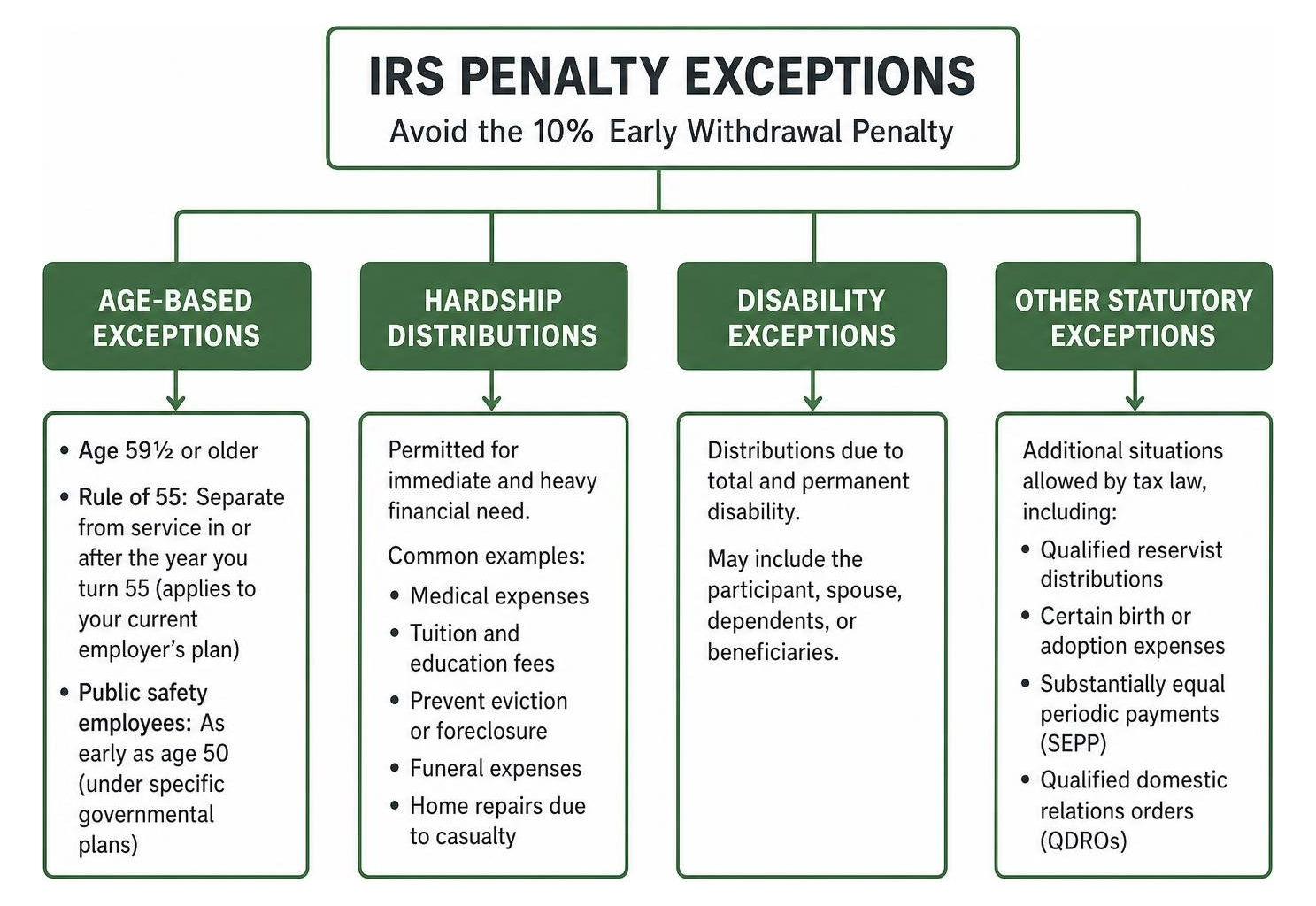
How the Rule of 55 waives the 401(k) early withdrawal penalty
Under the Rule of 55, you can take penalty-free distributions from your 401(k) if you separate from service with your employer in or after the calendar year you turn 55. As detailed in IRS Publication 575, this exception applies specifically to workplace retirement plans from the employer you just left.
This rule does not apply to Individual Retirement Accounts (IRAs) or to 401(k) accounts from previous employers unless they have been consolidated into your current plan prior to separation. Public safety employees, such as law enforcement officers and firefighters, may qualify for this exception as early as age 50 under specific governmental plans.
Qualifying exceptions to the 401(k) early withdrawal penalty

Several other circumstances qualify for penalty relief under Section 72(t) of the Internal Revenue Code:
- Total and permanent disability: Distributions taken after you become totally and permanently disabled as determined by a physician.
- Unreimbursed medical expenses: Distributions used to pay unreimbursed medical expenses that exceed 7.5% of your adjusted gross income (AGI) for the tax year.
- Qualified reservist distributions: Distributions made to military reservists called to active duty for at least 179 days.
- Substantially Equal Periodic Payments (SEPP): A series of scheduled payments calculated over your life expectancy under IRS Rule 72(t).
Expanded relief under the SECURE 2.0 Act
The SECURE 2.0 Act introduced several new penalty-free distribution options for workplace retirement plans. The provisions below generally apply to distributions made after December 31, 2023, though plan adoption timing and plan-specific rules may vary:
- Emergency personal expenses: Eligible participants may withdraw up to $1,000 per calendar year for unforeseen personal emergencies without the 10% tax (if your plan allows it). You can repay this amount within three years.
- Qualified birth or adoption: You may withdraw up to $5,000 per child penalty-free for expenses related to birth or legal adoption.
- Federally declared disasters: Eligible participants in federally declared disaster areas can withdraw up to $22,000 penalty-free for disaster recovery.
- Domestic abuse victims: Eligible survivors of domestic abuse can withdraw up to $10,000 or 50% of their vested account balance, whichever is less.
Hardship distributions and plan loans
If you face urgent financial needs, your plan may offer options such as hardship distributions or plan loans. These features depend on your specific plan design, so check your Summary Plan Description to confirm availability.
Reviewing 401(k) hardship withdrawals helps clarify which expenses qualify under IRS rules.
Hardship withdrawals vs. standard early distributions
An IRS hardship withdrawal is allowed only for an immediate and heavy financial need, and the amount is limited strictly to what is necessary to meet that need. Standard qualifying safe harbor reasons include:
- Certain medical expenses
- Costs related to purchasing a primary residence (excluding mortgage payments)
- Post-secondary tuition and educational fees
- Payments necessary to prevent eviction or foreclosure on a primary residence
- Funeral and burial expenses
- Certain home repairs resulting from casualty losses
A hardship distribution satisfies plan rules to let you access funds while still employed, but it does not automatically waive the 10% penalty. Unless you independently meet a statutory tax exception (such as high medical expenses), you will owe both ordinary income tax and the 10% penalty on the withdrawn amount.
401(k) loans as a non-taxable alternative
If you need liquidity, evaluating the difference between a 401(k) loan and withdrawal can help protect your savings. A loan is not considered a taxable distribution as long as it follows federal rules and is repaid on schedule.
Under federal limits, you may borrow up to 50% of your vested account balance or $50,000, whichever is less (or up to $10,000 if your balance is smaller, if permitted by the plan).
| Feature | 401(k) Plan Loan | Early 401(k) Withdrawal |
|---|---|---|
| Tax Impact | None, if repaid on schedule | Taxed as ordinary income |
| 10% Penalty | No | Yes, unless an exception applies |
| Repayment Requirement | Yes, typically within 5 years | No repayment required |
| Interest Rate | Set by plan (typically Prime + 1–2%) | N/A |
| Interest Destination | Paid back into your own account | N/A |
| Default Risk | Unpaid balance becomes taxable distribution | Immediate tax liability |
The long-term cost of withdrawing retirement funds early
Taking an early distribution removes capital from the market, ending the compounding process that drives long-term portfolio growth.
Opportunity cost and lost compound growth
When funds are distributed early, you lose both the initial principal and all future compound earnings.
For example, consider a hypothetical $25,000 withdrawal taken at age 40. Assuming a hypothetical 7% average annual return and no additional contributions, that $25,000 could have grown to approximately $135,686 by age 65 if left invested. Withdrawing early permanently reduces the total assets available to generate retirement income.
Note: This hypothetical example is for illustrative purposes only and does not represent any specific investment or account performance. Investing involves risk of loss, and past performance does not guarantee future results.
Practical alternatives to accessing retirement cash
Before initiating an early distribution, consider exploring other sources of liquidity:
- Dedicated emergency savings: Using short-term cash reserves can help prevent tax liabilities and preserve retirement assets.
- Home equity lines of credit (HELOC): For homeowners, borrowing against equity may offer lower interest rates without triggering tax events.
- Personal loans or bridge financing: Fixed-rate consumer loans can cover short-term gaps without depleting investment balances.
- Budget adjustments: Temporarily reducing discretionary spending can help manage cash flow without altering retirement plans.
Tax reporting and special expatriate considerations
All distributions from workplace retirement plans must be reported properly to the IRS to ensure accurate tax assessment.
Filing IRS Form 5329 for penalty exceptions
Your plan administrator will report your distribution to you and the IRS using Form 1099-R. Box 7 of this form contains a distribution code indicating whether the distribution is normal, early with no known exception, or early with an exception.
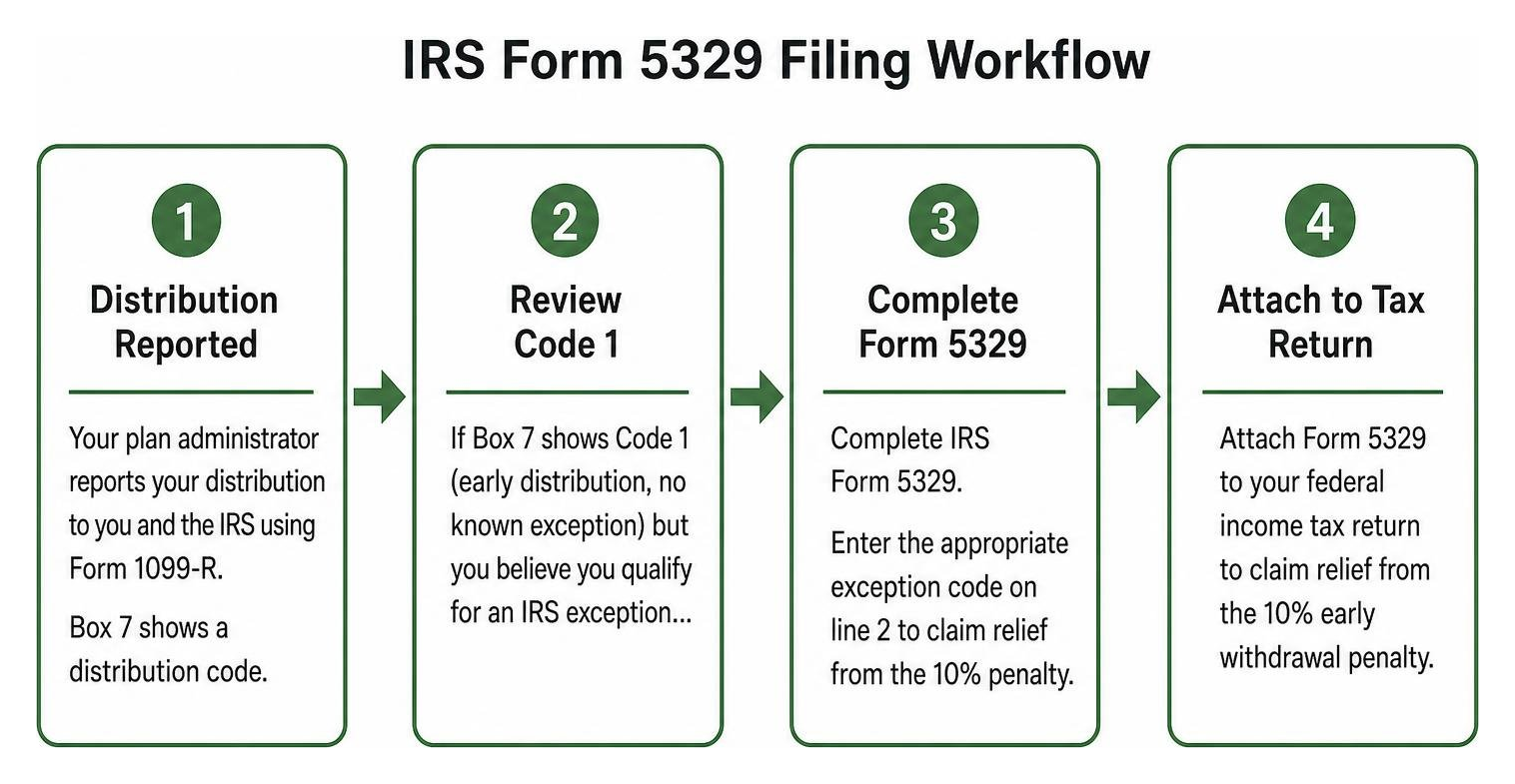
If your Form 1099-R shows Code 1 (early distribution, no known exception), but you qualify for an IRS exception, you must complete and attach IRS Form 5329 to your federal income tax return. You will enter the appropriate exception code on line 2 of Form 5329 to claim relief from the 10% penalty.
Tax rules for U.S. expats withdrawing retirement assets
U.S. citizens living abroad remain subject to U.S. tax laws on worldwide income, including 401(k) distributions. The 10% early withdrawal penalty applies regardless of your country of residence unless an exception is met.
Expats must also consider local tax laws in their country of residence. Depending on applicable Double Taxation Agreements (DTAs), distributions may be taxed locally as foreign pension income. Nonresident aliens receiving distributions generally face a standard 30% federal withholding tax unless a bilateral tax treaty provides a lower rate.
Key takeaways on early 401(k) withdrawals
- Base penalty: Distributions taken before age 59½ generally incur a 10% early distribution penalty in addition to ordinary federal and state income taxes.
- Mandatory withholding: Workplace plans must withhold 20% for federal taxes on lump-sum distributions, which may not cover your total tax bill.
- The Rule of 55: Leaving your employer in or after the calendar year you turn 55 allows penalty-free distributions from that specific employer’s plan.
- Hardships still face taxes: An approved hardship distribution allows access to funds but does not waive the 10% penalty unless a statutory IRS exception applies.
- SECURE 2.0 relief: New rules allow limited penalty-free withdrawals for personal emergencies (up to $1,000), qualified birth/adoption expenses (up to $5,000), and disasters (up to $22,000).
Frequently asked questions about 401(k) distributions
What is the penalty to cash out 401(k) funds before age 59½?
The standard early distribution penalty is 10% of the taxable amount withdrawn. This fee is paid directly to the IRS and applies on top of your standard federal and state income taxes.
Do hardship withdrawals automatically waive early distribution penalties?
No. An approved plan hardship allows you to take a distribution while actively employed, but it does not eliminate the 10% penalty. You will still owe ordinary income tax and the 10% tax unless you independently qualify for an IRS exception, such as deductible medical expenses.
How do Substantially Equal Periodic Payments (SEPP) avoid penalties?
Under IRS Rule 72(t), a SEPP arrangement allows you to receive penalty-free distributions before age 59½ by taking equal annual payments based on your life expectancy. As explained in IRS Publication 590-B, you must continue these payments for at least five consecutive years or until you reach age 59½, whichever period is longer. Modifying the payment schedule early can trigger retroactive penalties and interest on all prior distributions.
Conclusion
Managing workplace retirement assets involves balancing short-term liquidity needs with long-term retirement security. Understanding how penalties and taxes apply helps you avoid unintended costs and preserve your savings.
If you have questions about managing your account allocations, adjusting for market risk, or evaluating withdrawal strategies, our team is here to help. You can learn how 401(k) Maneuver works for independent fiduciary guidance tailored to your workplace plan.
Disclosure: 401(k) Maneuver is a business name of Royal Fund Management, LLC, an SEC-registered investment adviser. This article is provided for educational and informational purposes only and does not constitute personalized tax, legal, or investment advice. Investing involves risk of loss, and past performance is no guarantee of future results. Consult a qualified tax professional or financial adviser regarding your specific situation.