

How Much Should You Contribute to Your 401(k)?
How much should you contribute to your 401(k)?
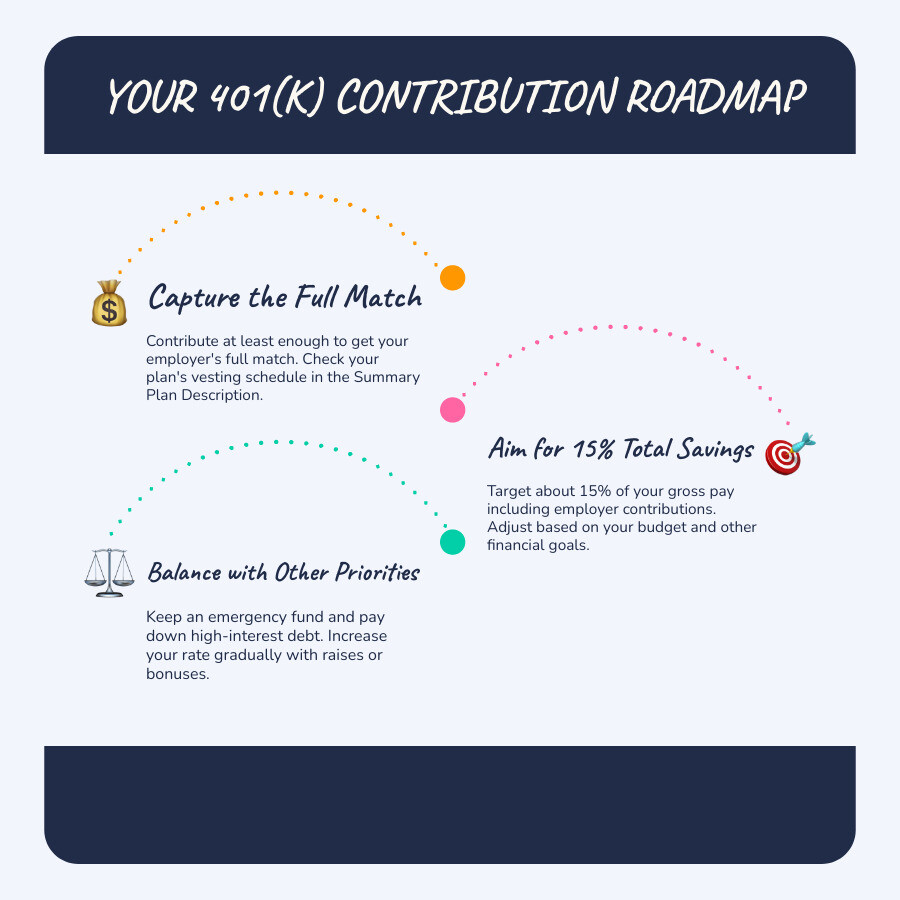
If you’re asking, “How much should I contribute to my 401(k)?” start with enough to get your employer’s full match, if one is offered. From there, aim to save about 15% of your gross pay for retirement, including employer contributions. That’s a planning guideline, not a requirement. The right rate is one you can keep up while covering your other needs.
If 15% does not fit your budget, start with what you can afford. Make room for emergency savings and high-interest debt payments, then consider raising your contribution after a pay increase. You can use the 401(k) calculator to compare rates and choose a starting point.
How much should I contribute to my 401(k)? A step-by-step decision framework
Determining how much to set aside from each paycheck comes down to personal cash flow and your individual goals. An elective deferral is simply the amount of pre-tax or Roth compensation you choose to direct from your salary into your workplace plan.
Because everyone manages different monthly obligations, contribution levels are practical planning benchmarks rather than mandatory rules. Following a clear decision framework can help you balance current living expenses with your long-term retirement objectives.
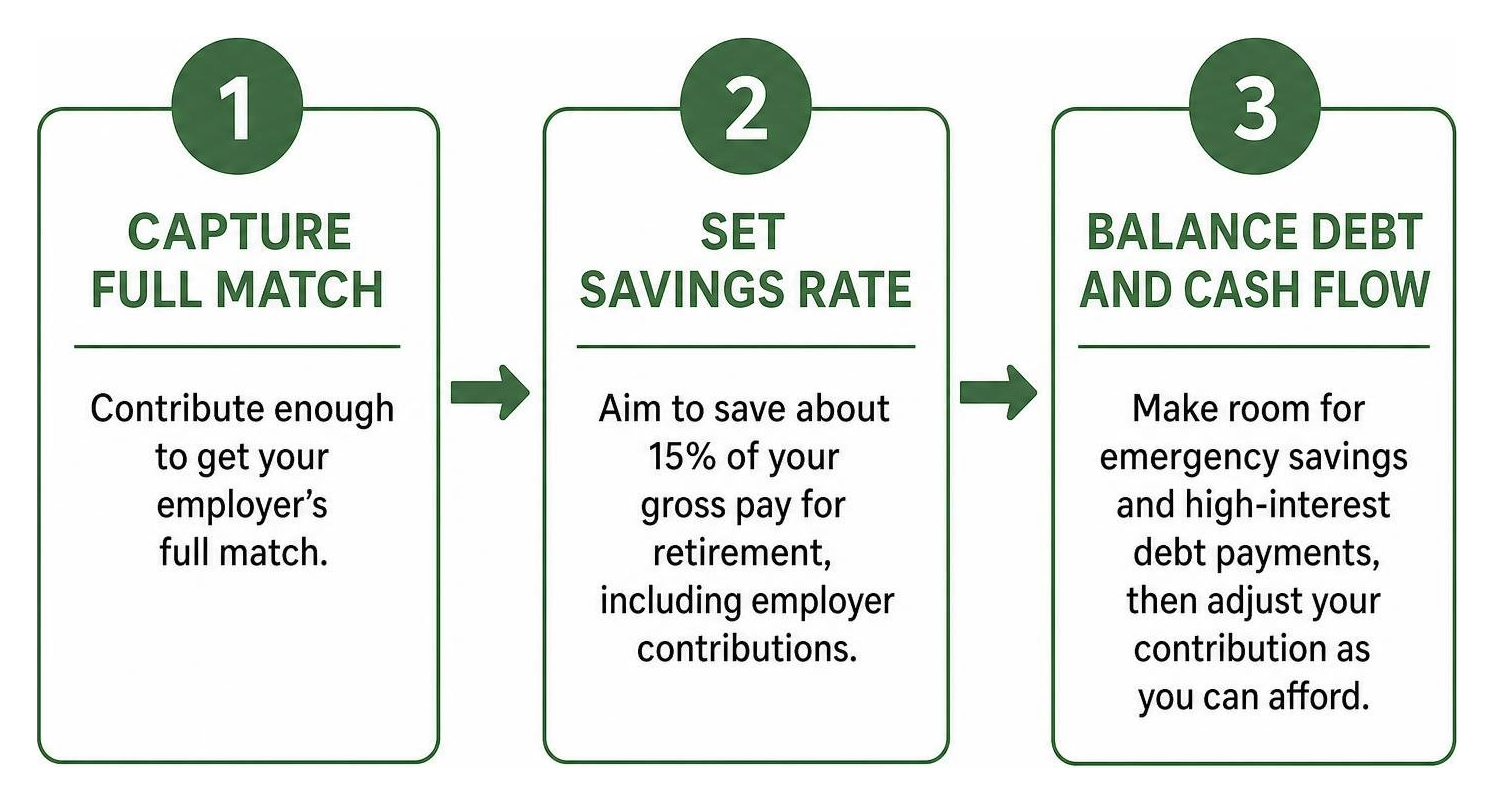
Step 1: How much should I contribute to my 401(k) to get the full match?
Your first milestone should always be capturing your full company match. An employer match is additional money your company deposits into your account based on how much you contribute from your salary. If you contribute less than the formula requires, you leave part of your compensation package on the table.
Matching formulas vary by company. A common arrangement is a dollar-for-dollar match on the first 3% of your salary and 50 cents on the dollar for the next 2%, meaning you must contribute 5% of your pay to receive a 4% total match.
You should also check your plan’s vesting schedule. Vesting represents the percentage of employer-matched funds you legally own based on your years of service. According to the U.S. Department of Labor’s vesting guidance, plans may offer immediate vesting, cliff vesting, or graded vesting. Review your Summary Plan Description (SPD) to understand how your company’s matching formula and vesting rules operate.
Step 2: Choose a sustainable 401(k) savings rate
Once you secure your match, the next step is establishing a total savings rate. Many financial professionals suggest targeting a total annual savings rate between 10% and 15% of your gross income, which includes your personal contributions and your employer’s match.
This percentage serves as a general guide. Saving within this range aims to help replace 55% to 80% of pre-retirement income over a full career, but personal factors like expected retirement age and living costs will shape your exact needs.
Compound earnings play a central role in your long-term growth. Because returns have the potential to generate their own returns over time, even modest contributions made consistently can accumulate substantially over decades.
Step 3: Balance retirement savings with debt and emergency funds
Your 401(k) percentage should never compromise your immediate financial stability. If high-interest consumer debt or an unexpected car repair forces you to borrow money, saving excessively in a retirement plan may become counterproductive.
We recommend maintaining a liquid emergency fund covering three to six months of essential living expenses. If you carry high-interest debt, such as credit cards, it is often prudent to contribute just enough to your 401(k) to secure the full employer match while directing remaining discretionary cash toward eliminating high-cost balances.
2026 contribution limits: How much can I contribute to my 401(k)?
Every year, the federal government establishes caps on the total amount workers can set aside in tax-advantaged accounts. According to the IRS’s 2026 contribution-limit announcement, elective deferral caps have adjusted to reflect inflation for the 2026 tax year.

Standard employee limits and catch-up rules for ages 50+ and 60–63
For the 2026 tax year, the standard employee elective deferral limit is $24,500 for workers under age 50. If you reach age 50 or older by December 31, 2026, you can make an additional catch-up contribution of $8,000, bringing your personal limit to $32,500.
Under the SECURE 2.0 Act statutory text, which took effect for this provision on January 1, 2025, participants aged 60, 61, 62, and 63 qualify for a higher super catch-up contribution. For 2026, this tier allows an elective catch-up limit of $11,250, resulting in a maximum employee contribution of $35,750, if your plan allows it.
The IRS also establishes an overall annual additions limit. For 2026, the combined total of all employee deferrals, employer matching, and profit-sharing contributions cannot exceed $72,000 (or $80,000 including standard catch-up contributions).
Traditional vs. Roth 401(k) tax considerations
Depending on your workplace plan options, you may have the choice to contribute on a pre-tax basis, an after-tax Roth basis, or a combination of both.
- Traditional 401(k): Contributions are made with pre-tax dollars, reducing your taxable income in the current year. Your investments grow tax-deferred, and distributions in retirement are taxed as ordinary income.
- Roth 401(k): Contributions are made with after-tax dollars, providing no immediate tax deduction. However, qualified withdrawals in retirement—including investment growth—are 100% tax-free.
| Feature | Traditional 401(k) | Roth 401(k) |
|---|---|---|
| Current-Year Tax Impact | Reduces current taxable income | No current-year tax deduction |
| Tax Treatment of Earnings | Tax-deferred until withdrawal | Tax-free growth |
| Tax on Qualified Withdrawals | Taxed as ordinary income | 100% tax-free |
| Plan Availability | Standard across almost all plans | Plan-dependent (check your SPD) |
| Ideal Tax Environment | Expecting lower tax bracket in retirement | Expecting higher tax bracket in retirement |
Choosing between traditional and Roth contributions depends on whether you believe your tax bracket is higher now than it will be during retirement. Consult your plan’s Summary Plan Description to confirm if Roth contributions are supported.
Age-based retirement benchmarks and catch-up strategies
Tracking your retirement progress against general benchmarks can help you determine whether you need to adjust your contribution rate. According to retirement research published by Fidelity Investments in 2025, common savings milestones based on gross salary multiples include:
- Age 30: 1× your annual salary
- Age 40: 3× your annual salary
- Age 50: 6× your annual salary
- Age 60: 8× your annual salary
- Age 67: 10× your annual salary
These multiples assume an ongoing 15% annual savings rate starting in your mid-20s. While helpful for a broad assessment, individual targets will vary based on desired lifestyle and retirement age.
How much should I contribute to my 401(k) if I started saving late?
If you are beginning your retirement journey in your 40s or 50s, you will likely need to save more than the standard 15% guideline to build an adequate balance. Catch-up contributions for individuals age 50 and older provide an opportunity to set aside extra funds each year.
Late-career savers should also pay close attention to asset allocation and risk management, ensuring their portfolio balances growth potential with downside protection.
Strategies to gradually increase contributions over time
You do not need to reach your target savings percentage overnight. Implementing incremental adjustments helps you expand your contributions without straining your household cash flow:
- Enable Auto-Escalation: If your plan allows it, automatic escalation raises your contribution percentage by 1% each year until you reach your chosen cap.
- Allocate Salary Raises: Whenever you receive a merit raise or promotion, direct half of the increase directly into your 401(k) deferral rate.
- Save Windfalls: Consider directing a portion of annual bonuses, tax refunds, or other one-time payments into your retirement account.
Frequently asked questions about 401(k) contributions
What should I do if I cannot afford to save 10% right now?
Start with whatever amount your monthly budget allows, even if it is only 1% to 3% of your paycheck. Capturing at least a portion of your company match should be your initial target. As you trim discretionary spending or pay off debt, use automatic escalation to increase your savings rate by 1% annually.
What happens if I contribute too much to my 401(k)?
If you contribute more than the IRS elective deferral limit across all your retirement plans for the 2026 tax year ($24,500, or $32,500/$35,750 if eligible for catch-up), you have an excess deferral. You must notify your plan administrator immediately and request a corrective distribution of the excess amount and associated earnings before the tax filing deadline (typically April 15). If uncorrected, the excess contribution is subject to double taxation—once in the year contributed and again when eventually distributed.
What accounts can I fund after maxing out my 401(k)?
If you reach the annual IRS contribution limit for your workplace plan, you can continue building tax-advantaged savings using alternative vehicles:
- Traditional or Roth IRA: Individual Retirement Accounts allow eligible individuals to contribute up to $7,500 for the 2026 tax year ($8,500 if age 50 or older), subject to IRS income limits.
- Health Savings Account (HSA): If you are enrolled in a qualifying High-Deductible Health Plan (HDHP), an HSA provides triple tax advantages: pre-tax contributions, tax-free growth, and tax-free withdrawals for qualified medical expenses. After age 65, non-medical withdrawals are taxed as ordinary income without penalty.
- Taxable Brokerage Account: Standard investment accounts offer complete liquidity with no annual contribution limits, though earnings and capital gains are subject to standard taxation.
Key takeaways
- Capture Your Full Match: Always contribute at least enough to receive your full employer matching contribution before allocating savings elsewhere.
- Target 10% to 15% as a Guideline: Aim for a total retirement savings rate of 10% to 15% of your gross pay, adjusting up or down based on your budget and debt obligations.
- Understand 2026 Limits: For 2026, standard employee contributions are capped at $24,500, with an $8,000 catch-up for ages 50+ and an $11,250 super catch-up for ages 60–63, if permitted by your plan.
- Increase Gradually: Use auto-escalation features and salary raises to steadily boost your contribution rate without disrupting your monthly lifestyle.
Choosing your contribution rate is an essential first step, but managing the investments inside your account over time is just as vital. The 401(k) Maneuver team provides professional, human-run account management designed to help you navigate market changes. We provide quarterly, personalized rebalancing and risk-control strategies for your workplace plan without moving your funds.
To learn more about how our independent fiduciary services can support your long-term retirement goals, call us at 1-877-218-5060 or visit How It Works.
Disclosures: 401(k) Maneuver is a business name of Royal Fund Management, LLC, an SEC-registered investment adviser. Information presented is for educational purposes only and does not intend to make an offer or solicitation for the sale or purchase of any specific securities, investments, or investment strategies. Investments involve risk and, unless otherwise stated, are not guaranteed. Be sure to first consult with a qualified financial adviser and/or tax professional before implementing any strategy discussed herein. Past performance is not indicative of future performance.