


What Happens to a 401(k) If There’s No Beneficiary? — 401(k) Death Distribution No Beneficiary
What happens to a 401(k) death distribution with no beneficiary?
The 401(k) does not disappear. If you die without a valid beneficiary designation, the plan’s default rules determine who may receive it. A surviving spouse may have priority. If the account instead goes to your estate, probate – the court process for settling someone’s affairs – may be needed before heirs can receive the funds.
Distribution deadlines depend on who inherits. Check your plan’s Summary Plan Description for its default rules, and see the IRS guidance on beneficiaries for withdrawal rules. Reviewing both your primary and backup beneficiary choices can help make your wishes clear.
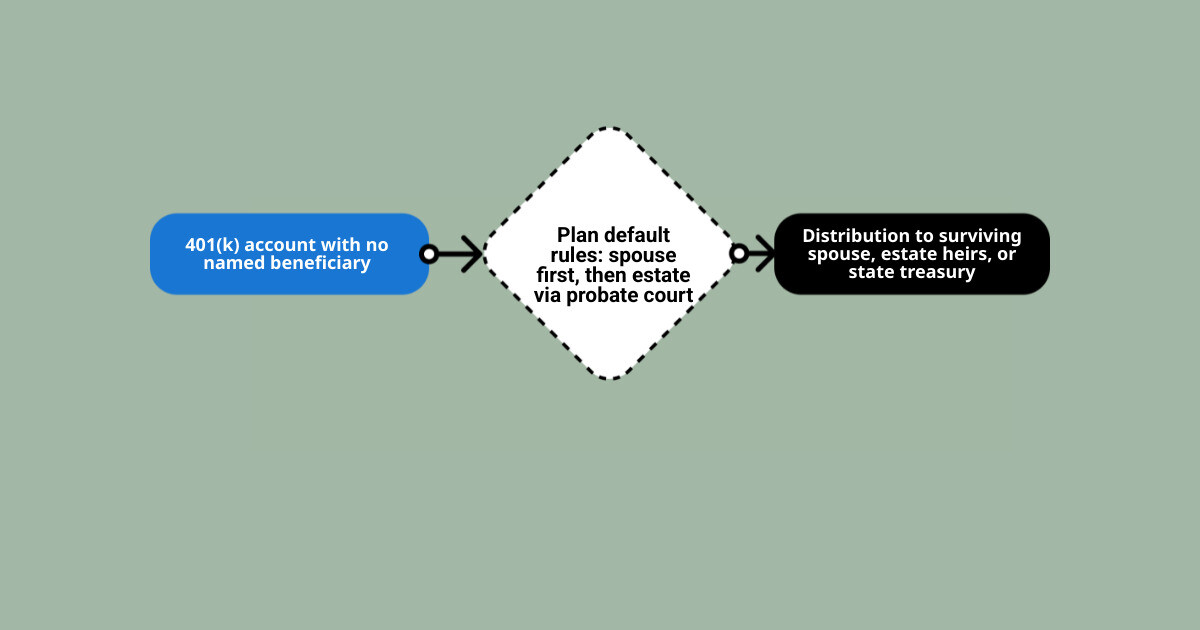
Understanding the rules for a 401(k) death distribution with no beneficiary

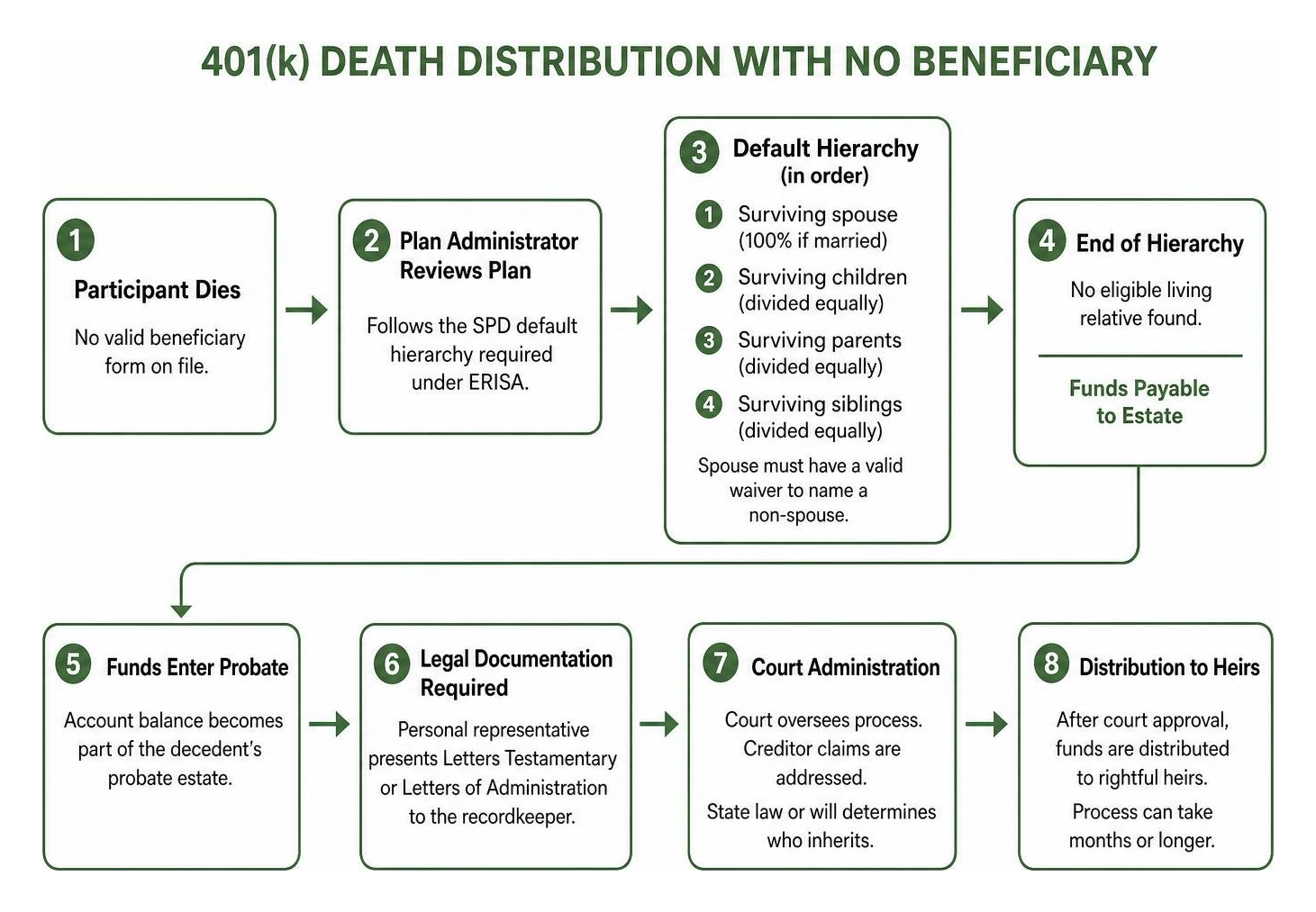
When an account holder passes away without designating an individual on file, the distribution process is governed directly by the governing plan document rather than an outside will. Qualified workplace plans follow statutory guidelines under the Employee Retirement Income Security Act (ERISA). These rules establish a clear order of precedence to resolve an unassigned balance. You can review what happens to your 401(k) when you die to understand how designations interact with federal frameworks.
Every retirement plan outlines its operational terms inside its Summary Plan Description (SPD). The plan administrator must follow the exact terms of this document to remain compliant with federal law. Under DOL guidance on retirement plan benefits, fiduciaries must carry out distributions strictly according to written plan instruments. When a form is missing or blank, the administrator looks to the SPD’s default hierarchy.
Default plan provisions and surviving spouse rights
Under ERISA-governed plans, federal law provides strong protections for a surviving spouse. If a participant is married at the time of death, the surviving spouse is typically entitled to 100% of the account balance automatically. This protection applies even if the participant never submitted a beneficiary form. A married participant can generally name a non-spouse primary beneficiary only if the spouse signed an explicit, written waiver that was witnessed by a plan representative or notary public.
If the participant was unmarried or the spouse predeceased them, the plan document dictates the next recipient. A common default hierarchy in employer plan documents follows this order:
- Surviving children (divided equally)
- Surviving parents (divided equally)
- Surviving siblings (divided equally)
- The participant’s estate
Because default hierarchies vary across employers, checking your plan’s SPD may be necessary to see the sequence your employer uses.
401(k) death distribution with no beneficiary: when funds pass to the estate
If the default hierarchy reaches the end of the list without finding an eligible living relative, the plan executes a 401(k) death distribution to an estate. When funds pass to the estate, they lose their non-probate transfer status. The account balance becomes part of the decedent’s general probate estate, requiring court administration before any heir can access the capital.
To collect these funds from the recordkeeper, a court-appointed personal representative or executor must present official Letters Testamentary or Letters of Administration. If the decedent died with a valid will (testate), the probate judge oversees distribution to named heirs after valid creditor claims are addressed. If there is no will (intestate), state intestacy laws dictate which relatives inherit the proceeds.
Probate, missing heirs, and plan administration challenges

When retirement funds enter the probate system, heirs often face administrative friction and court delays. Probate proceedings can take anywhere from several months to more than a year depending on local court backlogs and the complexity of the estate. During this period, the account balance remains frozen while the administrator awaits legal documentation. As an employee, understanding your rights as a 401(k) investor helps ensure your assets remain aligned with your personal goals during your career.
Retirement assets that pass through a designated beneficiary are generally shielded from general estate creditors under state non-probate asset laws. In contrast, funds payable to an estate become available to satisfy outstanding debts, including unpaid medical bills, personal loans, or administrative court fees. This exposure can diminish the final balance that reaches your family.
How plan administrators handle a 401(k) death distribution with no beneficiary during plan termination
If an employer terminates a 401(k) plan and discovers an account belonging to a deceased participant with no known heirs, the plan administrator should perform a diligent search. Plan fiduciaries may review death records, reach out to local coroners or funeral homes listed in public obituaries, and search public databases to help identify next of kin.
If all search efforts are exhausted without locating an heir, the administrator has specific regulatory avenues:
- PBGC Missing Participants Program: For terminating defined contribution plans, administrators may transfer unclaimed balances to the Pension Benefit Guaranty Corporation (PBGC) using Form MP-200. The PBGC holds these funds until an entitled heir files an official claim.
- Plan Forfeiture and Reallocation: If permitted by plan terms and Treasury regulations, certain unclaimed benefits may be forfeited to pay allowable administrative expenses or reallocated to remaining plan participants. However, if a valid heir comes forward later, the plan must generally restore the benefit.
The legal reality of having “no estate” and state intestacy laws
In cases where a deceased participant held minimal assets outside their workplace retirement plan, surviving family members may not open a formal probate estate due to court costs. When families state there is “no estate,” a legal entity still exists in the eyes of the law; it simply lacks an appointed administrator.
Many states offer simplified small-estate affidavits that allow heirs to collect assets below specific statutory dollar thresholds (which vary widely by state, often between $25,000 and $150,000) without full court administration. If no eligible heirs exist under state intestacy laws, the unclaimed retirement assets may eventually escheat (transfer) to the state’s unclaimed property division.
Tax implications and distribution options for heirs
Inherited retirement assets are subject to federal income tax rules established under the Internal Revenue Code and updated by the SECURE Act and SECURE 2.0 (effective for deaths occurring in 2020 and later, with certain provisions phased in through later years; guidance on some provisions remains pending). Distributions from traditional 401(k) accounts are treated as ordinary income to the recipient in the tax year received. In contrast, qualified distributions from designated Roth 401(k) accounts are generally free from federal income taxes, provided the 5-year aging rule has been satisfied. Investing involves risk of loss, and diversification or rebalancing does not guarantee a profit or protect against loss.
The tax options available to an heir depend on their legal relationship to the deceased and whether funds pass to an individual or an estate.
| Beneficiary Type | Primary Distribution Options | Standard Timeline / Rule |
|---|---|---|
| Surviving Spouse | Roll over to own IRA/plan, transfer to inherited IRA, or lump sum | Can delay until decedent would reach RMD age or use own life expectancy |
| Eligible Designated Beneficiary (EDB) | Transfer to inherited IRA or lump sum | Life expectancy payout or 10-year rule |
| Non-Spouse Designated Beneficiary | Transfer to inherited IRA or lump sum | Must empty account by end of 10th year post-death (10-Year Rule) |
| Estate / Non-Designated Entity | Direct distribution to estate | 5-Year Rule (death before RBD) or remaining life expectancy of decedent |
Options for surviving spouses vs. non-spouse beneficiaries
Surviving spouses maintain the highest degree of flexibility under federal tax rules. A spouse can choose to roll the balance into their own traditional or Roth IRA, treat the account as their own, or roll it into an inherited IRA. Under provisions expanded by the SECURE 2.0 Act, a surviving spouse can elect to be treated as the deceased employee for required minimum distribution (RMD) calculations, which may allow them to delay withdrawals until the deceased spouse would have reached their applicable RMD age (age 73 for individuals reaching that age between 2023 and 2032, per IRS guidance).
Non-spouse individual beneficiaries (such as adult children) are generally subject to the SECURE Act’s 10-year rule. Under this rule, the entire account balance must be fully distributed by December 31 of the tenth calendar year following the participant’s death. Annual RMDs during years 1 through 9 are required if the participant died on or after their Required Beginning Date (RBD). Exceptions to the 10-year rule apply only to “Eligible Designated Beneficiaries” (EDBs), which include minor children of the account owner (until reaching age 21), disabled or chronically ill individuals, and beneficiaries not more than 10 years younger than the deceased. For details on these distribution options, see the IRS guidance on distributions after a participant’s death.
401(k) death with no beneficiary: tax consequences of estate payouts
When a 401(k) death distribution to an estate occurs, tax consequences can accelerate. An estate is considered a “non-designated beneficiary” by the IRS, which removes the ability to use the 10-year rule or stretch distributions across an individual’s life expectancy.
The distribution timeline for an estate depends on the participant’s age at death:
- Death Before Required Beginning Date: The entire balance must be distributed under the 5-Year Rule (by December 31 of the fifth year following death).
- Death On or After Required Beginning Date: Distributions must occur at least as rapidly as the decedent’s remaining single life expectancy calculated using IRS tables.
Retirement funds distributed directly to an estate are reported on IRS Form 1041 (U.S. Income Tax Return for Estates and Trusts). Trust and estate tax brackets are compressed compared to individual tax brackets. For tax year 2026, the highest federal income tax bracket of 37% applies to estate income exceeding relatively low statutory thresholds (often around $15,000 to $16,000, adjusted annually for inflation). Distributing taxable funds across a shortened multi-year window can push the estate or its underlying heirs into higher effective tax brackets. A tax professional or estate planning attorney can help evaluate these outcomes for a specific situation.
Frequently asked questions about 401(k) beneficiary rules
What happens if you die without a named beneficiary on your 401(k)?
If you die without a designated beneficiary, your plan document’s default rules determine who receives the balance. In most cases, federal law awards the funds to your surviving spouse. If you are unmarried, the plan document typically directs the balance to surviving children or down an established hierarchy, eventually defaulting to your estate if no qualifying relatives are identified.
Does a will override a 401(k) default beneficiary designation?
No. Qualified retirement plans are governed by ERISA, which provides that plan terms and valid beneficiary forms generally take precedence over instructions left in a last will and testament. A will only controls the distribution of your 401(k) funds if the account defaults to your estate under the plan rules or if the estate was deliberately named as the primary beneficiary.
How long does an estate have to distribute inherited 401(k) funds?
If an estate inherits a 401(k) and the participant died before their Required Beginning Date (age 73, per IRS guidance), the estate must withdraw the entire balance within 5 years. If the participant died after their Required Beginning Date, the estate can take distributions over the decedent’s hypothetical remaining life expectancy. A qualified tax professional or estate planning attorney can help clarify how these rules apply to a specific plan.
Some Key takeaways and conclusion
- Plan Documents Control Payouts: Without a designated beneficiary on file, your employer’s plan document governs who receives your savings, giving statutory priority to a surviving spouse.
- Probate Can Cause Delays: If funds default to your estate, the account becomes subject to court probate, potential creditor claims, and legal costs.
- Tax Timelines Accelerate for Estates: Payouts made directly to an estate lose flexible multi-year payout rules, subjecting funds to the 5-year rule or compressed fiduciary tax rates.
- Regular Reviews Matter: Maintaining updated primary and contingent beneficiary designations is a practical way to help your assets transfer according to your wishes.
Reviewing your workplace retirement savings periodically helps ensure your long-term plans remain on track. To see how our team provides personalized, ongoing account management, learn how 401(k) Maneuver works to optimize your retirement.
Disclosure: 401(k) Maneuver is a business name of Royal Fund Management, LLC, an SEC-registered investment adviser. This article is provided for educational and informational purposes only and does not constitute individual investment, legal, or tax advice. Investing involves risk of loss, and past performance does not guarantee future results. Diversification and professional management do not guarantee a profit or protect against loss. Please consult a qualified tax professional or estate planning attorney regarding your specific situation.