


How to Find and Understand 401(k) Fees
How to find your 401(k) fees
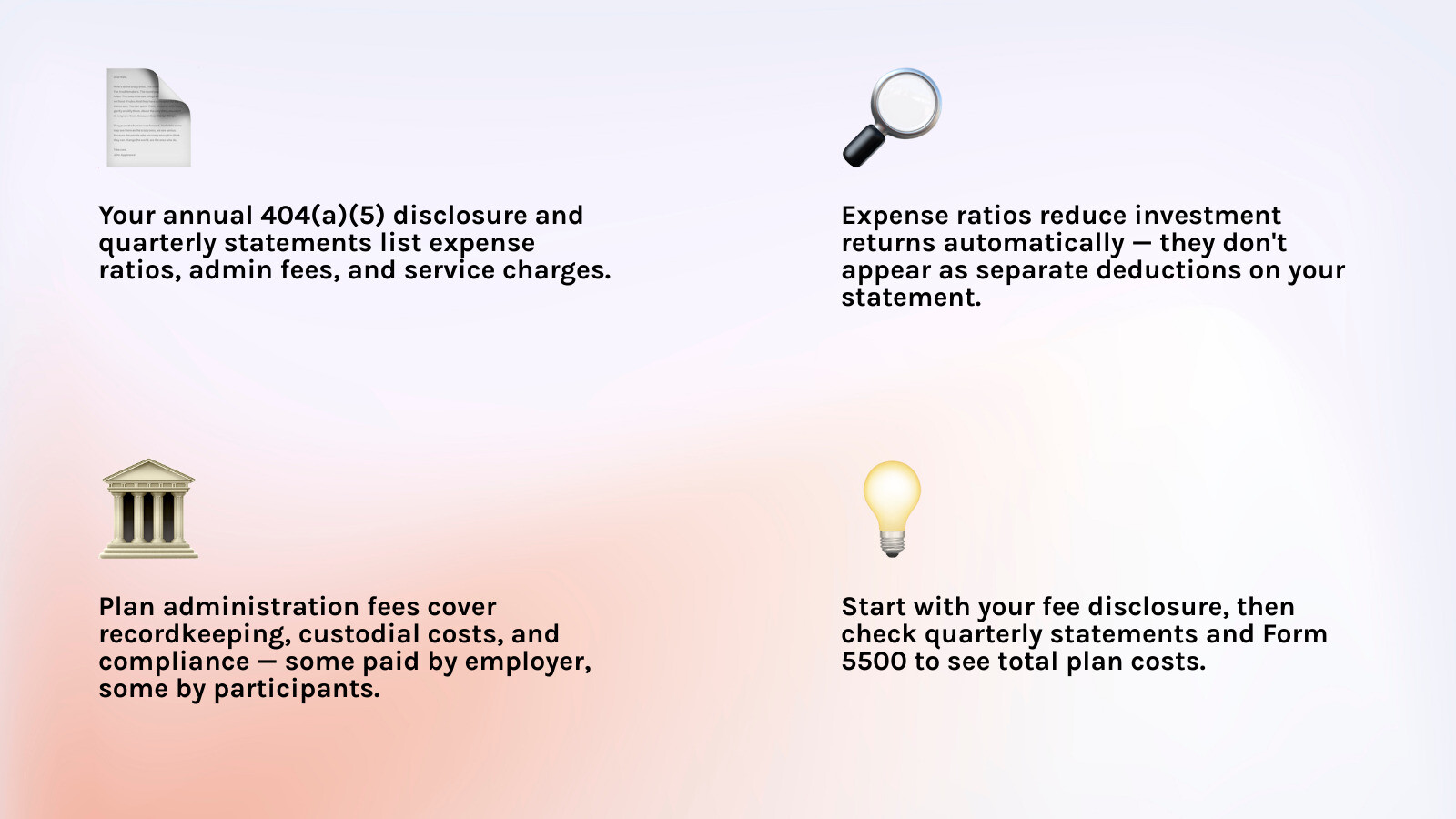
To find your 401(k) fees, start with your annual 404(a)(5) participant fee disclosure and quarterly account statement. Look for fund expense ratios (annual investment costs), plan administration or recordkeeping charges, and fees for services you use. Expense ratios typically reduce investment returns instead of appearing as separate deductions on your statement.
Some costs may come out of your account, while your employer may pay others. Workplace retirement accounts carry operational expenses that cover recordkeeping, administration, investment management, and custodial services. This guide shows you where to look and how to tell what you pay, so you can weigh those costs as you plan for retirement.
Types of 401(k) fees and how they are charged
Understanding how your workplace plan operates begins with breaking down the expenses behind the scenes. 401(k) expenses fall into three main categories: investment expenses, plan administration fees, and individual service charges. Each category serves a distinct operational purpose and affects your retirement account balance differently over time.
Investment expenses are often the largest component of total plan costs. These cover the management of mutual funds, collective investment trusts, or exchange-traded funds (ETFs) within your plan lineup. The cost is expressed as an expense ratio, which is the percentage of fund assets used to pay management, administrative, and marketing costs (such as 12b-1 fees). Rather than appearing as explicit line-item charges, these costs are subtracted directly from gross fund performance before daily net asset values are calculated.
Plan administration expenses cover recordkeeping, compliance testing, trustee oversight, custodial services, and daily accounting. Depending on the plan design, an employer might cover these expenses, or they may be allocated among participants either as a flat per-participant fee or as an asset-based fee calculated as a percentage of account assets.
Individual service charges apply only when you take advantage of specific optional features, if your plan allows them. These include 401(k) loan origination fees, annual loan maintenance costs, qualified domestic relations order (QDRO) reviews, or distribution processing charges when separating from service.
Where to locate fee details in your retirement plan documents

Federal regulations governed by the U.S. Department of Labor (DOL) under 29 CFR 2550.404a-5 mandate that plan administrators supply annual comparative charts of all available investment options. Knowing how to read a 401(k) statement makes it easier to spot where these expenses appear.
To conduct a thorough review of your account costs, we recommend you examine these primary documents:
- Annual Participant Fee Disclosure Notice (404(a)(5) Notice): Lists every investment option on the menu, its expense ratio, gross and net returns, historical performance, and any general administrative charges assessed across all participants.
- Quarterly Account Statements: Shows specific dollar amounts deducted from your balance for administrative or individual services during that three-month period, helping you track net deductions.
- Summary Plan Description (SPD): Provides the fundamental operational rules of your plan, detailing which administrative expenses may be passed through to participants and outline loan terms or distribution options.
- Form 5500 Filings: The annual return that retirement plans file with the DOL and IRS, accessible publicly via the DOL EFAST system, outlining total aggregate plan costs, service provider schedules, and audited financial statements.
Evaluating the long-term cost of plan expenses
Plan expenses operate as an ongoing drag on compounding growth. When an investment fee is deducted, it commonly reduces both your current net balance and the future earnings that money could have generated over decades.
You can model personal contribution targets using a 401(k) calculator to observe how incremental shifts in savings rates and fee structures interact over multi-year periods.
How 401(k) fees impact your long-term retirement savings
The cumulative impact of seemingly minor percentage differences can become substantial over a career. Because money remaining in your account continues to generate potential compound earnings, even modest annual basis-point differences accumulate meaningfully over twenty, thirty, or forty years of workplace savings.
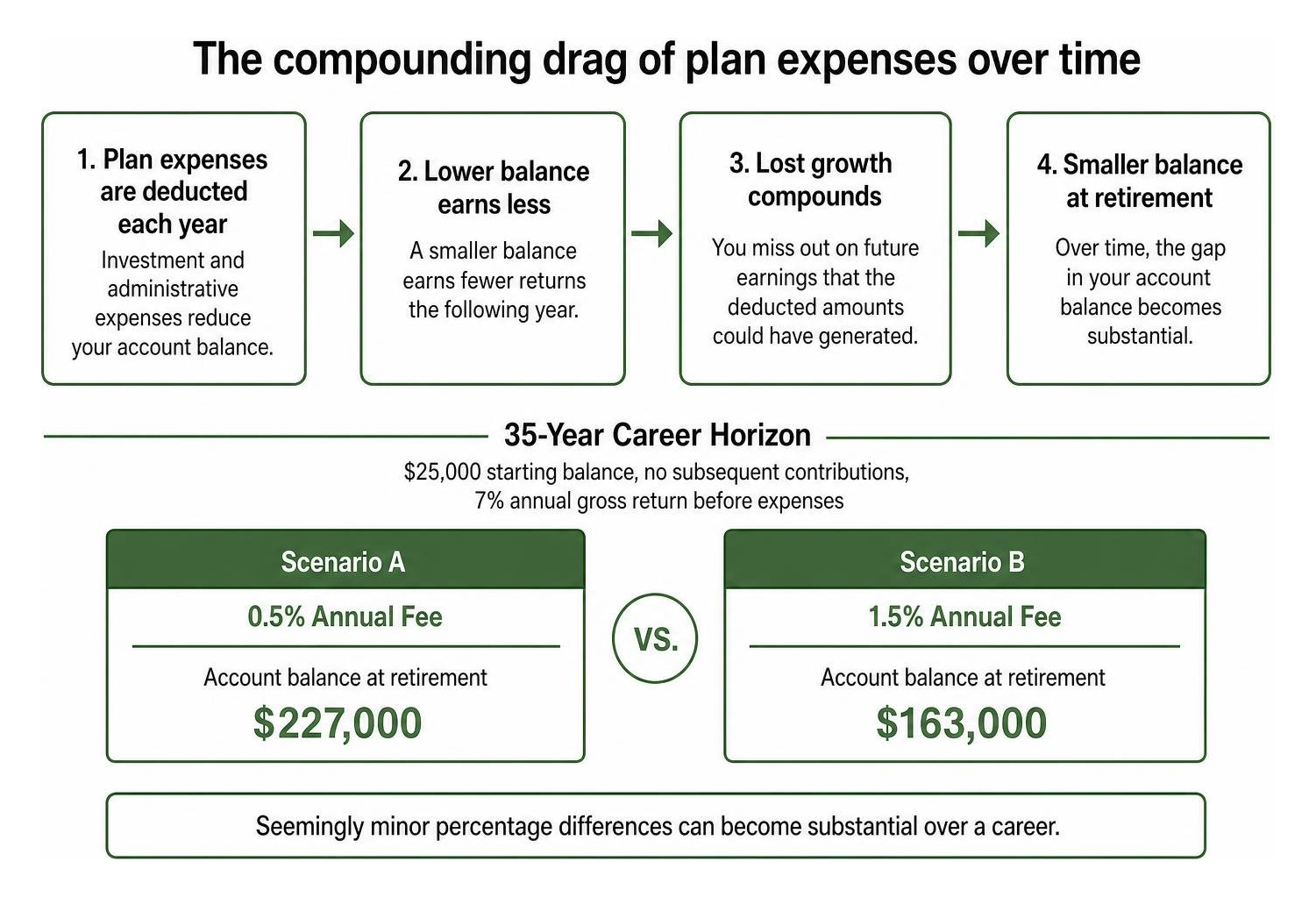
Consider this hypothetical example illustrating how fees compound over a 35-year career horizon (assuming a $25,000 starting balance, no subsequent contributions, and a consistent 7% annual gross return before expenses):
- Scenario A (0.5% Annual Fee): The account balance grows to approximately $227,000 at retirement.
- Scenario B (1.5% Annual Fee): The account balance grows to approximately $163,000 at retirement.
In this hypothetical calculation, a 1% difference in ongoing expenses results in an ending balance that is roughly 28% lower due to the compounded loss of earnings over time. This calculation is purely illustrative, assumes steady gross returns, and does not represent actual performance or guarantee specific future outcomes.
Active management vs. index funds in plan lineups
Investment menus typically provide a mixture of actively managed mutual funds and passively managed index funds.
- Actively Managed Funds: Portfolio managers actively buy and sell securities aiming to outperform a market benchmark. These funds generally carry higher expense ratios to cover research teams, fundamental analysis, and higher transaction volume.
- Passively Managed Index Funds: Designed to mirror a specific index (such as the S&P 500). Because they require minimal active trading and research overhead, they typically carry significantly lower expense ratios.
While active funds seek to outperform their benchmarks, higher ongoing expense ratios mean a manager must deliver enough excess return just to match the net performance of a comparable low-cost index fund.
Practical steps to manage and reduce plan expenses
Managing retirement costs does not mean eliminating every service; rather, it involves ensuring that you are receiving appropriate value for the fees deducted from your account.
- Review Fund Expense Ratios: Compare the options on your investment menu and consider whether low-cost index funds align with your broader asset allocation goals.
- Avoid Unnecessary Service Fees: If your plan permits 401(k) loans or in-service distributions, review the accompanying processing charges beforehand so you avoid paying avoidable transactional fees.
- Engage Plan Sponsors: Employers have a fiduciary duty under ERISA to monitor service providers and ensure plan fees remain reasonable for the services delivered.
How to check your 401(k) fees and optimize your portfolio

Optimizing a retirement portfolio involves balancing cost management, asset allocation, and regular rebalancing based on your individual time horizon and risk tolerance. Understanding how professional 401(k) management may help account performance can provide clarity on how ongoing oversight aims to keep your portfolio aligned with your long-term goals without requiring you to manage every quarterly adjustment manually.
Frequently asked questions about 401(k) plan costs
How can I find out exactly how much I am paying in 401(k) fees?
You can review your plan’s annual 404(a)(5) participant fee disclosure document, examine line-item deductions on your quarterly statements, or contact your employer’s human resources department or plan administrator for a complete fee schedule that details all applicable asset-based and transactional charges.
Are 401(k) plan fees tax-deductible?
For employees, administrative and investment management fees deducted directly from your account balance are not individually tax-deductible on your personal tax return. They are paid with pre-tax or Roth dollars already inside the plan. For businesses, ordinary and necessary expenses paid by the employer to maintain the plan may be deductible corporate expenses under IRS rules.
What is considered a reasonable fee for a 401(k) plan?
There is no single statutory percentage that defines a “reasonable” fee. Under ERISA guidelines enforced by the DOL, reasonableness is evaluated based on the size of the plan, total assets, the scope of recordkeeping services provided, and the quality of investment options available. Larger plans often benefit from institutional pricing, while smaller plans may experience higher proportional administrative overhead.
Conclusion
Understanding plan costs gives you the information needed to evaluate your workplace savings strategy effectively. By reviewing your fee disclosures, examining your investment options, and assessing the value of administrative services, you can make informed decisions tailored to your personal financial future.
Key takeaways
- 401(k) fees consist of investment expense ratios, administrative charges, and individual transaction costs.
- Investment expenses are deducted directly from fund performance rather than showing as explicit statement deductions.
- Your annual 404(a)(5) disclosure and quarterly account statements provide detailed breakdowns of all applicable charges.
- Compounding expenses can have a noticeable impact on total account accumulation over extended multi-decade time horizons.
- Evaluating passive index funds alongside active management helps clarify the cost-versus-return trade-offs in your investment menu.
If you would like a second opinion on your workplace retirement account, our independent fiduciary team is here to assist. You can speak with a 401(k) Maneuver adviser at 1-877-218-5060 or learn how our professional 401(k) management works.
Disclosure: 401(k) Maneuver is a business name of Royal Fund Management, LLC, an SEC-registered investment adviser. This article is provided for educational and informational purposes only and should not be construed as individualized investment, legal, or tax advice. Investing involves risk, including the possible loss of principal. Past performance does not guarantee future results, and diversification or portfolio rebalancing strategies do not ensure a profit or protect against loss in declining markets.