


Have Multiple 401(k)s From Old Jobs? Consolidation Pros and Cons
How to consolidate 401(k) accounts from old jobs
To consolidate 401(k) accounts, gather statements from your old plans. Compare each plan’s fees, investments, and features with your current employer’s plan and a rollover IRA. If your current plan accepts rollovers, you may be able to move old balances there. You can also move eligible balances to an IRA. Ask for a direct rollover, so the funds go to the receiving account rather than to you.
Combining accounts can make your savings easier to track, but the destination may have different costs, investment choices, and protections. The 401(k) Maneuver team will walk through those trade-offs so you can decide whether to move an old account or leave it where it is.
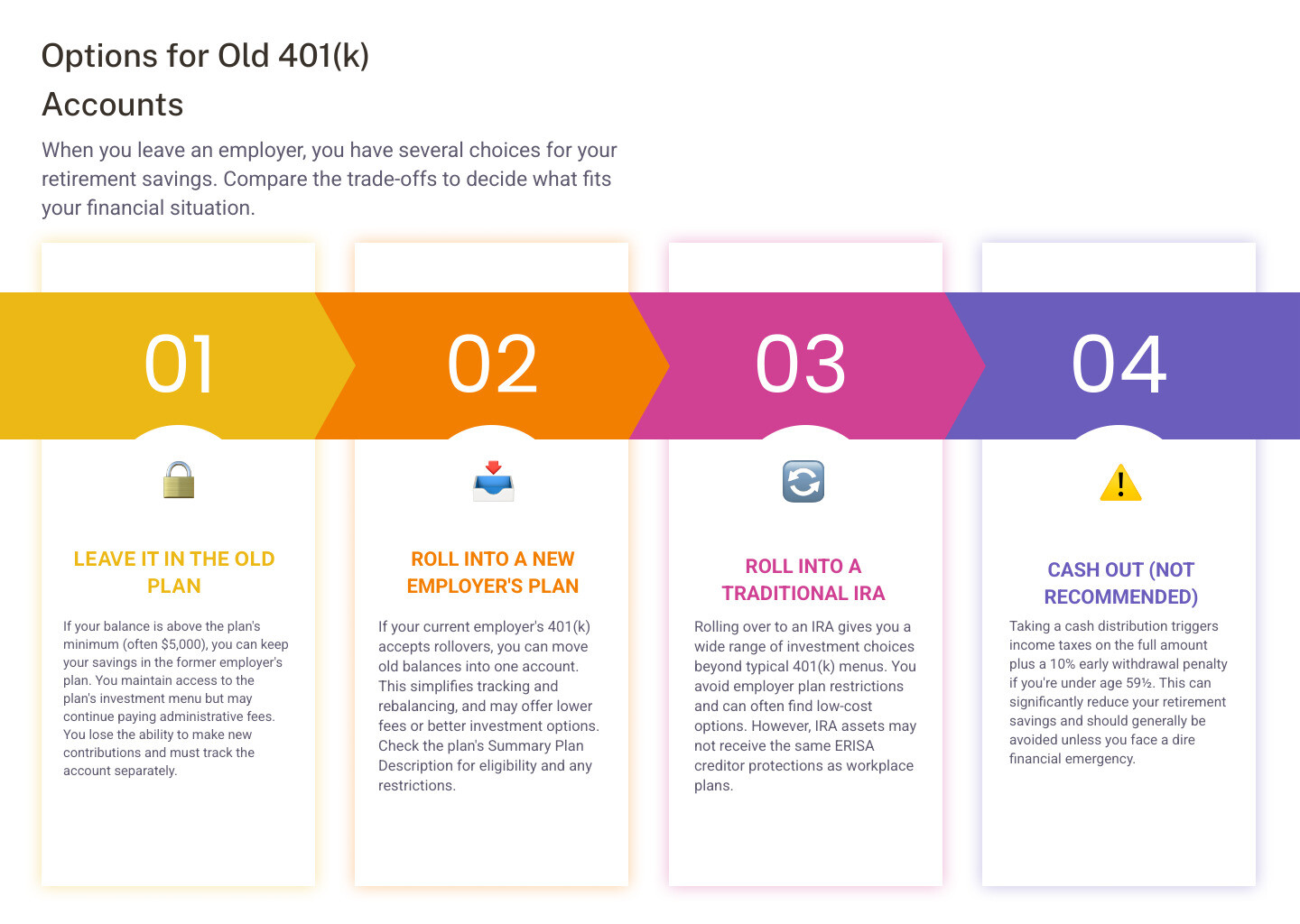
What happens when you leave multiple 401(k) accounts behind?
According to the U.S. Bureau of Labor Statistics, the average worker held 12.4 jobs from ages 18 to 54 in the 2022 National Longitudinal Survey of Youth 1979 cohort. Changing employers frequently often creates multiple workplace retirement accounts scattered across different financial institutions. These “orphan accounts” can quietly complicate your long-term financial planning.
When you leave an old account behind, each plan administrator continues assessing administrative, recordkeeping, and investment management fees. Over time, paying separate account fees across multiple providers can erode your overall savings. We recommend you also keep in mind the danger of forgetting to roll over old 401(k)s if you relocate, change your contact details, or lose track of former employer recordkeepers.
Under federal rules, employers have options for handling small balances left by former employees. Under the SECURE 2.0 Act of 2022, effective for distributions made after December 31, 2023, employers may automatically transfer balances between $1,000 and $7,000 into a default safe-harbor IRA if you do not make an election. Vested balances under $1,000 may be distributed as a direct check, subject to mandatory tax withholding. If an account remains completely unmaintained and contact is lost, state escheatment statutes may eventually require the recordkeeper to transfer unattended property to state unclaimed property divisions.
Some key advantages when you consolidate 401(k) accounts

Bringing scattered balances into a single plan or an IRA can offer meaningful administrative clarity. When you manage one central account, you gain full visibility into your overall asset allocation, total account balances, and annual investment fees. There are several reasons to move your old 401(k) into a centralized structure to help coordinate your retirement strategy.
Streamlined portfolio management and rebalancing
Holding multiple accounts often leads to unintended portfolio drift and duplicate investments. For example, you might unintentionally hold target-date funds with conflicting maturity dates or overlap identical large-cap mutual funds across three different accounts.
Consolidating accounts helps you to design an asset allocation tailored to your specific risk tolerance and target retirement date. It also streamlines rebalancing. Adjusting one centralized portfolio quarterly or annually may be simpler than logging into multiple outdated portals to reallocate individual fund holdings.
Simplified required minimum distributions (RMDs)
Consolidation can significantly simplify Required Minimum Distributions (RMDs) as you enter retirement. Under the SECURE 2.0 Act, the mandatory RMD starting age is currently 73 (and will shift to age 75 for individuals who reach age 74 after December 31, 2032).
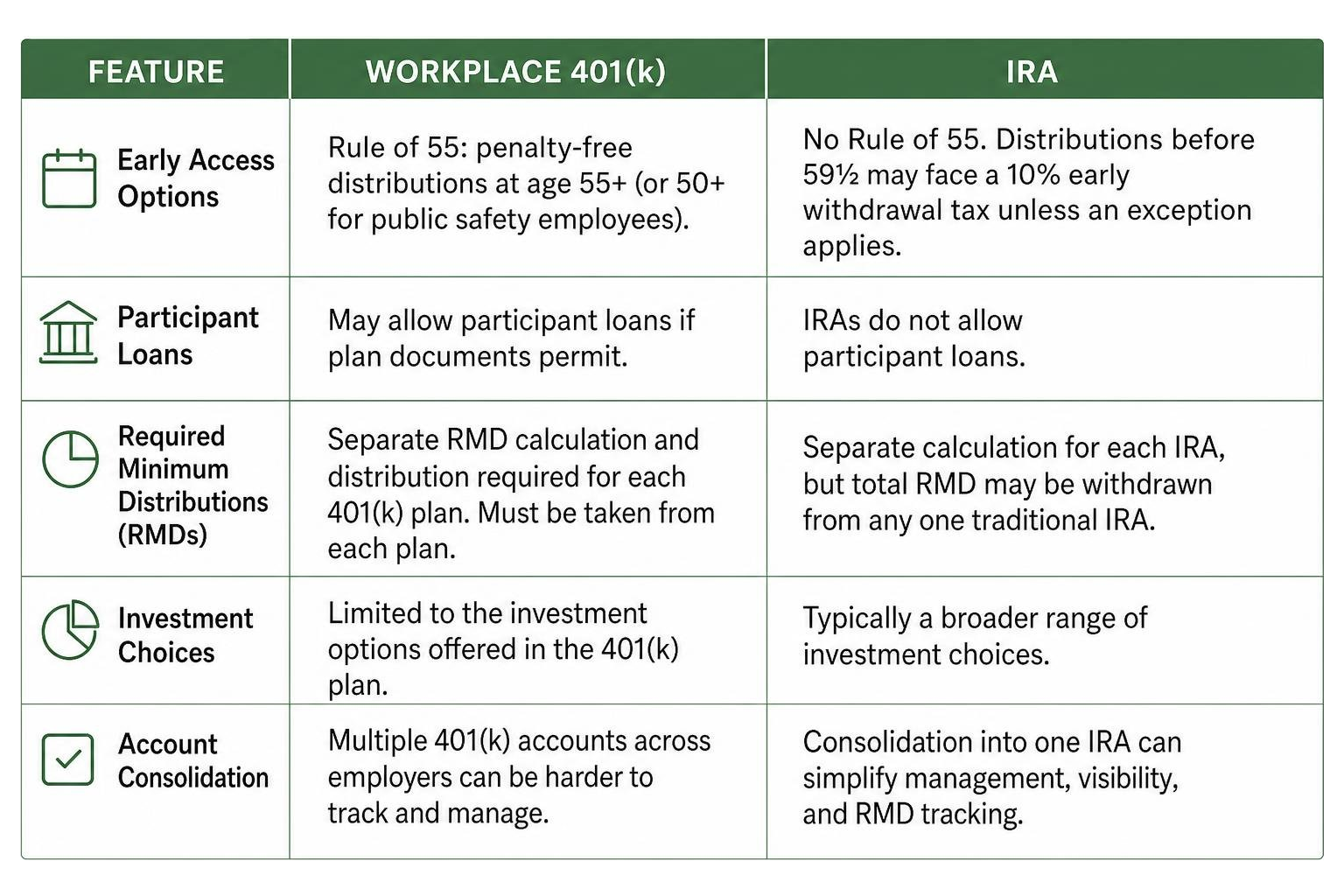
Traditional 401(k) plans require separate RMD calculations for each individual workplace account, and each plan must distribute its own required amount. In contrast, while multiple traditional IRAs still require separate annual calculations for each account, the total aggregate RMD amount may be withdrawn from any single traditional IRA you own.
Calculating distributions across several legacy 401(k) accounts increases the risk of mathematical errors or missed distribution deadlines. Under IRS rules, failing to take a full RMD can result in an excise tax of up to 25 percent on the amount not distributed, though this penalty may be reduced to 10 percent if corrected in a timely manner. Consolidating your balances simplifies tracking and may help reduce the chance of administrative mistakes.
Potential drawbacks: when you shouldn’t combine 401(k) accounts
While combining accounts can offer simplicity, it is not always the optimal move for every investor. We believe understanding when it may not make sense to roll over your 401(k) is critical before moving any money.
Preserving the Rule of 55 and plan loan provisions
If you leave your job during or after the calendar year in which you turn age 55 (or age 50 for qualifying public safety employees), IRS rules allow you to take penalty-free distributions from that specific employer’s 401(k) plan under the “Rule of 55.” If you roll those funds into an IRA, you generally lose this early-access privilege, and standard IRA distributions prior to age 59½ may face a 10 percent early withdrawal tax unless another statutory exception applies.
Additionally, active 401(k) plans may permit participant loans if your plan documents allow them. IRAs strictly prohibit participant loans under IRS rules. If your new workplace plan accepts roll-ins, moving old balances there could preserve or increase your potential loan borrowing capacity, whereas rolling to an IRA eliminates loan access.
Differences in creditor protections and investment menus
Employer-sponsored 401(k) plans governed by the Employee Retirement Income Security Act of 1974 (ERISA) generally provide unlimited federal protection against judgment creditors and bankruptcy proceedings. Traditional and Roth IRAs receive federal bankruptcy protection up to an inflation-adjusted cap under the Bankruptcy Abuse Prevention and Consumer Protection Act (BAPCPA), but non-bankruptcy judgment creditor protection depends entirely on varying state laws.
Furthermore, large employer 401(k) plans sometimes provide access to institutional share classes or stable value funds that are not commercially available to individual retail IRA investors. Review the investment menu and fee disclosures in your Summary Plan Description before leaving a plan with favorable institutional pricing.
Comparing your options to move old retirement balances
When deciding how to handle accounts from previous jobs, you have three primary paths:
| Feature | Roll Over to New Employer 401(k) | Roll Over to an IRA | Leave in Former Employer Plan |
|---|---|---|---|
| Account Management | Single workplace dashboard | Single independent dashboard | Multiple separate logins |
| Investment Choices | Limited to new plan’s menu | Broad (stocks, bonds, ETFs, funds) | Limited to old plan’s menu |
| Loan Provisions | Allowed (if new plan permits) | Prohibited by IRS rules | Generally unavailable to former employees |
| Early Access (Rule of 55) | Governed by new plan separation date | Not available (age 59½ standard) | Preserved for that specific employer |
| Creditor Protection | Strong federal ERISA protection | Varies by state statute (federal cap) | Strong federal ERISA protection |
To prevent tax complications, we highly recommend you follow standard IRS rollover guidance and use a direct rollover rather than taking a cash distribution.
How to consolidate 401(k) accounts into a new employer plan
If your new employer’s retirement plan accepts incoming rollovers, you can combine your previous accounts into your active workplace plan:
- Verify Plan Acceptance: Check your new plan’s Summary Plan Description or ask your plan administrator if the plan allows incoming roll-ins from former employer plans.
- Request Direct Transfer Instructions: Obtain incoming rollover forms and specific check-payable instructions from your current recordkeeper.
- Contact Former Recordkeepers: Request a direct rollover (trustee-to-trustee transfer) made payable to the new custodian for your benefit.
- Confirm Deposit and Asset Allocation: Once the funds arrive, log in to verify the balance and select your desired investment funds.
Steps to consolidate 401(k) accounts into an IRA
If your new employer does not offer a retirement plan, has limited investment options, or you prefer a broader range of investment choices, you can roll balances into an IRA:
- Open Corresponding IRA Accounts: Open a Traditional IRA for pre-tax balances and a Roth IRA for designated Roth balances.
- Initiate Trustee-to-Trustee Rollover: Contact your old 401(k) provider and request a direct rollover directly to your IRA custodian.
- Maintain Tax Classification: Ensure pre-tax funds go into the Traditional IRA and Roth funds move into the Roth IRA to avoid triggering immediate taxable income.
- Deploy Cash Holdings: Once transferred, allocate the cash into your selected portfolio of mutual funds, ETFs, or other investment vehicles.
Rollover rules: tax status and transfer traps
Maintaining the tax classification of your funds can be crucial when you move retirement money. Pre-tax traditional 401(k) assets must transfer into a Traditional IRA or a pre-tax workplace account. Designated Roth 401(k) funds must transfer directly into a Roth IRA or a Roth account within a new workplace plan. Converting pre-tax funds into a Roth account is allowed, but it triggers immediate ordinary income tax on the converted amount in the year of the transfer.
Always request a direct trustee-to-trustee rollover. If an old plan administrator issues a check directly in your name (an indirect rollover), federal law requires the plan to withhold a mandatory 20 percent for federal income taxes. You then have 60 calendar days from receipt to deposit the full 100 percent balance into a new qualified plan or IRA. To complete the rollover without penalty, you must replace the 20 percent withheld out of pocket until you file your annual tax return. Missing the 60-day deadline causes the distribution to be treated as ordinary income, which may also trigger a 10 percent early withdrawal tax if you are under age 59½.
Lastly, individual retirement accounts cannot be combined across individuals. Spouses must maintain separate accounts in their own legal names, though you may name your spouse as primary beneficiary.
Some Key takeaways
- Consolidation provides clarity: Combining accounts into a single plan or IRA streamlines investment tracking, simplifies rebalancing, and may reduce multiple recordkeeping fees.
- Weigh plan-specific benefits: Evaluate ERISA creditor protection, stable value funds, and Rule of 55 eligibility before moving money out of a workplace plan.
- Keep tax types separated: Direct pre-tax balances to traditional accounts and Roth balances to Roth accounts to avoid unintended tax liabilities.
- Always use direct rollovers: Request trustee-to-trustee transfers to avoid mandatory 20 percent federal withholding and 60-day transfer deadlines.
Frequently asked questions about consolidating retirement accounts
Can spouses combine their 401(k) accounts into a single account?
No. Under IRS rules, retirement accounts such as 401(k)s and IRAs are individual accounts tied to a specific Social Security number. Spouses cannot merge their balances into a joint account, but they can name each other as primary beneficiaries.
What happens if I miss the 60-day rollover window?
If you receive a check in your own name and miss the 60-day rollover window, the IRS considers the full amount a taxable distribution. It will be taxed as ordinary income and may be subject to a 10 percent early distribution tax if you are under age 59½, unless you qualify for an IRS self-certification waiver for circumstances beyond your control.
How do I locate forgotten 401(k) accounts from previous employers?
Start by contacting the human resources department or benefits administrator of your former employer. If the company has merged or closed, search the Department of Labor’s Form 5500 database through EBSA or check state unclaimed property registries.
Ready to evaluate your retirement savings across multiple plans? You can learn how 401(k) Maneuver works to optimize workplace retirement accounts or speak with a 401(k) Maneuver adviser to review your account options.
Disclosure: 401(k) Maneuver is a business name of Royal Fund Management, LLC, an SEC-registered investment adviser. This article is provided for educational purposes only and does not constitute personalized investment, legal, or tax advice. Investing involves risk of loss, and past performance does not guarantee future results. Diversification and rebalancing do not guarantee profit or protect against loss. Consult with qualified professional advisers before making significant changes to your retirement accounts.