


401(k) Blackout Periods: What Employers are Required to Tell Employees
What a 401(k) blackout period means for employers
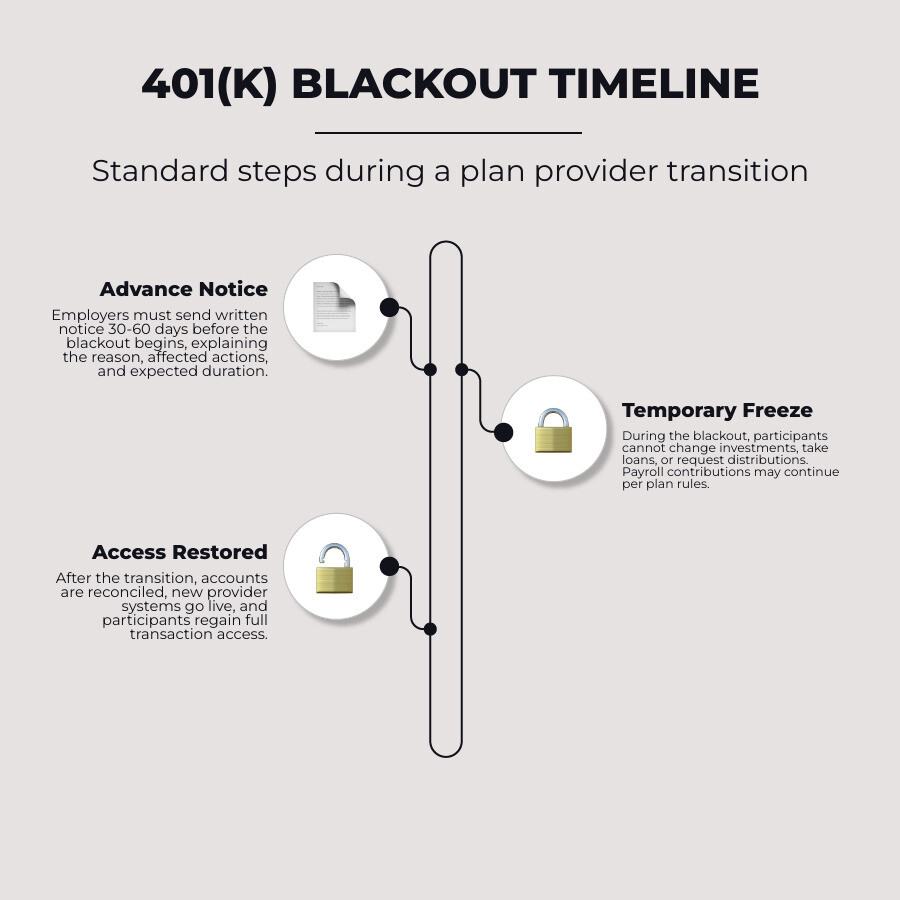
A 401(k) blackout period is a temporary pause on certain account transactions, often needed when an employer changes plan providers. Employees may be unable to change investments, request loans, or take distributions. Payroll contributions may continue, depending on how the transition is handled.
If you sponsor a plan, tell employees why the pause is happening, which actions are affected, and when access is expected to return. Federal rules generally require written notice at least 30 days, but no more than 60 days, before the last date employees can take the affected actions, with limited exceptions. Clear dates and a contact for questions can help employees plan around the pause.
Understanding the 401(k) blackout period: Definition and common triggers
Under Section 101(i) of the Employee Retirement Income Security Act (ERISA) and Department of Labor (DOL) regulation 29 CFR § 2520.101-3, a blackout period is formally defined as any temporary suspension, limitation, or restriction lasting more than three consecutive business days that curbs a participant’s ability to direct investments, obtain loans, or take distributions.
These freezes do not happen because of financial market instability. Instead, they occur as a necessary operational step during major administrative updates. Common events that trigger a 401(k) blackout period include:
- Recordkeeper and Third-Party Administrator (TPA) Changes: Migrating participant records, historical data, and custodial assets from one platform to another requires a freeze so accounts reconcile cleanly without moving targets.
- Corporate Mergers and Acquisitions: When two corporate entities merge, their individual retirement plans are often consolidated into a single plan structure.
- Investment Lineup Restructuring: Overhauling the core mutual fund lineup, changing share classes, or introducing new asset classes involves mapping old assets into new funds.
- Major System Upgrades: Fundamental software conversions by your current recordkeeper may require a multi-day data freeze.
Understanding these operational triggers helps fiduciaries safeguard employee interests and clarify what are my rights as a 401(k) investor during corporate shifts.
How long does a 401(k) blackout period last?
While federal law defines a blackout period as any restriction extending past three consecutive business days, there is no statutory maximum duration under ERISA.
A standard transition blackout typically lasts around 10 days, though total plan conversions can span 60 to 90 days from initial onboarding to final settlement. Simple investment lineup changes may freeze transactions for just a few days, whereas complex multi-company acquisitions or full recordkeeper migrations can take several weeks or up to two months. The blackout must remain in place only as long as necessary to complete asset transfers and audit account balances.
Participant rights and account restrictions during plan freezes

During a plan freeze, participants remain invested in the market, meaning account balances continue to fluctuate with standard market gains and losses. However, because trading is paused, participants cannot sell holdings or rebalance assets to shelter against short-term market swings.
This restriction is particularly relevant for accounts heavily concentrated in volatile assets or single company stock. Holding undiversified positions during an administrative freeze creates market risk because employees cannot trade to mitigate downturns. Reviewing what every investor needs to know about rebalancing a 401(k) before an administrative cutoff allows participants to establish appropriate risk levels across asset classes.
What actions are suspended during a 401(k) blackout period?
The following table summarizes which routine activities are restricted during a blackout and which operations generally proceed:
| Account Activity | Status During Blackout | Practical Notes |
|---|---|---|
| Payroll Deferrals | Permitted | Employee paycheck deductions continue as scheduled. |
| Employer Matching | Permitted | Employer match accruals and allocations continue subject to plan rules. |
| Portfolio Rebalancing | Restricted | Participants cannot buy, sell, or shift existing investments. |
| New 401(k) Loans | Restricted | Loan applications, processing, and disbursements are paused, if your plan allows loans. |
| Plan Distributions | Restricted | Hardship withdrawals, in-service distributions, and age 59½ withdrawals are paused, if your plan allows them. |
| Rollovers Out | Restricted | Transfers to external IRAs or outside workplace plans cannot be initiated. |
| Ongoing Loan Repayments | Permitted | Automatic payroll deductions for existing loan repayments continue. |
Plan administrators must explain the difference between a 401(k) loan and 401(k) withdrawal so employees facing emergency expenses can plan for temporary processing pauses. Because loan, hardship withdrawal, and in-service distribution features vary by employer, participants should review their Summary Plan Description to confirm which options their plan allows.
401(k) blackout notice requirements for plan sponsors

Federal regulations establish strict 401(k) blackout notice requirements to give participants adequate time to assess their portfolios. Modern rules trace back to major federal policy developments, including historical pension protection reforms designed to ensure fair notice and restrict insider advantages during plan lockouts.
Under ERISA rules, plan administrators must furnish written notice to all affected participants and beneficiaries at least 30 days—and no more than 60 days—before the last date on which participants can exercise affected rights before the freeze.
The DOL allows two narrow exceptions to the 30-day advance notice requirement:
- Fiduciary Duty Violations: When deferring the blackout start date to satisfy the 30-day window would result in a violation of ERISA fiduciary obligations (such as an immediate financial collapse of an investment manager).
- Unforeseeable Circumstances: When events entirely beyond the plan administrator’s control (such as sudden vendor bankruptcies or natural disasters) prevent timely delivery.
In either case, a fiduciary must document the determination in writing and issue the notice as soon as reasonably possible. Plan administrators that fail to provide compliant advance notices may face civil penalties assessed by the DOL of up to several hundred dollars per participant per day of non-compliance.
Essential elements of a compliant blackout notice
The DOL provides a model notice template that plans may use. To remain fully compliant with 29 CFR § 2520.101-3, every blackout notice must include:
- Reasons for the Freeze: A plain-English explanation of why the blackout is occurring (such as a recordkeeper conversion or fund restructuring).
- Identification of Suspended Rights: A list of all paused transactions, including asset rebalancing, loan originations, and cash distributions.
- Expected Dates: The exact beginning and ending dates of the blackout period, or the specific calendar weeks during which access will be suspended.
- Investment Evaluation Advisory: A formal statement advising participants to review their current investment holdings before the blackout begins, noting the risk of single-asset volatility while trading is paused.
- Plan Contact Information: The name, toll-free telephone number, and address of the plan administrator or designated representative responsible for answering transition questions.
Best practices for minimizing disruption and reopening accounts
Transitioning workplace plans requires active coordination between human resources, payroll managers, and incoming recordkeepers. Follow these practical steps to minimize administrative friction:
- Coordinate Payroll Software Schedules: Work with your payroll provider to maintain uninterrupted payroll deductions and match contributions throughout the transition window.
- Establish Multi-Channel Communications: Supplement mandatory written notices with email reminders and informational webinars explaining key cutoff dates.
- Review Fund Mapping Protocols: Ensure that investment options from the old lineup map into comparable asset categories on the new platform.
- Confirm Post-Blackout Balances: Once the freeze lifts, notify participants promptly and encourage them to log in, review starting balances, and verify their beneficiary designations.
Key takeaways for employers and plan fiduciaries
- Federal Notice Timelines: Employers must provide written blackout notices at least 30 days (and no more than 60 days) in advance of any account freeze exceeding three consecutive business days.
- Continued Contributions: Regular employee deferrals and employer matching contributions generally continue during a freeze, while trading, distributions, and loans pause.
- Duration Standards: Blackout periods average around 10 days, but complex conversions may take several weeks; ERISA specifies no legal maximum, but fiduciaries must limit the duration to what is operationally required.
- Fiduciary Responsibility: Plan sponsors retain an obligation to monitor transition accuracy, provide accessible administrator contacts, and verify final asset reconciliation upon reopening.
Frequently asked questions about 401(k) blackouts
Can employees continue contributing payroll deferrals during a blackout?
Yes. Scheduled payroll deductions and matching contributions generally continue without interruption. The payroll department deducts deferrals as usual and remits them to the new plan custodian once administrative connectivity is complete.
What happens if an employer fails to provide the required 30-day notice?
Failure to deliver timely written notice without an approved statutory exception can result in substantial DOL civil penalties against the plan administrator. Employers must furnish a written explanation signed by a plan fiduciary if emergency circumstances prevent the standard 30-day advance delivery.
Can participants take hardship distributions or emergency loans during a freeze?
No. All loan originations, hardship distributions, and non-emergency withdrawals are paused during the blackout window. Participants who anticipate needing immediate funds should submit required documentation before the pre-blackout transaction cutoff date.
Managing plan transitions responsibly
Navigating provider transitions, regulatory disclosures, and operational freezes requires consistent fiduciary attention. When evaluating your company’s retirement benefit structure, utilizing reliable administrative systems can help ensure compliance.
If you want to simplify retirement plan administration, explore how the 401(k) Maneuver pooled employer plan works by visiting our payroll integrations overview.
Disclosure: 401(k) Maneuver is a business name of Royal Fund Management, LLC, an SEC-registered investment adviser. This material is provided for educational and informational purposes only and does not constitute individual legal, tax, or investment advice. Investing in securities involves risk of loss that investors should be prepared to bear. Diversification, asset allocation, and account rebalancing strategies do not guarantee profits or protect against losses in declining markets. Plan rules, withdrawal options, and administrative features vary; consult your plan’s Summary Plan Description (SPD) or qualified legal counsel regarding specific compliance requirements.