

401(k) Required Minimum Distributions (RMDs): Ages and Rules
What is an RMD for 401(k) plans and how does it work?
A required minimum distribution is the baseline amount the Internal Revenue Service (IRS) requires you to withdraw annually from tax-deferred workplace savings plans. Because traditional 401(k) contributions and investment earnings accumulate tax-deferred, the federal government mandates these withdrawals to ensure it eventually collects ordinary income taxes on those balances.
Understanding how RMD changes protect your retirement savings helps you plan distributions without triggering unnecessary tax spikes or compliance penalties. RMD rules apply across various tax-deferred retirement accounts, but specific administrative guidelines govern workplace 401(k) plans differently than individual retirement accounts (IRAs).
Determining your 401(k) RMD age under SECURE 2.0
The SECURE 2.0 Act established an updated phased schedule for mandatory distribution ages based on your birth year. The table below outlines when you must begin taking annual distributions:
| Birth Year Range | Mandatory RMD Starting Age |
|---|---|
| 1950 or earlier | Age 72 (or 70½ if born before July 1, 1949) |
| 1951 through 1959 | Age 73 |
| 1960 or later | Age 75 |
The still-working exception for current employer plans
If you continue working past your standard RMD age, you may be eligible for the “still-working” exception. This rule allows you to postpone RMDs from your current employer’s 401(k) plan until April 1 of the calendar year following the year you retire.
To qualify for this delay, two conditions must be met:
- You must not own more than 5% of the business sponsoring the retirement plan.
- Your employer’s specific plan document must permit the deferral.
You cannot use the still-working exception for traditional IRAs or 401(k) plans from prior employers. Check your Summary Plan Description or ask your plan administrator to confirm your plan’s adoption of this provision.
Essential 401(k) RMD rules, deadlines, and penalties
Adhering to IRS distribution timelines prevents severe tax assessments. Learning how to avoid 401(k) withdrawal penalties requires tracking your initial Required Beginning Date and all subsequent annual distribution dates.
Critical deadlines: Required Beginning Date vs. annual withdrawals
Your initial RMD has a unique deadline known as the Required Beginning Date (RBD), which is April 1 of the year following the year you reach your RMD age (or the year you retire, if utilizing the still-working exception).
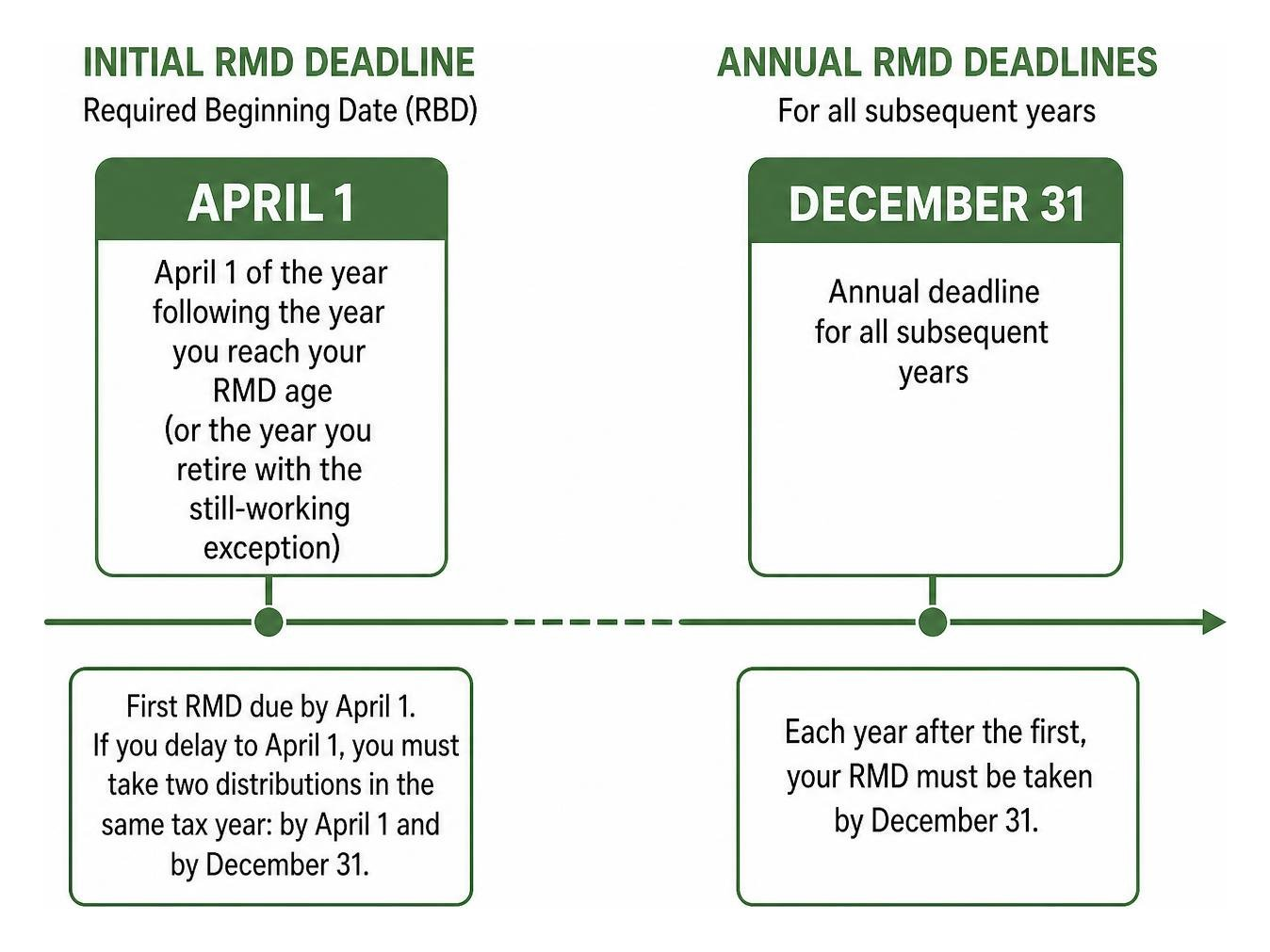
For all subsequent years, the annual deadline is December 31.
Delaying your initial distribution to April 1 requires you to take two distributions in that same tax year: your delayed first-year RMD by April 1, and your second-year RMD by December 31. This double distribution can push your taxable income into a higher federal tax bracket and potentially increase your Medicare Part B and Part D premiums through Income-Related Monthly Adjustment Amount (IRMAA) surcharges.
Missing an RMD: Excise taxes and correction steps
Under the SECURE 2.0 Act, the excise tax penalty for failing to take a full RMD is 25% of the shortfall amount. This penalty is reduced to 10% if you correct the error within a two-year correction window and submit the necessary documentation before the IRS assesses a formal deficiency notice.
If you miss a distribution due to reasonable error, you can submit IRS Form 5329 along with a letter explaining the oversight, detailing the corrective distribution, and requesting a waiver of the excise tax under reasonable cause provisions.
Step-by-step 401(k) RMD calculation and account aggregation
Calculating your 401(k) RMD requires dividing your prior year-end balance by an IRS life expectancy factor.
Calculating your annual 401(k) RMD amount
The standard formula uses the account balance on December 31 of the previous year divided by the distribution factor found in the IRS Uniform Lifetime Table (Table III in IRS Publication 590-B).
Formula: RMD = Prior December 31 Account Balance / IRS Life Expectancy Factor
| Account Owner’s Age | IRS Life Expectancy Factor | Distribution Percentage |
|---|---|---|
| 73 | 26.5 | 3.77% |
| 74 | 25.5 | 3.92% |
| 75 | 24.6 | 4.07% |
| 76 | 23.7 | 4.22% |
| 77 | 22.9 | 4.37% |
| 80 | 20.2 | 4.95% |
Hypothetical Example: A 73-year-old retiree with a traditional 401(k) balance of $500,000 on December 31 of the previous year divides $500,000 by 26.5, resulting in an annual RMD of $18,867.92.
If your sole primary beneficiary is your spouse and they are more than 10 years younger than you, you use the IRS Joint Life and Last Survivor Expectancy Table (Table II). This table provides a larger divisor, which reduces your annual mandatory withdrawal.
Multiple account rules: 401(k) plans vs. traditional IRAs
You cannot aggregate RMDs across different 401(k) plans. While traditional IRAs permit you to calculate RMDs for each account and withdraw the total amount from a single IRA, workplace 401(k) plans require separate calculations and separate distributions from each individual plan account.
Special considerations: Roth accounts, beneficiaries, and tax strategies

Workplace distributions require careful tax planning to avoid unexpected liabilities at filing time.
Roth 401(k) lifetime exemption and beneficiary rules
Under SECURE 2.0, designated Roth 401(k) accounts are exempt from lifetime RMDs, aligning their treatment with Roth IRAs. You are not required to take distributions from your Roth 401(k) during your lifetime.
After your death, distinct distribution rules take effect. Reviewing what happens to your 401(k) when you die clarifies how assets pass to heirs:
- Eligible Designated Beneficiaries (surviving spouses, minor children of the deceased, disabled or chronically ill individuals, or beneficiaries not more than 10 years younger than the owner) may take distributions over their remaining life expectancy.
- Non-Spouse Designated Beneficiaries must fully distribute the entire account balance within 10 years under the SECURE Act guidelines.
Strategies to manage RMD tax impact
Workplace 401(k) distributions are subject to a mandatory 20% federal income tax withholding, which is applied directly by your plan recordkeeper unless transferred via direct rollover. Consider these approaches to manage your distribution tax liability:
- In-Kind Distributions: If you do not need cash for living expenses, you can withdraw shares of stock or mutual funds in-kind and transfer them directly into a taxable brokerage account. You still pay ordinary income tax on the distribution value, but the assets remain invested.
- Pre-RMD Rollovers for Qualified Charitable Distributions (QCDs): 401(k) plans cannot process QCDs directly. However, rolling your traditional 401(k) into a traditional IRA before your RMD starting age allows you to execute direct charitable transfers up to the annual limit ($111,000 in 2026), satisfying your RMD without increasing adjusted gross income.
- Qualified Longevity Annuity Contracts (QLACs): You can use up to $210,000 of your retirement plan balance (indexed for inflation in 2026) to purchase a QLAC within your plan, if allowed, which defers RMD calculations on those funds up to age 85.
Key takeaways on 401(k) RMDs
- Starting Age: RMDs begin at age 73 for individuals born from 1951 through 1959, and age 75 for those born in 1960 or later.
- Still-Working Exception: You can delay RMDs from your current employer’s 401(k) past your starting age if you own 5% or less of the company and your plan allows it.
- Separate Plan Accounts: Unlike IRAs, you must calculate and withdraw RMDs separately from each individual 401(k) plan.
- Penalty Structure: Missing an RMD triggers a 25% excise tax on the undistributed amount, reducible to 10% if corrected within two years.
- Roth 401(k) Rules: Designated Roth 401(k) balances do not require lifetime RMDs.
Frequently asked questions about 401(k) RMDs
Can I roll over my 401(k) RMD into another tax-deferred account?
No. The IRS strictly prohibits rolling over required minimum distributions into an IRA, another 401(k), or any other tax-deferred vehicle. Once an amount is classified as an RMD, it must be distributed as taxable income.
What happens if I withdraw more than the required minimum distribution?
You may withdraw more than your required minimum distribution in any year. However, excess withdrawals cannot be applied or carried forward to satisfy RMD obligations in future tax years.
Does my employer still make contributions if I am taking RMDs while working?
Yes. If you continue working while receiving RMDs (such as a 5% owner subject to mandatory withdrawals), you remain eligible to make salary deferrals and receive employer matching contributions, provided you meet your plan’s eligibility terms.
Conclusion and next steps
Navigating required minimum distributions requires careful coordination between your age milestones, account balances, and tax considerations. Developing a structured withdrawal schedule helps maintain compliance with IRS mandates while keeping your retirement assets aligned with your financial goals.
If you have questions about structuring your workplace retirement savings or want an independent second opinion on managing your account, you can speak with a 401(k) Maneuver adviser at 1-877-218-5060 or learn how 401(k) Maneuver works.
Disclosure: 401(k) Maneuver is a business name of Royal Fund Management, LLC, an SEC-registered investment adviser. This article is provided for educational and informational purposes only and does not constitute individualized investment, tax, or legal advice. Investing involves risk of loss, and past performance or account management strategies such as rebalancing do not guarantee future profit or protect against loss. Consult a qualified tax professional or financial adviser regarding your specific situation.