

401k Auto Enrollment: What It Means for Employees and Employers
How 401(k) auto enrollment affects your paycheck
401(k) auto enrollment means your employer starts taking a plan-set percentage from your paycheck and putting it into your 401(k) unless you opt out. You can generally change your contribution rate or choose a different investment. Check your plan’s Summary Plan Description to see when deductions begin and what choices you have.
Auto enrollment can help employees start saving, but the default rate and investment may not fit everyone. Employers also need to follow the rules for their plan. Under SECURE 2.0, many new plans must use automatic enrollment for plan years beginning in 2025 or later, with exceptions that include very small and newer businesses. This guide explains those rules, automatic contribution increases, and the decisions worth reviewing.
Understanding 401(k) auto enrollment and how it works
To understand how this feature works, it helps to review the fundamentals of what is a 401(k). An automatic contribution arrangement permits an employer to deduct a specified default percentage from an eligible employee’s wages and deposit those funds directly into the retirement plan account.
These automated payroll deductions are typically made as pre-tax deferrals, which reduce your current taxable income. If your workplace plan allows it, the default contributions may be designated as Roth deferrals instead. Regardless of whether your savings are pre-tax or Roth, your own salary deferrals are always 100% immediately vested.
- Basic Automatic Enrollment: Enrolls employees at a set default percentage unless they opt out or select a custom rate.
- Eligible Automatic Contribution Arrangement (EACA): Adheres to specific annual notice guidelines and permits short-term permissible withdrawals.
- Qualified Automatic Contribution Arrangement (QACA): Combines mandatory annual contribution increases with safe harbor employer contributions.
Every employer plan document specifies its own eligibility criteria, entry dates, and default withholding percentages. Review your plan’s Summary Plan Description (SPD) to confirm the specific features and timelines that govern your account.
How 401(k) auto enrollment differs from auto-escalation
While automatic enrollment establishes your initial payroll contribution, automatic escalation is a separate plan feature designed to adjust your savings rate over time. Under an auto-escalation schedule, the plan increases your contribution percentage—frequently by 1% each year—until it reaches a predetermined cap, such as 10% or 15% of your pay.
These annual increases are plan design choices rather than universal mandates for older plans. According to a 2024 National Bureau of Economic Research (NBER) working paper, automatic enrollment alone increased employee net contribution rates by an average of 0.6% of income over five years, while pairing enrollment with automatic escalation increased contributions by 0.8% of income over the same period.
Basic enrollment, EACA, and QACA plan structures
Under guidance published by the Internal Revenue Service (IRS), automatic enrollment arrangements generally follow one of three standard designs:
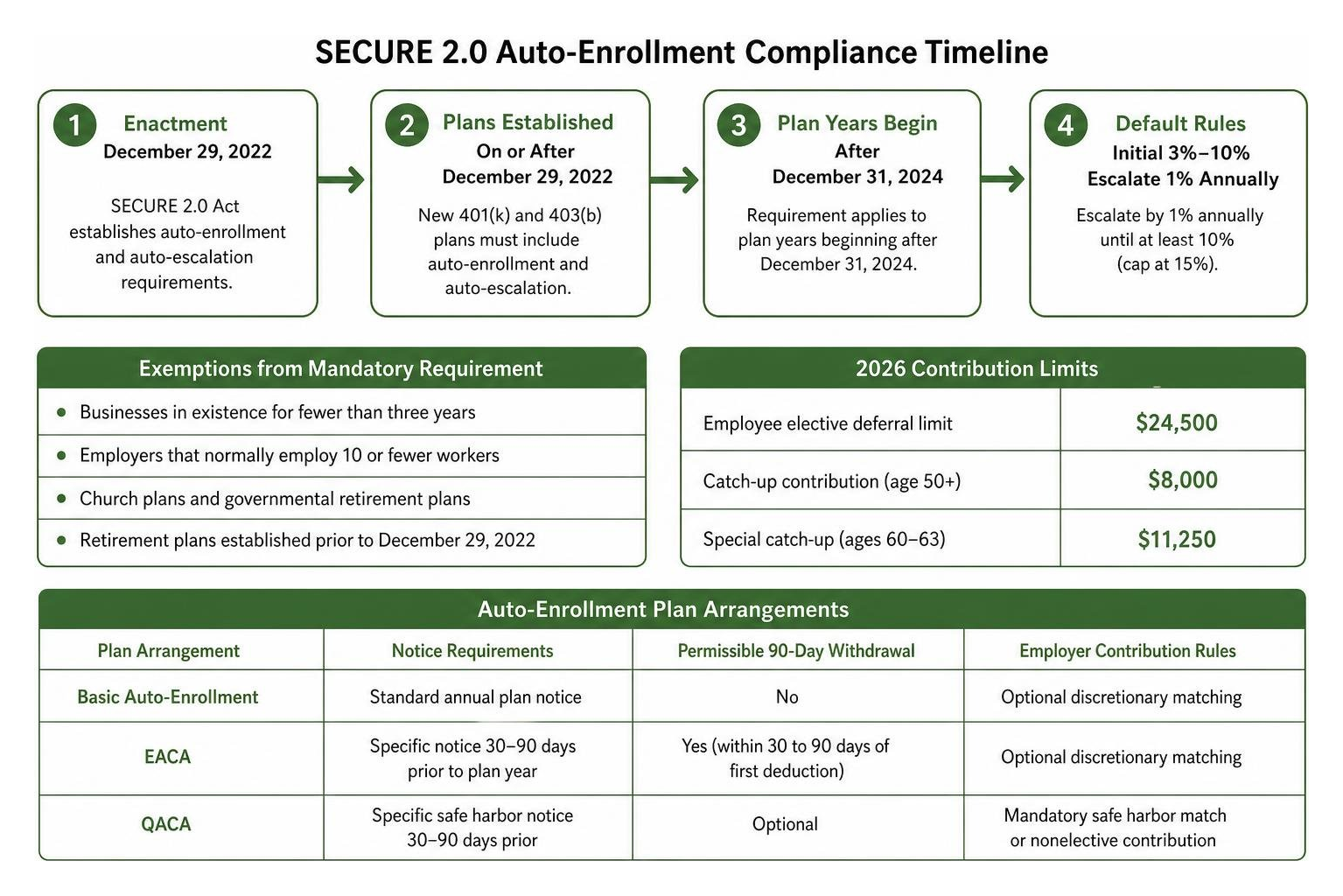
| Plan Arrangement | Notice Requirements | Permissible 90-Day Withdrawal | Employer Contribution Rules |
|---|---|---|---|
| Basic Auto-Enrollment | Standard annual plan notice | No | Optional discretionary matching |
| EACA | Specific notice 30–90 days prior to plan year | Yes (within 30 to 90 days of first deduction) | Optional discretionary matching |
| QACA | Specific safe harbor notice 30–90 days prior | Optional | Mandatory safe harbor match or nonelective contribution |
An EACA grants employees a specific 30- to 90-day window following their first automatic deduction to opt out and request a full refund of their salary deferrals without standard early distribution penalties. A QACA provides employers with safe harbor relief from annual nondiscrimination testing in exchange for mandatory employer contributions and structured annual deferral increases.
SECURE 2.0 requirements and default contribution rules
Section 101 of the SECURE 2.0 Act mandates that new 401(k) and 403(b) plans established on or after December 29, 2022, must include automatic enrollment and automatic escalation provisions for plan years beginning after December 31, 2024. These plans must set an initial default contribution rate between 3% and 10% of compensation, escalating by 1% annually until reaching at least 10% (capped at a maximum of 15%).
Certain employers remain exempt from this mandatory requirement:
- Businesses that have been in existence for fewer than three years
- Small employers that normally employ 10 or fewer workers
- Church plans and governmental retirement plans
- Pre-existing retirement plans established prior to December 29, 2022
For tax year 2026, standard employee elective deferrals are subject to federal limits established by the IRS contribution guidance. The basic deferral limit is $24,500, with a standard catch-up contribution limit of $8,000 for workers aged 50 and older, and a special catch-up limit of $11,250 for participants aged 60 through 63.
Setting default contribution rates and aligning the employer match
When considering how much should I contribute to my 401(k), the plan’s default rate provides a baseline, but it may not capture your full workplace benefits. If a company sets a default enrollment rate of 3%, but provides a dollar-for-dollar employer match up to 5% of compensation, employees who remain at the default rate will leave part of their match unclaimed.
Employer matching formulas and vesting schedules vary widely across workplace plans. Depending on your employer’s plan design, matching funds may vest immediately or follow a graded schedule over several years. Consult your Summary Plan Description to ensure your chosen deferral percentage can help you capture the full company match available to you.
Default investment selections: qualified default investment alternatives (QDIAs)
When an employee is auto-enrolled and does not manually select an investment portfolio, the plan sponsor directs their contributions into a Qualified Default Investment Alternative (QDIA). Under regulations established by the U.S. Department of Labor (DOL), plan fiduciaries receive safe harbor liability protection for investment performance when using approved QDIAs.

Permissible QDIAs typically include:
- Target-Date Funds (Lifecycle Funds): Portfolios that adjust their asset allocation over time, shifting toward more conservative investments as the target retirement year approaches.
- Balanced Funds: Portfolios maintaining a diversified mix of equity and fixed-income assets tailored to a broader group of investors.
- Managed Accounts: Professionally managed portfolios that allocate assets based on participant-specific demographic factors.
Federal regulations require that participants must have the opportunity to reallocate their investments out of a default QDIA into any other available plan option at least quarterly, without incurring financial penalties or surrender fees.
Benefits, drawbacks, and employee rights
Automatic enrollment helps overcome inertia and establishes structured savings habits from your first eligible pay period, allowing you to take advantage of the 5 perks of saving for retirement in a 401(k). According to a 2018 research report by Vanguard, automatic enrollment significantly increases participation rates among young, lower-income, and minority workers.
There are practical trade-offs to consider alongside these benefits. Setting a default contribution rate without reviewing personal cash flow can constrain households that lack sufficient short-term emergency funds. According to a 2023 ADP Research Institute report, 44% of workers maintain less than $1,000 available for unexpected expenses. Furthermore, the 2024 NBER study found that roughly 42% of plan balances are cashed out upon job separation, creating retirement asset leakage that can diminish long-term financial security.
Can employees opt out of 401(k) auto enrollment?
Employees always maintain the right to opt out of workplace retirement plan participation or adjust their deferral percentage. Plan administrators must provide an automatic enrollment notice between 30 and 90 days before deductions begin, detailing your default rate, investment allocation, and opt-out instructions.
If your plan operates as an EACA, you can request a permissible withdrawal within 30 to 90 days of your initial payroll deduction. The plan will return your salary deferrals adjusted for any market gains or losses. The refunded amount is taxable as ordinary income in the year distributed, and any associated employer matching contributions are forfeited back to the plan.
Key takeaways on automatic workplace retirement plans
- Automatic enrollment begins payroll contributions at a plan-specified default rate unless you proactively change it or opt out.
- Default contribution rates may not match the percentage needed to capture your full employer match.
- Contributions for non-directing participants are invested in default QDIAs, such as target-date or balanced funds.
- Under EACA arrangements, employees generally have 90 days to opt out and request a refund of initial salary deferrals.
- You can review your Summary Plan Description at any time to verify contribution rules, vesting schedules, and investment options.
Frequently asked questions about automatic 401(k) plans
What happens if I do nothing when auto-enrolled in a 401(k)?
If you take no action, your employer deducts the default contribution rate from your paycheck and allocates the money into the plan’s chosen QDIA. Deductions continue automatically, and annual auto-escalation may increase your contribution rate if your plan includes that feature.
Can I withdraw money if I was automatically enrolled by mistake?
If your employer utilizes an Eligible Automatic Contribution Arrangement (EACA), you can request a permissible withdrawal of your deferrals within 30 to 90 days of your first contribution. Returned deferrals are subject to income tax, and matching contributions linked to those deferrals will be forfeited.
Do employers match automatic contributions?
Employer matching depends on your workplace plan design. While standard plans may offer discretionary matches, QACA arrangements require specific minimum matching or nonelective contributions. Check your plan’s Summary Plan Description for exact match formulas and vesting schedules.
Conclusion
Automatic enrollment can serve as a helpful mechanism to begin saving for the future, but relying on default settings over the long term may not align with your specific retirement goals. Taking time to review your contribution rate, employer matching formula, and asset allocation can help ensure your workplace savings strategy fits your individual needs.
If you would like a second opinion on your workplace retirement account, our independent fiduciary team is here to assist. Visit How It Works to learn how the 401(k) Maneuver team provides personalized, quarterly account management.
Disclosure: 401(k) Maneuver is a business name of Royal Fund Management, LLC, an SEC-registered investment adviser. This article is for educational purposes only and does not constitute personalized investment, legal, or tax advice. Investing involves risk of loss, and past performance is no guarantee of future results. Consult with qualified legal, tax, or financial professionals regarding your personal circumstances.