

401(k) Contribution Limits: How They Work and This Year’s Numbers
401(k) contribution limits for 2026
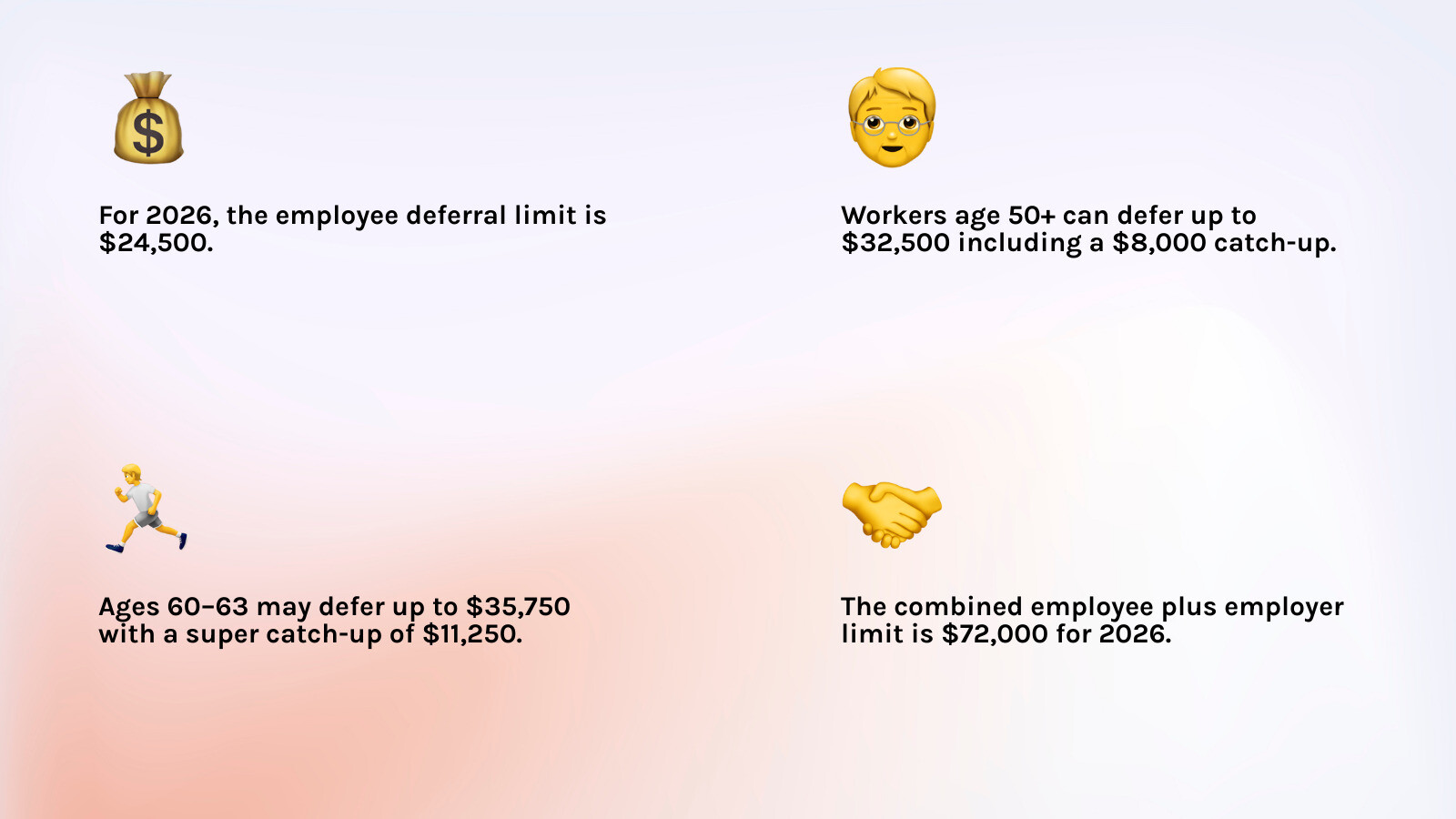
For the 2026 tax year, you can contribute up to $24,500 of your pay to a 401(k). If you turn 50 or older by year-end, the limit is $32,500. If you turn 60 to 63, it is $35,750 if your plan allows the higher catch-up contribution. These figures come from the IRS’s 2026 limit announcement.
A separate limit applies to contributions from you and your employer combined: generally $72,000 for 2026, before catch-up contributions, subject to pay and plan rules. Traditional and Roth 401(k) contributions share one employee limit. The rest of this guide explains how these 401(k) contribution limits fit together and what to check if you have more than one plan.
Understanding 2026 401(k) contribution limits and annual caps
Retirement planning requires keeping track of several moving targets. The Internal Revenue Service (IRS) adjusts annual contribution caps under Internal Revenue Code (IRC) Section 402(g) for cost-of-living increases. Knowing these numbers helps you budget your paychecks and take full advantage of tax-advantaged savings opportunities.
For a broader perspective on how workplace plans coordinate with individual accounts, reviewing 401(k) IRA contribution limits for 2026 can provide clarity across your complete retirement portfolio.
| Contribution Category | 2025 Tax Year | 2026 Tax Year |
|---|---|---|
| Employee Elective Deferrals | $23,500 | $24,500 |
| Catch-Up Contribution (Age 50+) | $7,500 | $8,000 |
| Super Catch-Up (Ages 60–63) | $11,250 | $11,250 |
| Overall Combined Limit (Employee + Employer) | $70,000 | $72,000 |
| Compensation Cap | $350,000 | $360,000 |
| SIMPLE 401(k) Deferral Limit | $16,500 | $17,000 |
Source: Internal Revenue Service (IRS) cost-of-living adjustments for 2025 and 2026.
Employee elective deferrals and the maximum 401(k) contribution
The employee elective deferral is the portion of your salary that you choose to send directly into your workplace retirement plan. For the 2026 tax year, the maximum 401(k) contribution you can defer as an employee is $24,500. This threshold applies across standard traditional pre-tax contributions and Roth post-tax contributions in traditional and safe harbor plans.
If your employer offers a SIMPLE 401(k) plan, a separate limit applies. Under IRS rules, the elective deferral limit for a SIMPLE 401(k) is $17,000 for 2026, with an allowable catch-up limit of $4,000 for participants age 50 and older (or $5,250 for ages 60 to 63 under SECURE 2.0).
Employer contributions and the total 401(k) investment limit
Beyond what you elect to withhold from your paycheck, your company may provide matching or nonelective profit-sharing contributions. These additions fall under IRC Section 415(c), which establishes an overall 401(k) investment limit.
For 2026, the combined annual addition from both employee deferrals and employer contributions cannot exceed the lesser of 100 percent of your compensation or $72,000. Additionally, the IRS caps the amount of annual compensation that can be factored into contribution calculations at $360,000 for 2026. You can use a workplace 401(k) calculator to model how matching formulas interact with your elective deferrals.
Catch-up contributions for older workers

As you approach retirement, saving extra funds can help strengthen your nest egg. Catch-up contributions allow participants who reach certain age thresholds to exceed the standard employee elective deferral ceiling.
Age 50+ catch-up rules and 401(k) contribution limits
If you are age 50 or older by December 31, 2026, you are eligible to make an additional catch-up contribution of $8,000 if your plan permits. This brings your total personal deferral limit to $32,500 for the year.
When factored into the total employer-and-employee cap under Section 415(c), your potential combined additions rise to $80,000 for 2026. For a deeper breakdown of eligibility timelines, consult our guide on 401(k) catch-up contribution rules for 2026.
SECURE 2.0 super catch-up for ages 60 to 63
Under the SECURE 2.0 Act, a special higher catch-up contribution applies to employees who reach ages 60, 61, 62, or 63 during the calendar year. For the 2026 tax year, this super catch-up limit is $11,250 instead of the standard $8,000.
This brings the maximum employee deferral for participants in this age bracket up to $35,750, while raising their overall combined Section 415(c) limit to $83,250. That this higher tier is optional for plan sponsors, so check your plan’s Summary Plan Description to confirm adoption. Once you reach age 64, your catch-up ceiling reverts to the standard age 50+ limit.
High-earner Roth catch-up requirements in 2026
A significant rule change effective January 1, 2026, under the SECURE 2.0 framework impacts higher-earning workers. According to official IRS guidance on 401(k) contributions, if your Social Security (FICA) wages from the employer sponsoring the plan exceeded $150,000 in the preceding calendar year (2025), all catch-up contributions must be designated as after-tax Roth contributions.
This rule means you will not receive an immediate pre-tax deduction on your catch-up amount. However, your earnings and future qualified distributions can be withdrawn tax-free in retirement. If your plan does not offer a Roth feature, high-earning participants may be unable to make catch-up contributions until the plan is updated.
Traditional vs. Roth and after-tax contributions
When funding your 401(k), you have options regarding how and when your money is taxed. Traditional pre-tax contributions reduce your current-year taxable income, with taxes deferred until distributions occur in retirement. Roth 401(k) contributions are made with after-tax dollars, meaning no upfront tax deduction is taken, but qualified withdrawals in retirement are entirely tax-free.
Shared 401(k) contribution limits across account types
It is important to remember that traditional pre-tax and Roth workplace contributions share a single employee elective limit. For 2026, your combined salary deferrals across both account buckets cannot exceed $24,500 (or $32,500 / $35,750 if eligible for catch-up contributions). You may split your payroll withholding across both options—for instance, placing $14,500 into a traditional 401(k) and $10,000 into a Roth 401(k)—as long as the total remains within the annual cap.
After-tax 401(k) contributions and the mega-backdoor strategy

Some workplace plans offer a third bucket: voluntary non-Roth after-tax contributions. These are distinct from Roth deferrals and do not count toward your $24,500 employee elective deferral cap. Instead, they are governed by the overall Section 415(c) addition limit of $72,000 for 2026.
This feature is central to what financial planners refer to as the “mega-backdoor Roth” strategy:
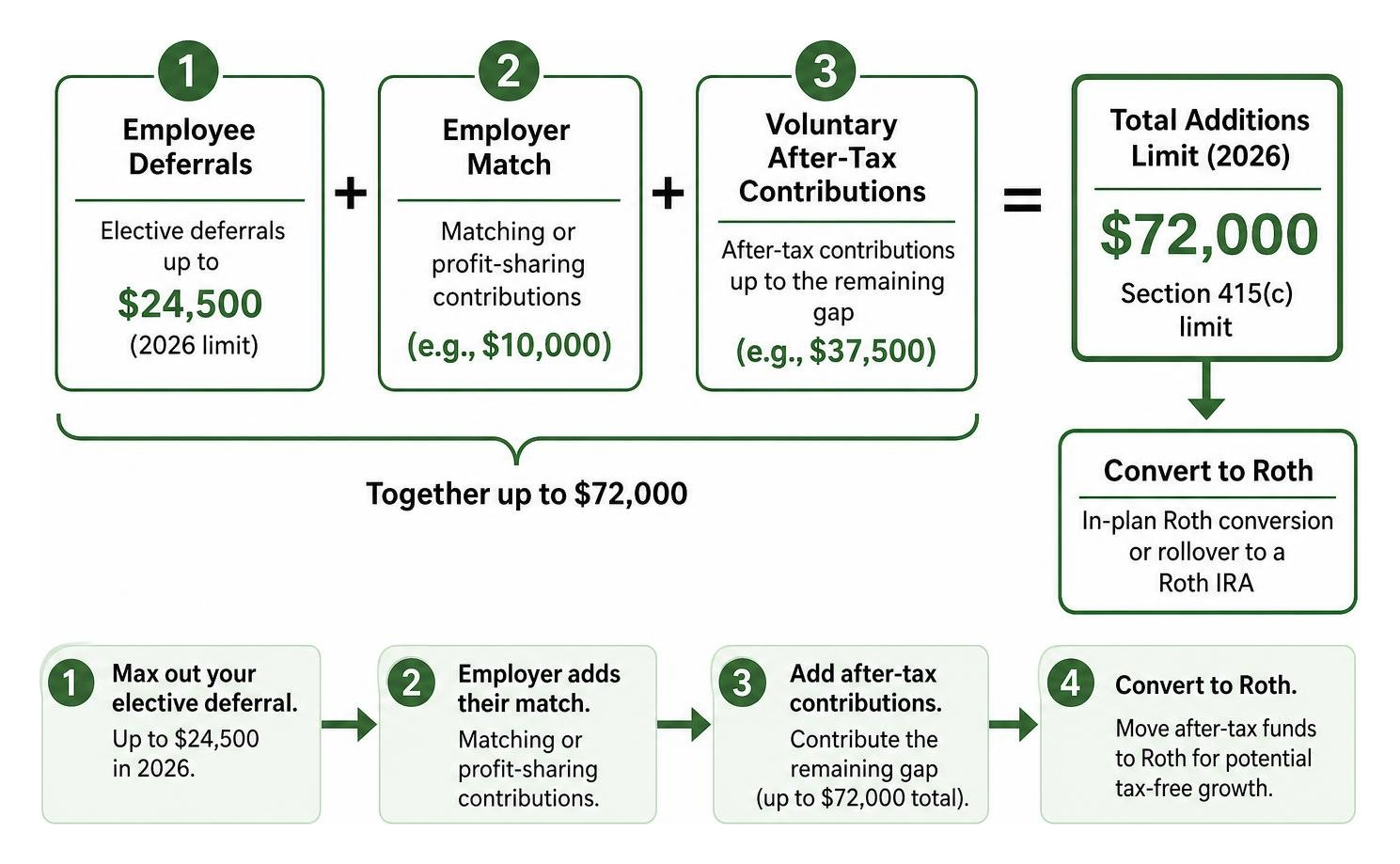
- You max out your standard elective deferral ($24,500 in 2026).
- Your employer deposits matching or profit-sharing contributions (e.g., $10,000).
- If permitted by your plan, you contribute the remaining gap ($37,500) as voluntary after-tax money.
- You execute an in-plan Roth conversion or rollover to a Roth IRA, moving those after-tax funds so future earnings may grow tax-free.
Always review your Summary Plan Description before attempting this strategy, as plans must explicitly allow voluntary after-tax deposits and in-service distributions or conversions.
Special rules, excess deferrals, and plan interactions
Your total annual retirement savings can also be shaped by administrative plan testing and external account coordination. The IRS enforces nondiscrimination tests—such as the Actual Deferral Percentage (ADP) test—to ensure 401(k) plans do not disproportionately favor business owners and Highly Compensated Employees (HCEs).
For 2026, an employee is generally classified as an HCE if their compensation from the business exceeded the IRS-defined threshold in the prior year. If a traditional plan fails these tests, HCEs may have a portion of their contributions refunded as taxable income. Safe harbor 401(k) plans bypass these tests by committing to specific mandatory employer contributions.
| Account Type | 2026 Base Limit | 2026 Catch-Up Limit | Key Eligibility Rule / Milestone |
|---|---|---|---|
| 401(k) / 403(b) | $24,500 | $8,000 (Age 50+) / $11,250 (Ages 60–63) | Workplace plan sponsored by employer |
| Traditional / Roth IRA | $7,500 | $1,100 (Age 50+) | Income phaseouts apply for deductibility/Roth |
| Health Savings Account (HSA) | $4,400 (Self) / $8,750 (Family) | $1,000 (Age 55+) | Requires qualifying High Deductible Health Plan |
Source: IRS revenue procedures and cost-of-living notices for 2026.
Multiple 401(k) plans and aggregated 401(k) contribution limit rules
If you change jobs mid-year or participate in two unrelated employer plans simultaneously, your employee elective deferral limit ($24,500 in 2026) applies to you as an individual across all plans. You cannot contribute $24,500 at Company A and another $24,500 at Company B in the same tax year.
However, the overall Section 415(c) limit of $72,000 applies per unrelated employer. If you work for two completely unaffiliated companies, or have a W-2 job alongside a side business with a Solo 401(k), each unrelated plan can receive up to $72,000 in total additions, provided your total employee elective deferrals across all plans stay within the $24,500 limit.
Correcting excess contributions before tax deadlines
If you inadvertently exceed your elective deferral limit across one or more plans, you must act promptly to avoid double taxation:
- Notify Your Plan Administrator: Inform your plan administrator in writing as soon as you identify the overcontribution.
- Request a Corrective Distribution: Request that the excess amount, plus any attributable investment earnings, be distributed to you.
- Meet the April 15 Deadline: Under IRS regulations, this corrective distribution must be completed by the tax-filing deadline (generally April 15 of the year following the excess deferral).
- Report on Form 1099-R: The returned excess deferral is reported as taxable income for the year it was contributed, while the earnings are taxed in the year they are distributed.
Failing to correct an excess contribution before the deadline results in double taxation: the excess amount is taxed in the year contributed and taxed again when ultimately withdrawn in retirement.
Key takeaways
- Employee Deferral Cap: The standard limit for employee elective deferrals in 2026 is $24,500 across pre-tax and Roth accounts.
- Older Worker Catch-Ups: Participants age 50 and older can add $8,000 (totaling $32,500), while those aged 60 to 63 have access to a special $11,250 super catch-up (totaling $35,750) if their plan allows.
- High-Earner Roth Rule: Starting in 2026, employees with prior-year FICA wages above $150,000 must allocate all catch-up contributions to a Roth account.
- Combined Additions: The total limit for employee and employer contributions combined under Section 415(c) is $72,000 (or up to $83,250 with catch-ups).
- Annual Coordination: The elective limit applies to you as an individual across all workplace plans, requiring careful tracking if you change employers mid-year.
Frequently asked questions about 401(k) contributions
What is the maximum 401(k) contribution for 2026?
For 2026, the maximum employee elective deferral is $24,500. When factoring in employer matching and profit-sharing contributions, the overall additions limit across employee and employer sources is $72,000 (or $80,000 for age 50+, and $83,250 for ages 60 to 63).
How does the 2026 super catch-up contribution work?
Under the SECURE 2.0 Act, participants who turn 60, 61, 62, or 63 during the 2026 tax year can contribute an extra $11,250 above the standard $24,500 limit, for a personal deferral total of $35,750. This higher tier depends on whether your employer’s plan has adopted the provision.
What happens if you accidentally overcontribute to a 401(k)?
If you contribute more than the annual statutory cap, you should contact your plan administrator to request a corrective distribution of the excess funds and attributable earnings before the April 15 tax deadline to prevent the excess amount from being taxed twice.
Conclusion and next steps
Staying informed about annual 401(k) contribution thresholds helps you optimize your tax deductions, make full use of company matches, and structure a disciplined retirement path. Because workplace plan rules, vesting schedules, and investment menus vary, regular review of your account settings ensures you remain aligned with your long-term financial goals.
If you are looking for personalized, ongoing management of your workplace retirement plan, the 401(k) Maneuver team acts as an independent fiduciary to review your portfolio quarterly, rebalance holdings, and manage downside risk. We invite you to learn more about how it works for a no-pressure conversation about your workplace account.
Disclosure: This article is provided for educational and informational purposes only and does not constitute individualized investment, legal, or tax advice. Investing involves risk of loss, and diversification or rebalancing does not guarantee profit or protect against market losses. Consult a qualified financial adviser, CPA, or tax professional regarding your specific situation before making financial decisions.