

401(k) Plan Design Basics: The Choices Every Employer Makes
How to approach 401(k) plan design
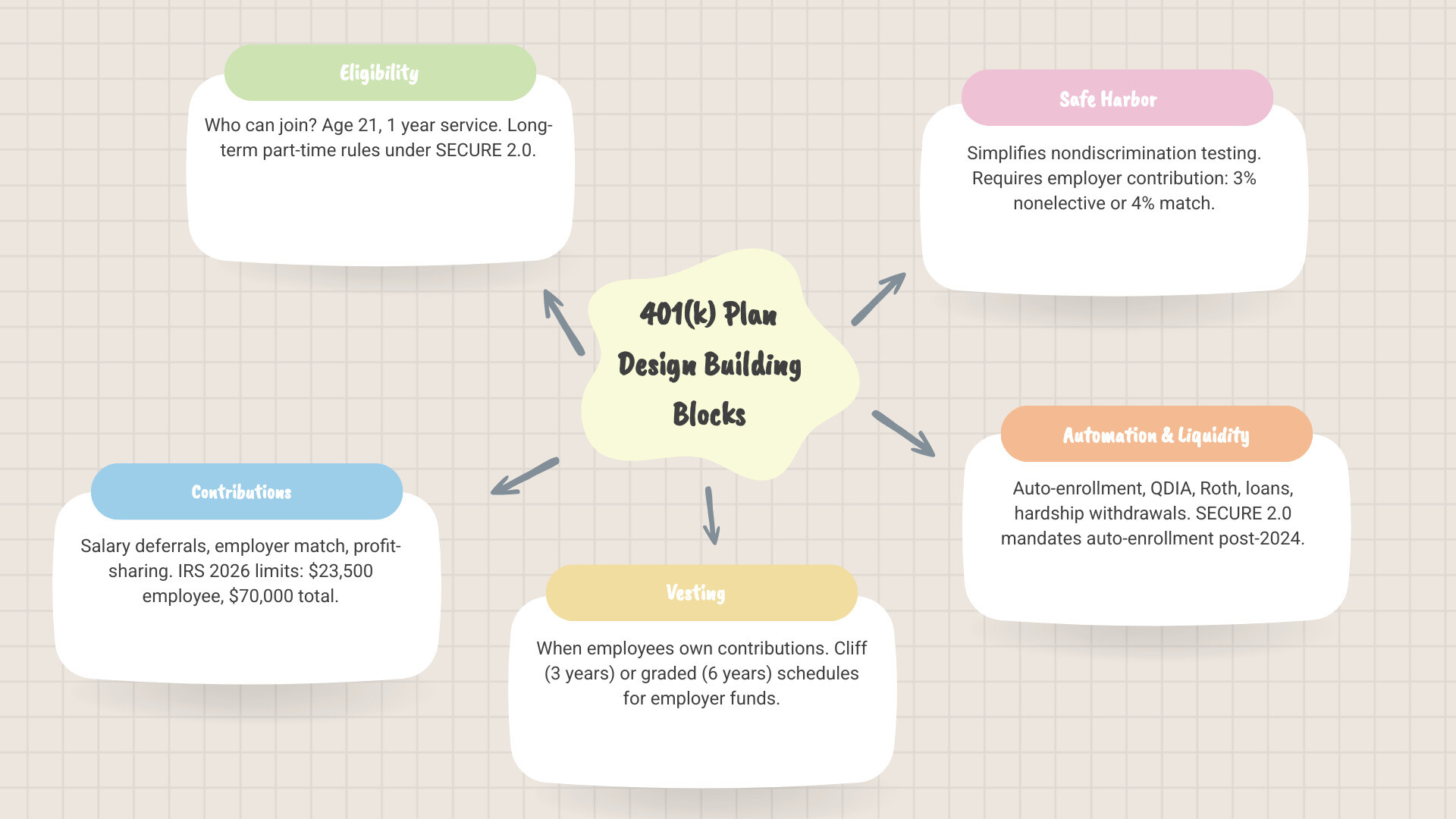
Start 401(k) plan design with 3 questions: Who can join? What will the business contribute? When will employees own those contributions? Then decide whether a safe harbor design, which requires employer contributions but can simplify certain compliance tests, fits your goals.
Other choices include Roth contributions, automatic enrollment, loans, and the investment menu and default. If you are considering a pooled employer plan (PEP), ask which features you can customize. Each choice affects what employees experience, what the business may spend, and the duties you must oversee.
Essential 401(k) plan design terms:
Essential Elements of 401(k) Plan Design
When structuring a retirement plan, defining plan compensation is one of your most foundational operational steps. Plan documents must specify whether compensation means standard Form W-2 wages, Section 3401(a) withholding wages, or a statutory safe harbor definition under Internal Revenue Code (IRC) Section 415. Exclusions—such as bonuses, overtime, or commissions—must satisfy nondiscrimination rules to ensure the definition does not disproportionately favor business owners or highly paid executives.
Federal law establishes annual boundaries on total additions to a participant’s account. For 2026, employee elective deferrals are capped at $24,500, with an additional catch-up contribution limit of $8,000 for participants age 50 and older (or a higher limit of $11,250 for individuals aged 60 through 63), pursuant to IRS contribution limits. The overall limit for all employer and employee additions under IRC Section 415(c) is capped at $70,000 (or $78,000 including standard catch-up contributions) for the 2026 tax year. Furthermore, the IRS highly compensated employee (HCE) compensation threshold is $160,000 for 2026 determinations based on 2025 lookback compensation.
Aligning 401(k) Plan Design with Eligibility and Vesting Rules
Eligibility conditions govern who can enter the plan and when. Federal regulations allow employers to require that workers reach age 21 and complete one year of service (generally defined as 1,000 hours worked in a 12-month period) before becoming eligible. Alternatively, employers may offer immediate eligibility upon hire to support talent recruitment.
Under the SECURE 2.0 Act, long-term, part-time (LTPT) employees who work between 500 and 999 hours per year must be permitted to make elective salary deferrals once they meet specific service thresholds. Effective for plan years beginning after December 31, 2024, the service requirement for LTPT eligibility was reduced from three consecutive years to two consecutive years. Employers are not required to provide matching or nonelective contributions to LTPT participants, though tracking these hours remains mandatory for compliance.
Vesting determines when employees earn non-forfeitable ownership of employer-provided contributions; employee salary deferrals are always 100% immediately vested. When structuring an employer vesting schedule, employers typically choose between two primary options for matching or profit-sharing dollars:
- Cliff Vesting: Employees gain 100% ownership all at once after completing a set period of service (for example, a 3-year cliff, where vesting is 0% in years one and two, and 100% after year three).
- Graded Vesting: Employees earn ownership incrementally over time (such as a 6-year graded schedule: 20% after two years, 40% after three, 60% after four, 80% after five, and 100% after six years).
Structuring Matching Formulas and Profit-Sharing Allocations
Employer contributions can take several forms depending on corporate cash flow and retention goals. A basic matching formula matches a fixed percentage of employee deferrals up to a specific cap—for example, 50% on deferrals up to 6% of compensation. Tiered matching structures front-load incentives, such as 100% on the first 3% deferred and 50% on the next 2%.
Employers may also use discretionary profit-sharing contributions. These allow the company to share profits without committing to a fixed annual obligation. Contributions can be allocated using a standard pro-rata method based on relative compensation, or an integrated/new comparability formula that allocates larger shares to specific employee tiers while meeting nondiscrimination testing standards.
| Contribution Type | Common Formula Example | Statutory Vesting Rules | Testing Considerations |
|---|---|---|---|
| Standard Match | 50% match up to 6% of pay | Up to 3-year cliff or 6-year graded | Subject to ACP testing |
| Discretionary Profit Sharing | Pro-rata percentage of annual pay | Up to 3-year cliff or 6-year graded | Subject to general nondiscrimination tests |
| Basic Safe Harbor Match | 100% on first 3%, 50% on next 2% | 100% immediate vesting | Exempt from ADP/ACP testing |
| QACA Safe Harbor Match | 100% on first 1%, 50% on next 5% | Up to 2-year cliff permitted | Exempt from ADP/ACP testing |
Evaluating Traditional vs Safe Harbor Plan Structures

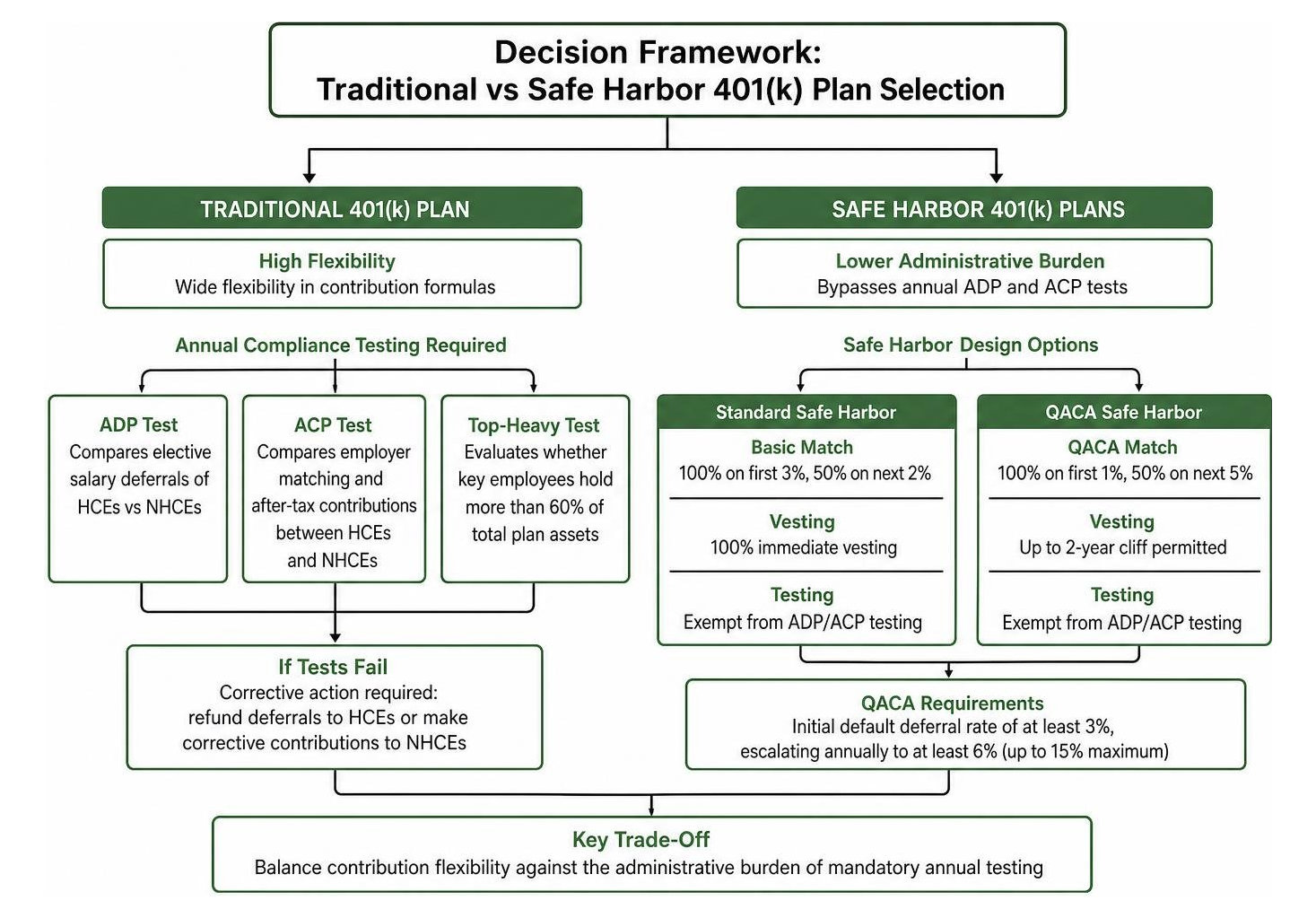
Choosing among various 401(k) plan design options involves balancing contribution flexibility against the administrative burden of mandatory annual nondiscrimination testing.
Traditional 401(k) Mechanics and Annual Testing
Traditional 401(k) plans provide employers with wide flexibility in contribution formulas, but they require annual compliance checks to ensure that contributions do not disproportionately favor owners and HCEs:
- Actual Deferral Percentage (ADP) Test: Compares elective salary deferrals of HCEs against non-highly compensated employees (NHCEs).
- Actual Contribution Percentage (ACP) Test: Compares employer matching and after-tax contributions between HCEs and NHCEs.
- Top-Heavy Test: Evaluates whether key employees (officers and significant owners) hold more than 60% of total plan assets.
If a traditional plan fails these tests, the employer must take corrective action, which often involves refunding deferrals to HCEs—creating unexpected taxable income—or making corrective contributions to non-highly compensated staff.
Safe Harbor Designs: Standard vs. QACA Arrangements
Safe harbor 401(k) plans bypass annual ADP and ACP tests entirely by providing mandatory, fully disclosed employer contributions. Under IRS regulations, standard safe harbor plans can satisfy requirements using either a basic match (100% on the first 3%, 50% on the next 2%), an enhanced match (such as 100% on the first 4%), or a 3% nonelective contribution made to all eligible employees regardless of whether they defer.
A Qualified Automatic Contribution Arrangement (QACA) safe harbor blends automatic enrollment features with a modified contribution requirement. A QACA requires an initial default deferral rate of at least 3%, escalating annually to at least 6% (up to a 15% statutory maximum). In exchange, employers can use a lower matching formula (100% on the first 1% and 50% on the next 5%) and may attach a 2-year cliff vesting schedule to those employer contributions, rather than the immediate 100% vesting mandated by standard safe harbor designs.
Boosting Participation with Automation and Modern Liquidity Rules
Modern plan features can influence how employees save and manage their accounts over time.
Automatic Enrollment and Participant Outcomes
Automatic enrollment helps overcome administrative inertia by automatically enrolling eligible employees into the plan unless they affirmatively opt out. Employers can choose among basic automatic contribution arrangements, Eligible Automatic Contribution Arrangements (EACA), and QACAs. Under an EACA, employees who are automatically enrolled are permitted to request a permissible withdrawal of their deferrals within 90 days of their first payroll deduction.
Under the SECURE 2.0 Act, new 401(k) plans established on or after December 29, 2022, are generally required to include mandatory automatic enrollment and automatic escalation provisions for plan years beginning after December 31, 2024, pursuant to IRS Notice 2024-2. The initial default deferral rate must be set between 3% and 10%, escalating by 1% each year until reaching at least 10% (up to a maximum of 15%). Statutory exceptions apply to businesses in operation for less than three years, employers with 10 or fewer employees, governmental and church plans, and plans established prior to December 29, 2022.
Default contributions must be directed into a Qualified Default Investment Alternative (QDIA), such as target-date funds, balanced funds, or professionally managed accounts, to afford sponsors fiduciary relief under ERISA Section 404(c)(5).
Loans, Hardships, and In-Service Distribution Rules
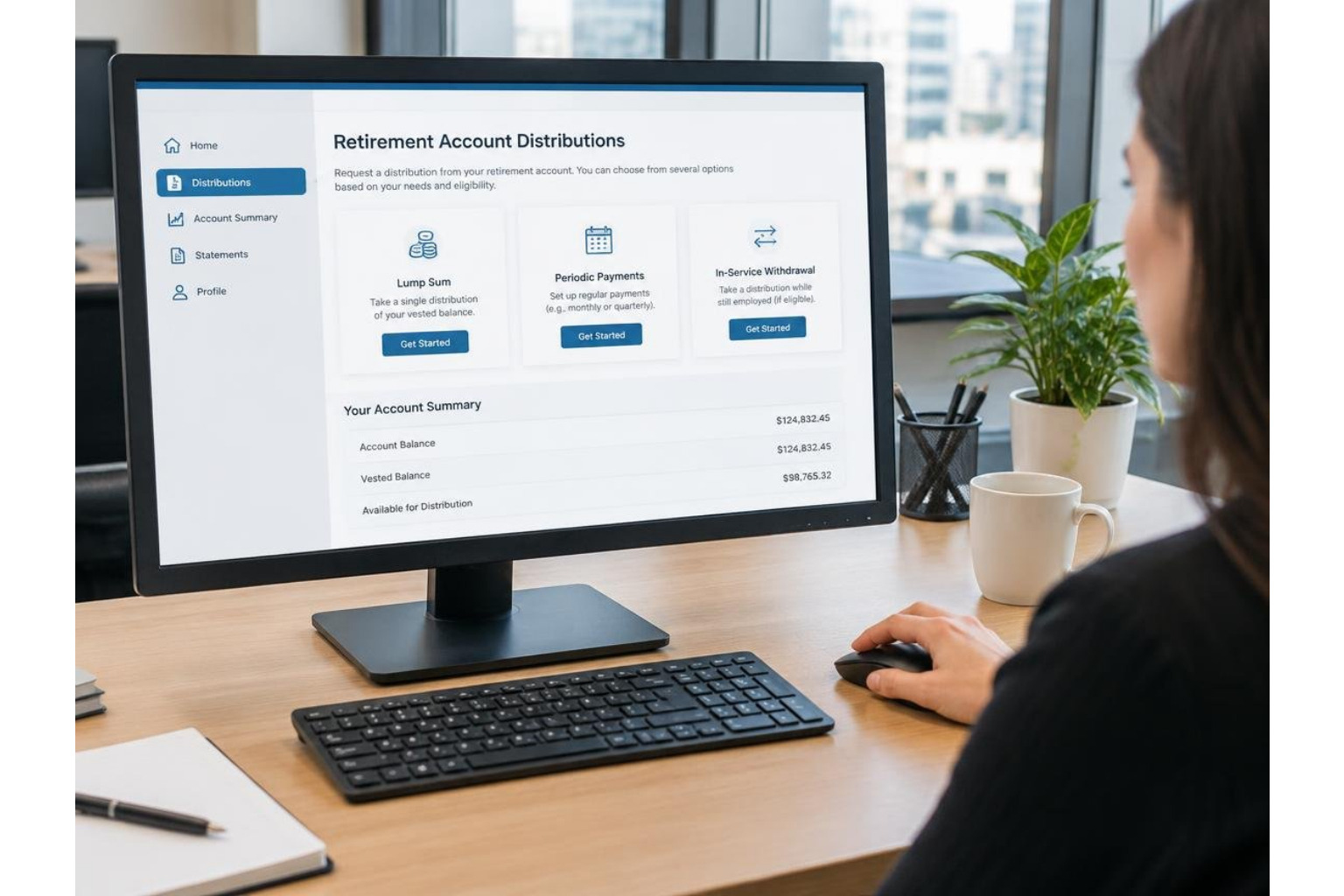
Plan sponsors may elect to include liquidity features to encourage participation by reassuring employees that savings remain accessible under qualified circumstances. If your plan allows these features, review your Summary Plan Description for the specific terms that apply.
- Participant Loans: If your plan allows it, the general statutory limit under IRC Section 72(p) for a participant loan is the lesser of $50,000 or 50% of the participant’s vested balance. Loans must typically be repaid via payroll deduction over a term not exceeding five years, unless used to acquire a principal residence.
- Hardship Distributions: If your plan permits hardship withdrawals, participants may access their own elective deferrals to satisfy an immediate and heavy financial need, subject to IRS safe harbor standards (such as medical expenses or eviction prevention).
- Emergency Personal Expense Distributions: Under SECURE 2.0, plans may permit one penalty-free withdrawal per calendar year of up to $1,000 for unforeseen personal emergency expenses, with the option for participants to repay the amount within three years.
- Involuntary Cash-Out Threshold: Sponsoring employers may automatically cash out terminated employees with small account balances. Effective January 1, 2024, SECURE 2.0 increased the statutory involuntary distribution limit from $5,000 to $7,000. Balances between $1,000 and $7,000 must be rolled over into an individual retirement account (IRA) on the participant’s behalf unless directed otherwise.
Managing Plan Governance, Related Employers, and PEP Adoption
Operating a compliant retirement plan requires ongoing governance, accurate reporting, and adherence to federal rules governing related business entities.
Controlled Groups and 401(k) Plan Design Compliance
Under IRC Section 414(b), (c), and (m), businesses linked through common ownership or shared management must be analyzed as a single employer for retirement plan purposes. This includes:
- Parent-Subsidiary Groups: Where one entity owns at least 80% of another.
- Brother-Sister Groups: Where five or fewer individuals own at least 80% of each entity and more than 50% identically.
- Affiliated Service Groups: Where service-based businesses regularly collaborate or share management.
Failing to recognize controlled group status can cause a plan to fail mandatory minimum coverage and nondiscrimination tests, as all eligible employees across related entities must be accounted for during compliance reviews.
Customizing Plan Features Within a Pooled Employer Plan
A pooled employer plan (PEP) allows multiple unrelated employers to participate in a single retirement plan administered by a pooled plan provider (PPP). Sponsoring a standalone single-employer plan requires managing Form 5500 filings, independent plan audits for large plans, and administrative operations.
While a PEP delegates many administrative responsibilities to the PPP, participating employers retain significant design flexibility. Employers generally select their own eligibility criteria, employer contribution levels, vesting schedules, and loan rules. Adopting a PEP may shift certain operational and investment duties to the provider, but employers remain fiduciaries responsible for prudently selecting and monitoring the PPP and ensuring employee contributions are remitted accurately and on time according to Department of Labor fiduciary standards.
Frequently Asked Questions about Retirement Plan Options
What is the most cost-effective plan design for a small business?
For many small businesses, a safe harbor 401(k) using a 3% nonelective contribution or basic match provides predictable costs while avoiding annual nondiscrimination testing expenses. Furthermore, eligible small employers may offset administrative setup expenses by claiming SECURE 2.0 retirement plan startup tax credits of up to 100% of qualified startup costs (capped at $5,000 annually for the first three years for employers with up to 50 employees).
How does SECURE 2.0 impact automatic enrollment requirements?
SECURE 2.0 mandates that non-grandfathered 401(k) plans established on or after December 29, 2022, must implement automatic enrollment with a default rate between 3% and 10%, along with an annual 1% automatic escalation up to at least 10% (and a maximum of 15%), effective for plan years beginning after December 31, 2024. Businesses with 10 or fewer employees, businesses less than three years old, and plans established prior to December 29, 2022, are exempt from this requirement.
Can an employer change plan design features mid-year?
Certain discretionary provisions—such as changing matching formulas or moving to a safe harbor design—can be updated mid-year if specific IRS notice and timing conditions are satisfied. However, changes cannot retroactively reduce or eliminate accrued, protected benefits under IRC Section 411(d)(6). Plan modifications generally require providing participants with a Summary of Material Modifications (SMM) within 210 days after the end of the plan year in which the change was adopted.
Key Takeaways
- Eligibility, vesting, and contribution rules shape who can participate, the costs incurred by the business, and when employees own employer dollars.
- Traditional 401(k) plans offer formula flexibility but require passing annual ADP/ACP nondiscrimination and top-heavy testing.
- Safe harbor designs bypass annual ADP/ACP testing in exchange for mandatory matching or nonelective employer contributions.
- Automatic enrollment and modern liquidity features (such as loans and emergency distributions) depend on plan provisions, business goals, and applicable statutory mandates.
- Employers must evaluate controlled group rules, fulfill fiduciary duties, and choose an administrative structure that matches their operational capacity.
Conclusion
Designing a 401(k) plan requires aligning corporate budgets, workforce demographics, and tax-deferred savings objectives. Whether you structure a traditional plan with flexible profit-sharing, implement a safe harbor arrangement to simplify testing, or evaluate pooled structures, your plan design serves as the blueprint for your company’s retirement benefit. Sponsoring employers should consult with an independent fiduciary or qualified retirement plan professional to evaluate specific design features.
If you are evaluating your options, you can explore a customized pooled employer plan to learn how pooled solutions operate, or call the 401(k) Maneuver team at 1-877-218-5060 to discuss your retirement plan design questions.
Disclosure: 401(k) Maneuver is a business name of Royal Fund Management, LLC, an SEC-registered investment adviser. This article is intended solely for educational purposes and does not constitute individualized legal, tax, or investment advice. Investing involves risk of loss, and diversification or account management does not guarantee a profit or protect against loss. Plan sponsors and participants should consult qualified legal, tax, or financial professionals regarding their specific circumstances.