


What Is a 3(16) Fiduciary and Does Your Plan Need One?
What a 3(16) fiduciary does for your 401(k)
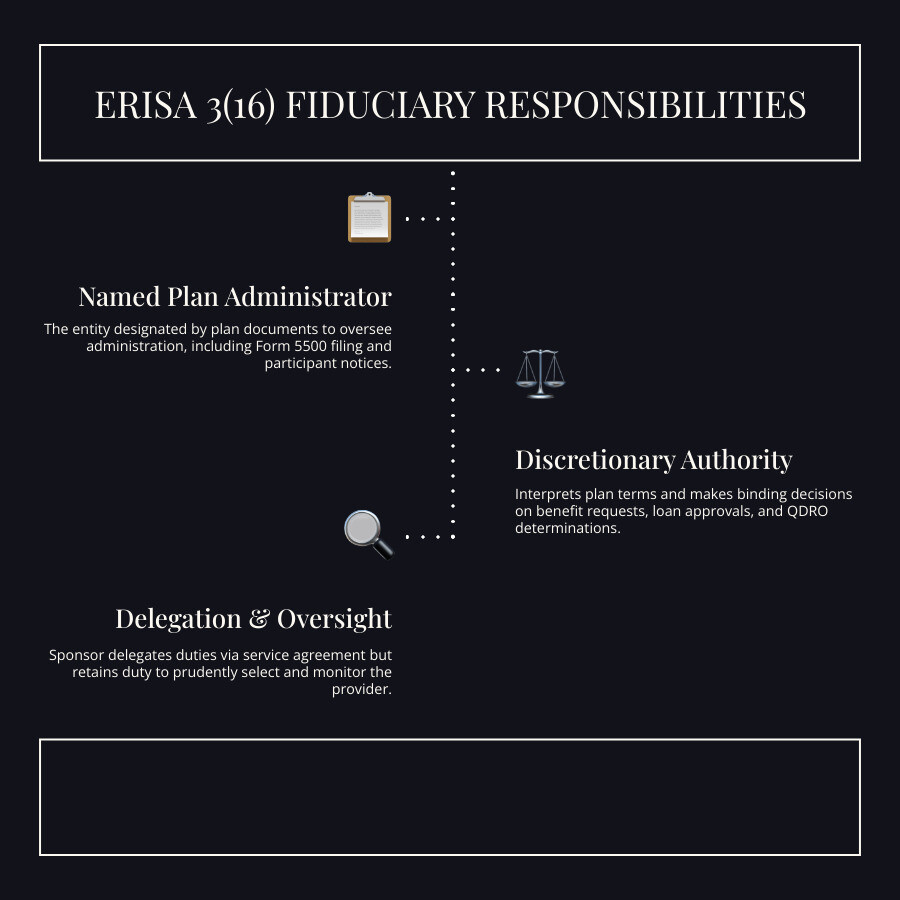
A 3(16) fiduciary can take on specified duties for a 401(k), such as overseeing annual filings, participant notices, and benefit requests. Under ERISA section 3(16), the plan administrator is the person named in the plan document. If no one is named, the plan sponsor fills that role.
How much an outside provider takes on depends on the plan documents and service agreement. Delegation can ease your workload, but you still need to prudently select and monitor the provider. This guide explains those choices, including how administration works in a pooled employer plan (PEP).
Understanding the role of an ERISA 3(16) fiduciary
Under the Employee Retirement Income Security Act of 1974 (ERISA), retirement plans require clear operational governance. Section 3(16)(A) defines the plan administrator as the entity specifically designated by the terms of the instrument under which the plan is operated. When an employer creates a 401(k) without explicitly naming an outside entity, the employer automatically shoulders this role by default.
A critical distinction exists between ministerial administration and true fiduciary authority. Non-fiduciary service providers perform routine tasks within a framework of policies made by others. In contrast, an ERISA 3(16) administrator holds discretionary authority over plan operations, interpreting governing terms and making binding operational determinations.
Many plan sponsors report that day-to-day retirement plan administration can take up a meaningful share of their internal operational time, and some of these tasks may be delegated depending on the plan’s documents. However, hiring a 3(16) fiduciary does not mean passing off all operational involvement. The extent of authority transferred is strictly governed by the formal contract and plan documents.
Core administrative duties that may be assumed by a 3(16) fiduciary

When an employer delegates responsibilities to a 3(16) administrative partner, the scope of services typically encompasses several critical compliance areas. The provider may assume direct responsibility for:
- Annual Reporting: Coordinating, completing, signing, and submitting the annual Form 5500 series with the Department of Labor (DOL) and the Internal Revenue Service (IRS).
- Mandatory Participant Disclosures: Distributing Summary Plan Descriptions (SPDs), Summary of Material Modifications (SMMs), annual fee disclosures under ERISA Section 404(a)(5), and safe harbor notices.
- Participant Transaction Approvals: Reviewing and approving participant distribution requests, hardship withdrawals, and participant loans (if your plan allows them, subject to terms in your Summary Plan Description).
- Domestic Relations Orders: Reviewing, interpreting, and qualifying Qualified Domestic Relations Orders (QDROs).
- Census and Eligibility Tracking: Monitoring employee service hours, tracking entry dates, and managing automatic enrollment or escalation features.
Full vs. limited 3(16) delegation models
Administrative delegation exists on a spectrum rather than as an all-or-nothing engagement. Service providers structure their offerings across different service levels based on operational complexity and employer preference.
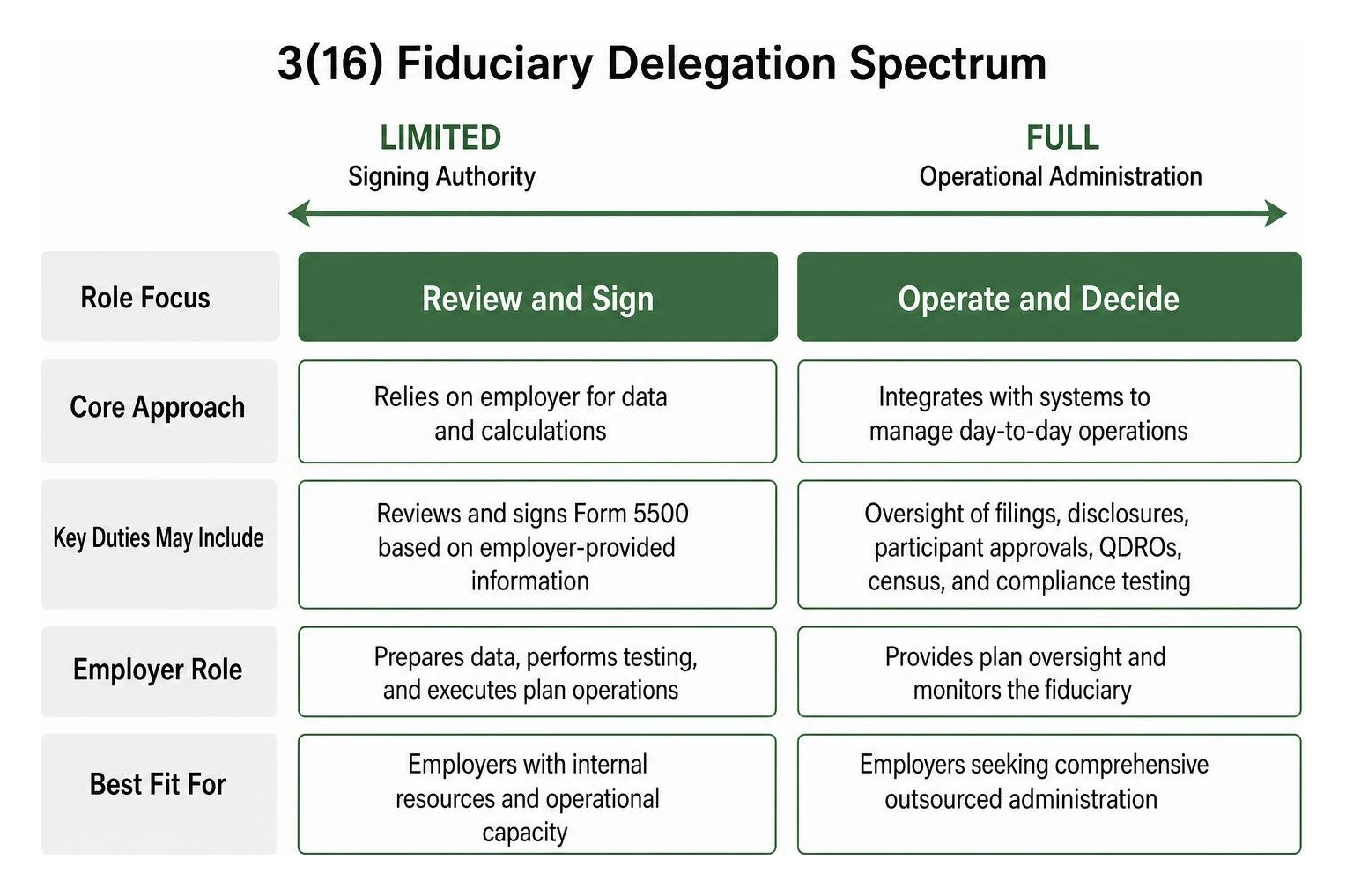
In a limited or signature-only model, the provider primarily reviews and signs the Form 5500, relying on the employer’s internal calculations and census records. In a full administrative model, the fiduciary integrates directly with payroll systems to conduct ongoing contribution validations, review participant eligibility, process distributions, and manage corrective distributions if nondiscrimination testing issues arise.
How a 3(16) fiduciary compares to 3(21) and 3(38) roles
Retirement plan oversight involves distinct functional categories: plan operations and investment governance. ERISA categorizes these responsibilities under separate statutory sections.
Plan sponsors frequently engage independent partners to access trustworthy independent advice for investment choices while maintaining a separate approach for operational tasks. The table below outlines how these roles may differ in scope and legal responsibility:
| Fiduciary Role | ERISA Section | Primary Scope | Discretionary Authority | Retained Employer Duty |
|---|---|---|---|---|
| Plan Administrator | 3(16) | Operational & day-to-day administration | Discretion over plan terms, filings, and participant transactions | Prudent provider selection and ongoing operational oversight |
| Investment Adviser | 3(21) | Investment recommendations & fund line-up | Non-discretionary; provides advice, but sponsor approves changes | Final approval of investment menus and ongoing monitoring |
| Investment Manager | 3(38) | Discretionary investment management | Full discretion to select, monitor, and replace plan investments | Prudent selection and ongoing monitoring of the manager |
According to the Plan Sponsor Council of America’s 2025 Annual Survey of Profit Sharing and 401(k) Plans, approximately 92% of plan sponsors engage an independent consultant or adviser. Within these arrangements, roughly 38% utilize a 3(21) adviser, 25% hire a 3(38) manager, and 63% engage or express a preference for 3(16) administrative support.
Integrating a 3(16) fiduciary with investment fiduciaries
A plan sponsor may engage both an administrative fiduciary and an investment fiduciary simultaneously. For example, an employer might retain a 3(16) provider to handle participant loan approvals and Form 5500 filings, while delegating fund selection to a discretionary manager.
Plan sponsors exploring this structure often review our FAQ on discretionary management to understand how an investment manager operates alongside day-to-day administrative partners. Clear, written agreements ensure each party understands the boundaries of their respective duties, avoiding unassigned operational gaps.
Strategic benefits and retained responsibilities for plan sponsors
Delegating operational duties can significantly lighten the internal administrative workload for human resources and payroll personnel. Specialized providers utilize software validation rules to catch payroll data discrepancies, miscalculated entry dates, and late contribution remittances.

However, engaging an external fiduciary does not completely absolve the plan sponsor of legal responsibility. Under ERISA, plan sponsors always retain the non-delegable duty of procedural prudence. Key retained responsibilities include:
- Prudent Selection and Monitoring: Conducting thorough due diligence before hiring an administrative provider and continually evaluating their operational performance.
- Fee Reasonableness: Reviewing direct and indirect service compensation to confirm plan fees remain reasonable for the services delivered.
- Accurate Data Transmission: Providing, timely payroll records, census details, and employee status updates to the administrator.
- Timely Contribution Remittance: Helps to ensure employee deferrals and employer matching contributions are deposited into the plan trust as soon as administratively feasible, meeting DOL timing guidelines.
Delegating administration in pooled employer plans (PEPs)
A Pooled Employer Plan (PEP), established under the SECURE Act and expanded under SECURE 2.0 legislation effective for plan years beginning after December 31, 2022, offers an alternative structure for administrative delegation. In a PEP, multiple unrelated businesses participate in a single retirement plan administered by an authorized Pooled Plan Provider (PPP).
The PPP serves as both the named fiduciary and the ERISA Section 3(16) plan administrator. This entity assumes primary responsibility for centralized Form 5500 preparation, independent plan-level audit coordination, and operational compliance.
Participating employers in a PEP remain responsible for remitting payroll contributions promptly, providing clean employee data, and monitoring the PPP’s overall performance. Employers interested in evaluating this model can review the cost-effective pooled employer retirement plans framework to see how operational oversight is handled within a pooled environment.
Frequently asked questions about 3(16) plan administrators
For additional answers to common operational questions, explore the broader 401(k) Maneuver FAQ.
Does hiring a 3(16) administrator eliminate all fiduciary liability for the employer?
No. Hiring a 3(16) administrator transfers primary responsibility for specified operational functions, but the employer retains the ongoing fiduciary responsibility to prudently select, monitor, and evaluate that provider. Employers also continue to provide accurate census data and remit payroll deductions on time.
What is the difference between a traditional TPA and a 3(16) administrative fiduciary?
A traditional Third-Party Administrator (TPA) generally provides ministerial services, such as calculating testing numbers or drafting Form 5500 forms for the employer to review and sign. A 3(16) administrative fiduciary formally accepts discretionary authority in writing, signs required regulatory filings, and makes binding administrative decisions on behalf of the plan.
How are 3(16) fiduciary services priced?
Pricing models vary across providers. Typical structures include a flat annual administrative fee, a base fee paired with a per-participant monthly charge, or an asset-based fee. Service agreements and Schedule C disclosures on Form 5500 reflect whether fees are billed directly to the employer or allocated to plan assets.
Conclusion
Managing the operational requirements of a company retirement plan can involve detailed compliance tracking, timely regulatory filings, and participant communication. Appointing a 3(16) administrator can allow employers to outsource complex day-to-day tasks while maintaining a structured governance process.
Some Key takeaways
- An ERISA 3(16) fiduciary serves as the named plan administrator, handling tasks such as Form 5500 filings, mandatory disclosures, and distribution approvals.
- Administrative delegation ranges from limited signature authorization to full operational integration with company payroll systems.
- Engaging a 3(16) provider transfers operational execution but leaves the plan sponsor responsible for prudent provider selection, fee monitoring, and timely contribution funding.
- Pooled Employer Plans (PEPs) centralize 3(16) administrative duties under a single Pooled Plan Provider, helping to streamline plan-level governance for participating employers.
If you are an employer evaluating your workplace retirement plan structure, the 401(k) Maneuver team invites you to visit our pooled employer plan page to discuss your options.
Disclosures: 401(k) Maneuver is a business name of Royal Fund Management, LLC, an SEC-registered investment adviser. This article is educational in nature and does not constitute personalized tax, legal, or investment advice. 401(k) Maneuver provides discretionary investment management services and does not act as an ERISA 3(16) plan administrator. Investing involves risk of loss, and diversification or account management does not guarantee a profit or protect against loss.